Bitcoin is increasingly seen as the dominant asset of the 21st century — a form of “digital gold” with a limited supply and a superior ability to combat inflation compared to any current fiat currency. The rise of Bitcoin is not coincidental, but is linked to deep fractures within the global monetary system.
Currently, the world is quietly entering a monetary system transformation, even though most are still unaware of it.
Japan: the place where the story begins
On the surface, the global economy seems stable. But upon closer inspection, the fiat currency system is being eroded by:
- persistent inflation
- public debt reaches a record high
- currency depreciates significantly
It is not a coincidence that central banks in many countries are quietly accumulating gold, preparing for an era of scarce assets — where Bitcoin is also becoming one of the strategic choices.
And the brightest lesson for this transition is Japan.
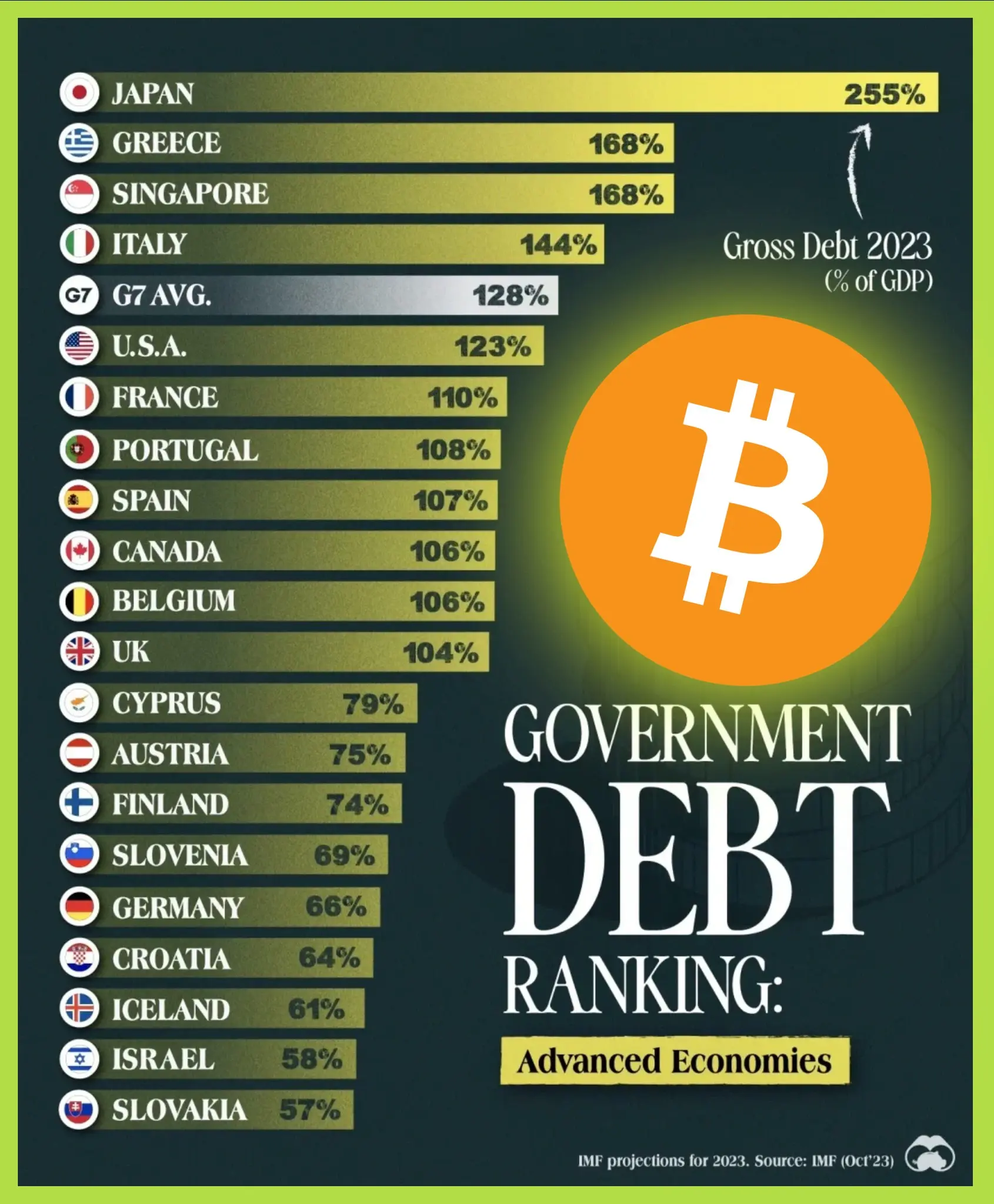 Japan's public debt is the highest in the world## Japan and the consequences of prolonged low interest rates
For many years, Japan has kept bond yields at extremely low levels to support the economy. Cheap capital has been pumped globally, contributing to a significant increase in global assets.
But then problems arose:
- inflation returns
- Yen is in free fall
- energy and commodities soar
Japan has discovered something unavoidable:
You can print money, but you cannot print oil, gas, wheat, or metals.
When the currency weakens, everything becomes more expensive.
Finally, to save the Yen, Japan is forced to raise yields — a risky move as the country has the highest public debt in the world.
What if the US follows this path?
Many people believe that the US will:
- sharply lower interest rates
- pump money back
- or fixed bond yield
But Japan has shown:
👉 Low interest rates for too long lead to inflation getting out of control
👉 Inflation devalues the currency and makes the financial system unstable.
If the US goes down this path, the global market could face a very severe repricing cycle.
Assets inflated by cheap money will need to be revalued
In the past 10-15 years, the US stock market has surged thanks to:
- cheap loans
- company buyback shares
- nearly unlimited cash flow
But when high interest rates persist, many assets may:
- slow down
- or decrease sharply if measured by “real” standards, such as gold or commodities
One signal: despite the strong rise of AI stocks, gold is still up 32% compared to the Nasdaq this year — proving that money is flowing towards hard assets.
Fiat currency is silently depreciating
The Fed could cause stocks to soar, creating an illusion of prosperity. But when measured in gold, oil, energy:
➡️ financial assets are depreciating in real value.
The value of a coin is always based on:
- goods
- energy
- gold
- assets with real production costs
No government can print these.
So what should investors do when yields are forced to be fixed?
They look at Japan.
They recognize that the fiat system is reaching its limit.
And they turn to assets that cannot be printed infinitely, such as:
- gold
- Bitcoin
- assets linked to energy and real production
Gold has stood firm through every currency system change.
As for Bitcoin, with its absolutely scarce supply, it is increasingly viewed as the new “pillar of value” of the digital age — a form of digital gold that global investors will have to re-evaluate in the coming years.
Of course, because Bitcoin does not have any central bank backing it:
➡️ The road ahead will be full of volatility.
But it is also because of this that Bitcoin is seen as an asset representing the future — where value no longer comes from infinite money printing, but from true scarcity.
Thach Sanh
Disclaimer: The information on this page may come from third parties and does not represent the views or opinions of Gate. The content displayed on this page is for reference only and does not constitute any financial, investment, or legal advice. Gate does not guarantee the accuracy or completeness of the information and shall not be liable for any losses arising from the use of this information. Virtual asset investments carry high risks and are subject to significant price volatility. You may lose all of your invested principal. Please fully understand the relevant risks and make prudent decisions based on your own financial situation and risk tolerance. For details, please refer to
Disclaimer.
Related Articles
Why Bitcoin's Biggest Quantum Critic Says Real Bull Market Starts at $80,000 - U.Today
Charles Edwards, founder of Capriole Investments, analyzes Bitcoin's market, stating that a move above $80,000 could signal a bull market. His outlook is based on institutional purchasing patterns, while he continues to warn of quantum computing threats to Bitcoin's future by 2028.
UToday6m ago
BTC breaks below $73,000, intraday decline of 1.32%
Gate News, on March 18, BTC fell below the $73,000 mark, with a daily decline of 1.32%.
GateNews7m ago
BTC drops below 73,000 USDT
Gate News bot message: According to Gate market data, BTC has broken below 73000 USDT, currently trading at 72990.7 USDT.
CryptoRadar9m ago
BTC 15-minute decline of 0.48%: Selling pressure and liquidity shifts amplify global volatility
2026-03-18 11:15 to 11:30 (UTC), BTC recorded a -0.48% return within 15 minutes, with a price range of 73570.9 to 74008.0 USDT, and amplitude reaching 0.59%. The market exhibited increased volatility characteristics during this period, drawing investor attention to the causes of short-term movements.
The main driving force behind this movement is the release of short-term selling pressure and changes in liquidity. If large-scale BTC transfers occur on-chain, and spot and futures trading volumes surge, it may trigger short-term market selling, especially in the context of sell-side dominance and weakened order book liquidity.
GateNews14m ago
Bitcoin and Gold Correlation Coefficient Drops to -0.88, Reaching Lowest Level Since November 2022
Gate News reports that on March 18, CryptoQuant data showed the correlation coefficient between Bitcoin and gold dropped to -0.88, hitting a new low since November 2022. The data indicates a strong negative correlation between the two, with Bitcoin's price rising to $74,000 while gold experienced a slight decline.
GateNews44m ago
Royal Government of Bhutan Moves 973 BTC in Latest Treasury Activity
Bhutan transferred 973 BTC worth approximately $72.3 million, aligning with its ongoing treasury management strategy. The state-owned Druk Holding & Investments conducted the transactions without impacting bitcoin's market price. Mining activities may have slowed recently.
Coinpedia47m ago


