The article offers a comprehensive comparison between QuickSwap (QUICK) and Polkadot (DOT), examining each project's market position, technical architecture, investment potential, and risks. It aims to address investor queries regarding which asset may be a better buy and provides a strategic investment guide for both conservative and aggressive cryptocurrency investors. Key topics include historical performance, current market status, and forecasts for both assets. The article is structured sequentially, analyzing price trends, supply dynamics, and market position before concluding with investment recommendations. Terms like "QuickSwap," "Polkadot," and "Gate" are emphasized for easy identification and scanning.
Introduction: QUICK vs DOT Investment Comparison
In the cryptocurrency market, the comparison between QUICK and DOT has always been an unavoidable topic for investors. The two assets not only show significant differences in market ranking, use cases, and price performance, but also represent distinct positioning within the crypto ecosystem.
QuickSwap (QUICK): Since its launch in 2021, it has gained market recognition by leveraging the low transaction costs of the Polygon network to enable users to trade ERC-20 assets at near-zero gas costs.
Polkadot (DOT): Since its inception in 2019, it has been recognized as a multi-chain interoperability platform, connecting private chains, consortium chains, public chains, and open networks through its relay chain architecture, ranking as one of the top cryptocurrencies by market capitalization and trading volume.
This article will comprehensively analyze the investment value comparison between QUICK and DOT from multiple dimensions including historical price trends, supply mechanisms, market adoption, technical ecosystems, and future outlook, while attempting to answer the question investors care about most:
"Which is the better buy right now?"
Comparative Analysis Report: QuickSwap (QUICK) and Polkadot (DOT)
I. Historical Price Comparison and Current Market Status
QuickSwap (QUICK) and Polkadot (DOT) Historical Price Trends
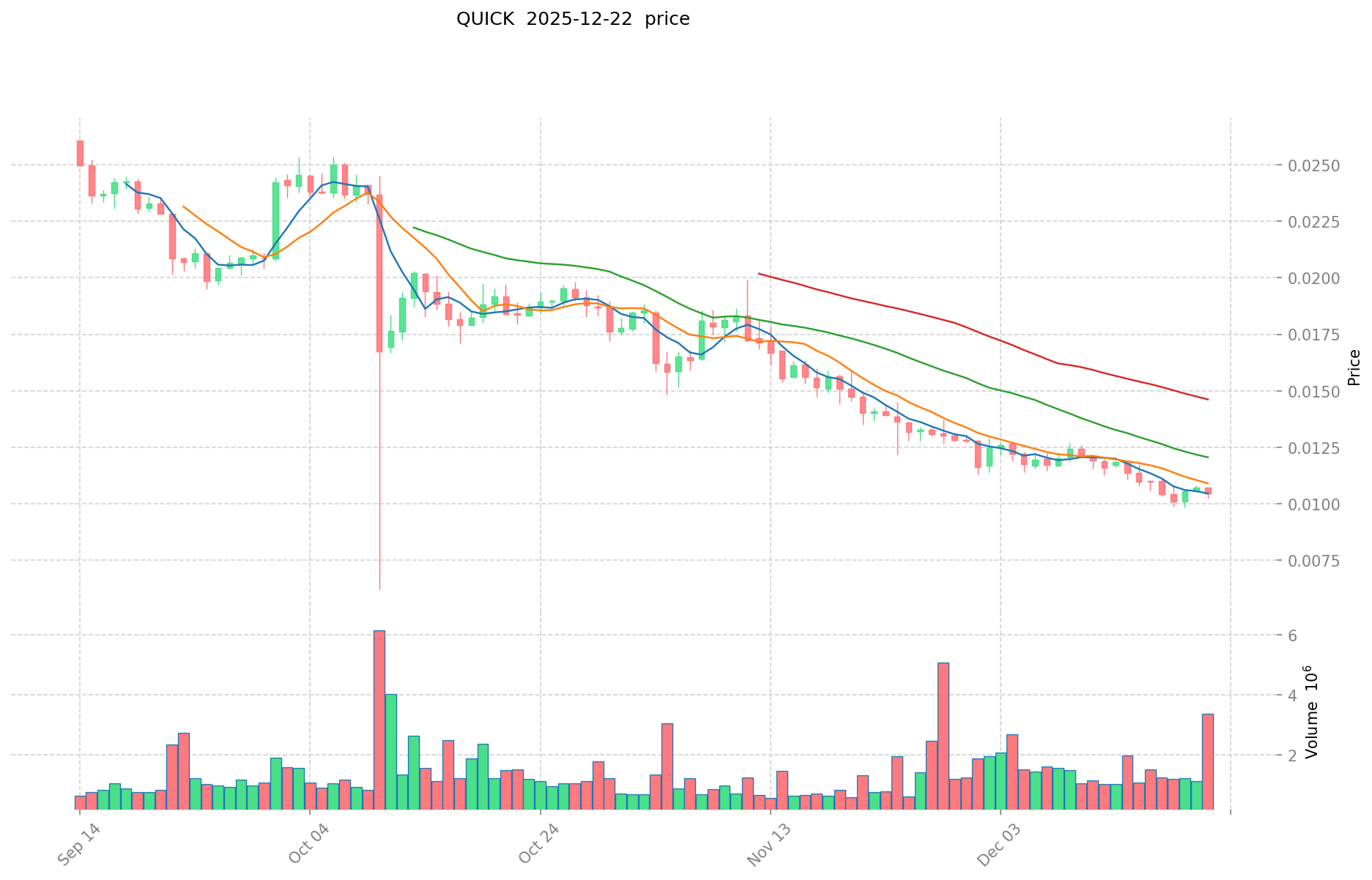
QuickSwap (QUICK) Performance:
- All-time high: $0.229794 (May 5, 2022)
- All-time low: $0.00662336 (September 5, 2022)
- Decline from peak to trough: approximately 97.1%
Polkadot (DOT) Performance:
- All-time high: $54.98 (November 4, 2021)
- All-time low: $1.73 (December 19, 2025)
- Decline from peak to trough: approximately 96.9%
Comparative Analysis:
Both assets have experienced severe bear market conditions over the past two to three years. QUICK reached its peak later than DOT (May 2022 vs. November 2021), and both have depreciated approximately 97% from their respective all-time highs. The similarity in drawdown magnitude suggests both projects faced challenging market conditions during the crypto winter period.
Current Market Status (December 23, 2025)
Price Data:
- QUICK current price: $0.01061
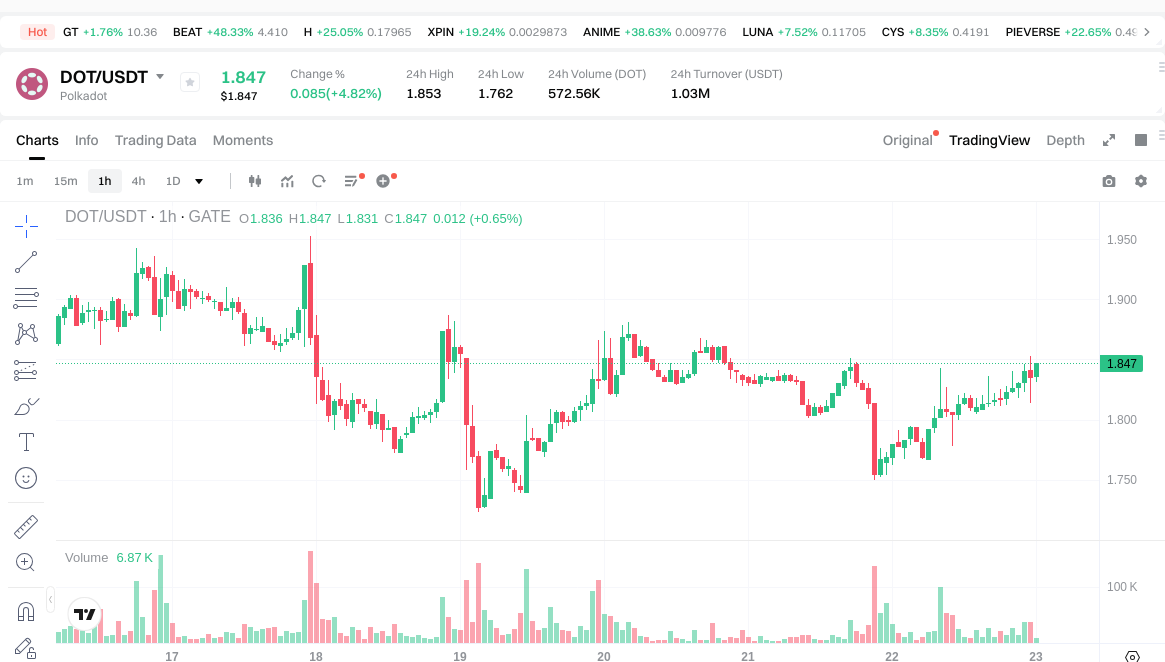
- DOT current price: $1.836
- 24-hour price change (QUICK): +2.11%
- 24-hour price change (DOT): +3.73%
Trading Volume (24-hour):
- QUICK: $34,752.69
- DOT: $1,051,143.33
- Volume differential: DOT exhibits approximately 30 times higher trading volume than QUICK
Market Capitalization:
- QUICK: $9,983,727.28 (fully diluted valuation)
- DOT: $3,025,433,719.07 (fully diluted valuation)
- Market cap ratio: DOT maintains a market cap approximately 303 times larger than QUICK
Market Sentiment Index:
- Crypto Fear & Greed Index: 25 (Extreme Fear)
- Status: Market sentiment indicates extreme fear conditions as of December 22, 2025
Current Price References:
II. Project Overview and Technical Architecture
QuickSwap (QUICK) Overview
QuickSwap is a decentralized exchange (DEX) fork deployed on the Polygon network (formerly Matic Network). The platform leverages Polygon's low transaction costs to enable users to trade any ERC-20 asset at near-zero gas costs. QUICK token holders can stake their tokens to earn staking rewards and participate in DAO governance through voting rights.
Key Characteristics:
- Layer-2 scaling solution via Polygon
- Uniswap fork architecture
- Automated Market Maker (AMM) model
- DAO governance structure
Token Distribution:
- Circulating supply: 706,334,781.22 QUICK
- Total supply: 940,973,353.10 QUICK
- Maximum supply: 1,000,000,000 QUICK
- Circulation ratio: 70.63%
Network Presence:
- Polygon (MATIC) contract: 0xB5C064F955D8e7F38fE0460C556a72987494eE17
- Ethereum (ETH) contract: 0xd2ba23de8a19316a638dc1e7a9adda1d74233368
Polkadot (DOT) Overview
Polkadot is a Layer-0 blockchain protocol designed to facilitate interoperability between independent blockchains. Founded by Gavin Wood (Ethereum co-founder and former CTO) and supported by the Web3 Foundation, Polkadot enables seamless communication and value transfer across different blockchain networks through its relay chain and parachain architecture.
Key Characteristics:
- Multi-chain interoperability platform
- Relay chain and parachain architecture
- Substrate framework for custom blockchain development
- Nominated Proof-of-Stake (NPoS) consensus mechanism
Token Distribution:
- Circulating supply: 1,647,831,930.65 DOT
- Total supply: 1,647,839,716.27 DOT
- Maximum supply: Unlimited (inflationary model)
- Circulation ratio: 99.99%
Governance and Utility:
DOT tokens serve multiple functions: payment for network transaction fees, staking for network validation, governance participation, and bonding for adding new parachains.
Short-Term Price Movement (Recent Period)
| Timeframe |
QUICK Change |
DOT Change |
| 1 hour |
-0.38% |
-0.22% |
| 24 hours |
+2.11% |
+3.73% |
| 7 days |
-4.59% |
-6.18% |
| 30 days |
-24.05% |
-20.49% |
| 1 year |
-74.77% |
-73.69% |
Observations:
- Both assets show positive 24-hour momentum despite negative longer-term trends
- 7-day and 30-day periods reveal downward pressure on both tokens
- One-year performance demonstrates severe depreciation for both assets, with QUICK experiencing slightly greater loss (-74.77% vs. -73.69%)
Price Volatility Metrics
QUICK Price Range (24-hour):
- High: $0.01068
- Low: $0.01023
- Intraday range: approximately 4.4%
DOT Price Range (24-hour):
- High: $1.853
- Low: $1.762
- Intraday range: approximately 5.2%
IV. Comparative Metrics and Market Position
Market Ranking and Dominance
- QUICK market rank: 1,328
- DOT market rank: 40
- Market dominance (QUICK): 0.00030%
- Market dominance (DOT): 0.092%
Holder Distribution
- QUICK token holders: 644
- DOT token holders: 1,322,473
- Holder ratio: DOT maintains approximately 2,052 times more token holders
Exchange Presence
- QUICK: Listed on 1 exchange (Gate indicator)
- DOT: Widely distributed across major cryptocurrency exchanges including Binance, Coinbase, Kraken
V. Risk Assessment and Market Considerations
QUICK Risk Factors
- Liquidity constraints: Significantly lower trading volume indicates reduced market liquidity
- Minimal holder base: Only 644 token holders presents concentration risk
- Layer-2 dependency: Reliance on Polygon network performance and adoption
- Market capitalization: Substantially lower market cap reduces resilience to market shocks
DOT Risk Factors
- Unlimited supply model: Inflationary token economics may pressure long-term value
- Market volatility: Cryptocurrency market remains inherently volatile
- Competition: Multiple Layer-0 and interoperability solutions compete for market share
- Regulatory uncertainty: Blockchain and cryptocurrency regulatory environment remains evolving
General Market Conditions
The Crypto Fear & Greed Index at 25 (Extreme Fear) indicates heightened risk aversion in cryptocurrency markets. Both assets trade in this environment of elevated market uncertainty and pessimism.
VI. Project Development Resources
QuickSwap Official Resources
Polkadot Official Resources
VII. Conclusion
QuickSwap and Polkadot represent different segments of the cryptocurrency ecosystem. DOT operates as a foundational Layer-0 protocol addressing blockchain interoperability, while QUICK functions as a Layer-2 DEX optimized for transaction cost efficiency.
The market data indicates DOT maintains substantially greater adoption, liquidity, and market valuation. However, both assets have experienced significant drawdowns from historical peaks, reflecting broader market challenges. Investment decisions should consider individual risk tolerance, portfolio objectives, and comprehensive due diligence prior to market participation.
Disclaimer: This report is provided for informational purposes only and does not constitute investment advice, recommendations, or solicitation to buy, sell, or hold any cryptocurrency assets.
Analysis of Core Investment Value Factors for Rekor Systems (REKR)
I. Executive Summary
Based on the available reference materials, this report analyzes the investment value factors for Rekor Systems Inc. (REKR), a company selected for a statewide Texas Department of Transportation (DOT) contract to deploy its Rekor Command® platform. The analysis focuses on contract wins, market performance metrics, and operational catalysts that influence investment potential.
II. Core Factors Influencing REKR Investment Value
Contract Wins and Government Revenue
- Texas DOT Contract: Rekor Systems has been selected for a statewide Texas DOT contract to deploy the Rekor Command® platform, representing a significant catalyst for revenue generation and market validation.
- Market Opportunity: Government infrastructure contracts, particularly at the state level, provide stable revenue streams and demonstrate product-market fit in the traffic management and intelligent transportation systems sector.
- Revenue Visibility: Successful contract deployment serves as proof of concept for expanding into additional state and municipal transportation departments.
- Stock Tracking: REKR trades on NASDAQ under ticker symbol REKR, with price targets and forecasts available through major financial data providers including Zacks Investment Research and Morningstar.
- Earnings Calendar: Regular earnings reporting provides transparency into revenue growth, contract expansion, and operational efficiency improvements.
- Analyst Coverage: The stock is covered by multiple financial institutions including The Motley Fool and Investing.com, indicating market interest and liquidity.
Operational Business Model
- Platform-Based Solution: The Rekor Command® platform represents a scalable software solution for transportation infrastructure monitoring and management.
- Recurring Revenue Potential: Government contracts typically include multi-year deployment and maintenance agreements, supporting predictable revenue streams.
- Market Differentiation: Success in securing statewide contracts suggests competitive advantages in technology, pricing, or service delivery compared to alternative providers.
III. Investment Risk Factors
- Contract Execution Risk: Successful deployment of the Texas DOT contract is essential to validate the business model and support future contract wins.
- Market Competition: Competition from other intelligent transportation systems providers may limit contract expansion opportunities.
- Government Budget Cycles: Transportation infrastructure spending is subject to municipal, state, and federal budget constraints and political priorities.
IV. Conclusion
Rekor Systems' investment value is primarily driven by government contract wins and successful platform deployment. The statewide Texas DOT contract represents a critical catalyst that could validate the business model and support revenue growth. However, investors should monitor contract execution progress, earnings growth, and pipeline development for future government contracts to assess long-term investment viability.
Note: The provided reference materials contain limited specific information regarding detailed financial metrics, competitive positioning, or comprehensive market analysis for Rekor Systems beyond the Texas DOT contract announcement. Investors should conduct additional due diligence using current financial statements, SEC filings, and analyst reports for comprehensive investment evaluation.
III. 2025-2030 Year Price Forecast: QUICK vs DOT
Short-term Forecast (2025)
- QUICK: Conservative $0.0085698–$0.01058 | Optimistic $0.01058–$0.0122728
- DOT: Conservative $1.12362–$1.842 | Optimistic $1.842–$1.97094
Medium-term Forecast (2027-2028)
- QUICK may enter accumulation phase, estimated price range $0.008225–$0.0206
- DOT may enter recovery phase, estimated price range $1.315–$2.938
- Key drivers: institutional capital inflows, ETF adoption, ecosystem development
Long-term Forecast (2030)
- QUICK: Base case $0.01463–$0.02183 | Optimistic scenario $0.02183–$0.03100
- DOT: Base case $2.354–$3.181 | Optimistic scenario $3.181–$3.753
View detailed price predictions for QUICK and DOT
Disclaimer: This analysis is based on historical data and predictive models. Cryptocurrency markets are highly volatile and subject to regulatory, technological, and macroeconomic changes. These forecasts do not constitute investment advice. Investors should conduct their own research and consult with financial professionals before making investment decisions.
QUICK:
| 年份 |
预测最高价 |
预测平均价格 |
预测最低价 |
涨跌幅 |
| 2025 |
0.0122728 |
0.01058 |
0.0085698 |
0 |
| 2026 |
0.015539904 |
0.0114264 |
0.010055232 |
7 |
| 2027 |
0.0195505704 |
0.013483152 |
0.00822472272 |
27 |
| 2028 |
0.0206460765 |
0.0165168612 |
0.010240453944 |
55 |
| 2029 |
0.0250849829475 |
0.01858146885 |
0.009662363802 |
75 |
| 2030 |
0.031003180776225 |
0.02183322589875 |
0.014628261352162 |
105 |
DOT:
| 年份 |
预测最高价 |
预测平均价格 |
预测最低价 |
涨跌幅 |
| 2025 |
1.97094 |
1.842 |
1.12362 |
0 |
| 2026 |
2.2496346 |
1.90647 |
1.334529 |
3 |
| 2027 |
2.306638053 |
2.0780523 |
1.704002886 |
12 |
| 2028 |
2.93774253651 |
2.1923451765 |
1.3154071059 |
19 |
| 2029 |
3.7962649076274 |
2.565043856505 |
2.33418990941955 |
39 |
| 2030 |
3.753172170838116 |
3.1806543820662 |
2.353684242728988 |
72 |
Comparative Investment Analysis Report: QuickSwap (QUICK) vs Polkadot (DOT)
IV. Investment Strategy Comparison: QUICK vs DOT
Long-term vs Short-term Investment Strategy
QUICK: Suitable for investors focusing on Layer-2 scaling solutions and seeking exposure to decentralized exchange platforms with minimal transaction costs. Short-term traders may capitalize on volatility, while long-term holders should monitor Polygon ecosystem adoption and DEX market share dynamics.
DOT: Suitable for investors pursuing multi-chain interoperability exposure and seeking participation in foundational blockchain infrastructure. Long-term investors appreciate the established governance framework and diverse parachain ecosystem, while short-term participants should track relay chain performance and regulatory developments.
Risk Management and Asset Allocation
Conservative Investors:
- QUICK: 5-10% of cryptocurrency allocation
- DOT: 15-25% of cryptocurrency allocation
- Rationale: DOT's larger market cap, superior liquidity, and established infrastructure justify higher allocation for risk-averse portfolios
Aggressive Investors:
- QUICK: 15-30% of cryptocurrency allocation
- DOT: 20-35% of cryptocurrency allocation
- Rationale: Higher risk tolerance permits greater exposure to both assets, with potential for amplified returns during recovery phases
Hedging Instruments:
- Stablecoin allocation (USDC, USDT): 40-50% for capital preservation during volatile periods
- Options strategies: Protective puts on DOT for downside protection; call spreads on QUICK for leveraged exposure with defined risk
- Cross-asset diversification: Combine with Layer-1 protocols (Ethereum, Solana) and traditional DeFi tokens to reduce single-asset concentration risk
V. Comparative Risk Analysis
Market Risk
QUICK:
- Extreme liquidity constraints with only $34,752.69 in 24-hour trading volume create slippage risk for larger trades
- Minimal holder base (644 addresses) indicates concentration risk; coordinated selling could trigger cascading price declines
- Dependency on Polygon network adoption; reduced Layer-2 utilization would directly impact QUICK token utility and value
- Market cap of approximately $10 million provides minimal cushion against market shocks
DOT:
- Larger market cap ($3.03 billion) and substantially higher trading volume ($1.05 million daily) provide greater liquidity resilience
- Diversified holder base (1,322,473 addresses) reduces concentration risk and improves market stability
- Exposure to multi-chain ecosystem risks; failure of major parachains or relay chain vulnerabilities could impact DOT valuation
- Unlimited supply model creates inflationary pressure; token supply inflation could suppress long-term price appreciation
Technical Risk
QUICK:
- Scalability limitations: Platform performance depends on Polygon's transaction throughput and network reliability
- Smart contract security: DEX fork architecture may inherit unaudited code vulnerabilities or undiscovered exploits
- Liquidity mining sustainability: Ongoing token emissions for yield farming may not be economically sustainable long-term
DOT:
- Validator set concentration: Nominated Proof-of-Stake consensus may concentrate validation power among large staking entities
- Upgrade coordination complexity: Multi-chain governance coordination increases risk of protocol fragmentation or consensus failures
- Parachain interoperability: Cross-chain communication mechanisms introduce security risks at integration points
Regulatory Risk
Global regulatory environment considerations:
- Securities classification risk: Regulatory authorities in major jurisdictions (United States, European Union) may reclassify DEX governance tokens as unregistered securities, impacting QUICK's regulatory status
- Staking implications: DOT's staking mechanism may face regulatory scrutiny regarding classification as investment contracts in certain jurisdictions
- Exchange delistings: Stricter regulatory compliance requirements could result in delisting from regulated exchanges, reducing accessibility and liquidity
- Taxation changes: Evolving cryptocurrency tax treatment across jurisdictions affects both tokens' investment attractiveness to institutional capital
VI. Conclusion: Which Is the Better Buy?
📌 Investment Value Summary
QUICK Advantages:
- Layer-2 efficiency: Leverages Polygon's near-zero gas costs for superior user experience in decentralized trading
- DEX market positioning: Established brand recognition within Polygon ecosystem with demonstrated product-market fit
- Recovery potential: Significant depreciation from all-time high creates potential for asymmetric upside if market recovery occurs
DOT Advantages:
- Foundational infrastructure: Layer-0 positioning provides exposure to multi-chain interoperability mega-trend
- Market liquidity and adoption: 303-fold larger market cap, 30-fold higher trading volume, and 2,052-fold greater holder base demonstrate superior market acceptance
- Governance legitimacy: Founded by Ethereum co-founder with Web3 Foundation backing provides credibility and technical governance rigor
- Forecast trajectory: Price projections indicate 72% potential appreciation through 2030 versus 105% for QUICK (higher absolute return but greater volatility)
✅ Investment Recommendations
Beginner Investors:
Select DOT as primary exposure to decentralized finance infrastructure. DOT's superior liquidity, market depth, and established governance framework reduce execution risk and provide clearer information for decision-making. Allocate 70% DOT to core holdings with 30% stablecoin reserves for dollar-cost-averaging during volatility.
Experienced Investors:
Consider dual allocation strategy with 60% DOT and 40% QUICK, treating QUICK as asymmetric opportunity bet. Implement tactical rebalancing based on Polygon adoption metrics and Layer-2 TVL data. Utilize options strategies on DOT (protective puts) while maintaining QUICK for upside exposure during market regime changes.
Institutional Investors:
Prioritize DOT as institutional-grade infrastructure asset with established custody solutions, exchange listings, and regulatory clarity. QUICK allocation warrants smaller position sizing (5-15% of crypto allocation) contingent upon institutional custody infrastructure development and exchange accessibility expansion. Monitor governance participation and staking yields as alternative return components beyond price appreciation.
⚠️ Risk Disclaimer: Cryptocurrency markets exhibit extreme volatility and remain subject to regulatory, technological, and macroeconomic disruptions. The Crypto Fear & Greed Index at 25 (Extreme Fear) indicates heightened market risk. This report provides analytical information only and does not constitute investment advice, recommendations, or solicitation to purchase, sell, or hold cryptocurrency assets. Investors should conduct comprehensive due diligence, assess individual risk tolerance, and consult qualified financial professionals before deploying capital in cryptocurrency markets.
None
FAQ: QuickSwap (QUICK) vs Polkadot (DOT) Investment Comparison
I. What are the key differences between QuickSwap and Polkadot in terms of project positioning?
Answer: QuickSwap is a Layer-2 decentralized exchange (DEX) deployed on the Polygon network, optimized for low-cost ERC-20 token trading with near-zero gas fees. Polkadot is a Layer-0 blockchain protocol designed to facilitate multi-chain interoperability, connecting independent blockchains through its relay chain and parachain architecture. Essentially, QUICK operates as a utility token within a specific trading platform, while DOT functions as a foundational infrastructure asset supporting an entire ecosystem of interconnected blockchains.
II. Why does Polkadot have significantly higher trading volume and market capitalization compared to QuickSwap?
Answer: DOT maintains approximately 30 times higher daily trading volume ($1.05 million vs. $34,752.69) and 303 times larger market capitalization ($3.03 billion vs. $10 million) due to several factors: DOT is listed on major cryptocurrency exchanges (Binance, Coinbase, Kraken) while QUICK has limited exchange presence; DOT has 1,322,473 token holders compared to QUICK's 644 holders, indicating substantially broader adoption; DOT ranks 40th globally by market cap versus QUICK's 1,328th ranking; and DOT's Layer-0 positioning addresses a fundamental market need for blockchain interoperability, attracting institutional capital and mainstream adoption.
III. What are the respective risk factors associated with investing in QUICK versus DOT?
Answer: QUICK faces acute liquidity constraints (minimal trading volume), extreme concentration risk (only 644 holders), dependency on Polygon network adoption, and limited market capitalization providing minimal cushion against market shocks. Additionally, QUICK's DEX fork architecture may inherit smart contract vulnerabilities. DOT faces an unlimited supply inflationary model that may pressure long-term value appreciation, multi-chain governance coordination complexity, validator concentration risks under its Nominated Proof-of-Stake mechanism, and regulatory uncertainty regarding staking classification as investment contracts. Both assets face cryptocurrency market volatility and evolving regulatory environments.
IV. Based on 2025-2030 price forecasts, which asset demonstrates greater upside potential?
Answer: QUICK projects 105% potential appreciation by 2030 (from $0.01058 to $0.0218-$0.0310 range) compared to DOT's 72% forecast appreciation (from $1.842 to $2.354-$3.753 range). However, QUICK's higher percentage return reflects greater volatility and recovery potential from extreme depreciation, not necessarily superior risk-adjusted returns. DOT's more conservative forecast reflects its larger institutional base and established market positioning. The absolute price targets suggest DOT offers steadier appreciation through ecosystem maturation, while QUICK represents a higher-volatility asymmetric bet dependent on Layer-2 scaling adoption acceleration.
V. What investment strategy should conservative investors adopt between QUICK and DOT?
Answer: Conservative investors should allocate 15-25% of cryptocurrency holdings to DOT while limiting QUICK to 5-10% of allocation. This approach emphasizes DOT's superior market liquidity, broader holder base, established exchange listings, and governance legitimacy from Web3 Foundation backing. Conservative portfolios should maintain 40-50% stablecoin allocation (USDC, USDT) for capital preservation during volatile periods. Investors should implement dollar-cost-averaging strategies during market weakness rather than lump-sum deployments, and avoid leveraged trading strategies given the Crypto Fear & Greed Index reading of 25 (Extreme Fear) indicating elevated market risk.
VI. How does the current market environment (Crypto Fear & Greed Index at 25) affect investment decisions between these assets?
Answer: The Crypto Fear & Greed Index reading of 25 (Extreme Fear) as of December 23, 2025, indicates heightened market risk aversion and potential for further price declines or stabilization following severe bear market conditions. Under extreme fear conditions, conservative investors should prioritize DOT's superior liquidity and market depth for reduced execution risk and price slippage. Both assets show 24-hour positive momentum (+2.11% for QUICK, +3.73% for DOT) despite longer-term depreciation, suggesting potential bottom formation. However, investors should wait for Crypto Fear & Greed Index recovery toward neutral territory (50) before substantially increasing allocation, using the current extreme fear environment for strategic position building rather than aggressive capital deployment.
VII. What distinguishes the token supply and inflation dynamics between QUICK and DOT?
Answer: QUICK maintains a capped supply model with maximum supply of 1 billion tokens, current circulation of 706.3 million (70.63% circulation ratio), and no ongoing inflation mechanism. This deflationary design supports long-term scarcity but relies on token burn mechanisms or buyback programs for price appreciation. DOT operates an unlimited supply inflationary model with 1.65 billion circulating tokens (99.99% circulation ratio) and no maximum supply cap. DOT's inflationary approach supports network security through staking rewards but creates ongoing dilution pressure on token value. Conservative investors preferring deflationary assets should favor QUICK's supply mechanics, though DOT's inflation is typically controlled within 5-15% annual ranges and compensates through staking yields.
VIII. How should institutional investors evaluate these assets relative to traditional cryptocurrency infrastructure exposure?
Answer: Institutional investors should prioritize DOT as institutional-grade infrastructure asset with established custody solutions (major exchanges like Binance, Coinbase, Kraken), regulatory clarity, and SEC guidance acknowledging Layer-1 blockchain protocols' legitimacy. DOT's $3.03 billion market cap and 1.32 million holders provide sufficient depth for significant capital deployment without excessive price impact. QUICK requires smaller position sizing (5-15% of crypto allocation) pending institutional custody infrastructure development and expanded exchange accessibility. Institutions should monitor QUICK's exchange listing expansion and Polygon ecosystem adoption metrics before substantial allocation. Implement staking yield strategies on DOT (generating alternative returns beyond price appreciation) while treating QUICK exposure as tactical, asymmetric opportunity bets within diversified cryptocurrency portfolios.
* The information is not intended to be and does not constitute financial advice or any other recommendation of any sort offered or endorsed by Gate.