An Alternative Approach to Leverage: How Gate Leveraged ETFs Simplify Amplified Trading

Last Updated 2026-03-24 13:55:18
Reading Time: 1m
In traditional leveraged trading, investors must manage margin ratios, leverage levels, and liquidation risks, making operations relatively complex. Gate Leveraged ETFs streamline this by turning leveraged exposure into directly tradable assets, allowing users to amplify market movements through spot trading. This article explains how leveraged ETFs work, details their rebalancing mechanisms, and compares them to traditional contract trading to help investors better understand the features and optimal use cases of these products.

Operational Challenges of Traditional Leveraged Trading
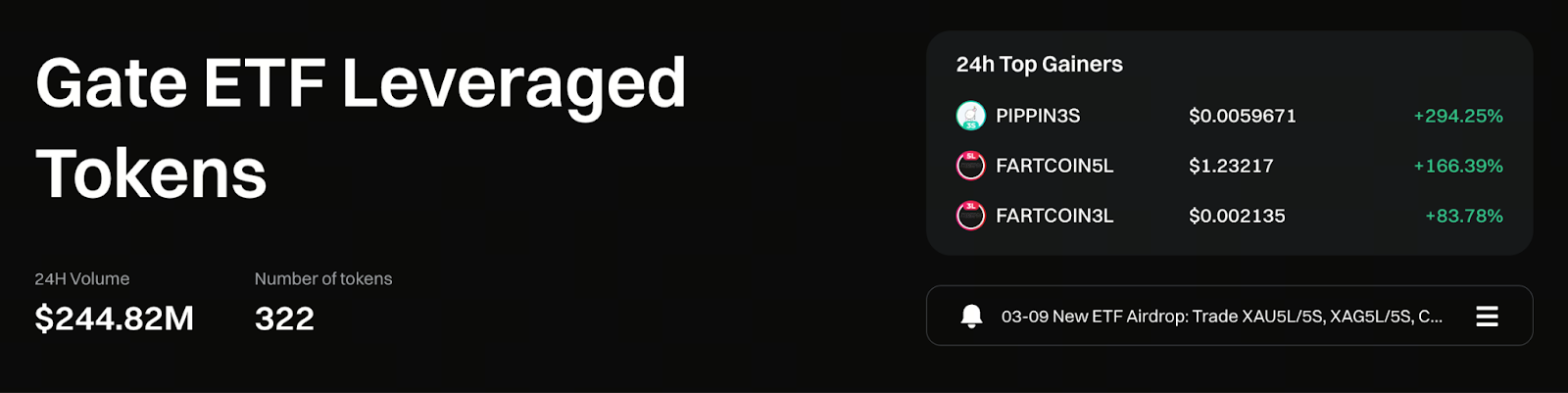
Operational Challenges of Traditional Leveraged Trading

In most trading markets, leverage is typically linked to contract trading. Investors must open positions, set leverage ratios, and continuously monitor their margin status. When volatility increases, they must quickly adjust positions or add funds to avoid forced liquidation.

While this trading model offers considerable flexibility, it also raises the operational threshold. For many investors, margin calculations and risk management often demand extra time and effort.

Start trading Gate Leveraged ETFs now: https://www.gate.com/leveraged-etf

Productizing the Leverage Effect

Gate Leveraged ETFs provide an alternative way to access leveraged returns. Unlike traditional contracts, users can buy and sell leveraged ETFs directly on the spot market, just like regular tokens.

Each product is designed with a fixed target leverage multiple—such as 3x or 5x. Investors are not required to set leverage ratios or establish independent contract positions.

This approach transforms the actively managed leverage mechanism into a built-in product feature, streamlining the entire trading process for greater simplicity and clarity.

Rebalancing Mechanism Maintains Leverage Ratio

To keep the intended leverage multiple, leveraged ETFs use a rebalancing mechanism to adjust their internal holdings. When market price fluctuations push the actual leverage ratio away from the target, the system reallocates positions. This mechanism aims to keep the product’s leverage effect within a reasonable range, preventing unlimited amplification from market volatility. Investors don’t have to track margin ratios or frequently adjust positions during sharp market swings.

Why There’s No Liquidation Mechanism

Unlike contract trading, leveraged ETFs do not have individual margin positions, so forced liquidation does not apply.

Key reasons include:

  • Investors do not directly borrow assets

  • Risk is reflected in the product’s net asset value, not individual accounts

  • The rebalancing mechanism proactively adjusts internal holdings

As a result, when markets move against investors, they typically see a decline in net asset value rather than forced account liquidation. This changes how leveraged risk is presented compared to traditional contracts.

Performance Across Different Market Conditions

Leveraged ETF performance depends on market structure. In clear trending markets, sustained price movement in one direction can deliver amplified returns.

In choppy or range-bound markets, frequent rebalancing may erode net asset value. These products are generally better suited to trending environments, while their results may differ from simple leverage calculations during prolonged sideways periods.

Greater Flexibility in Capital Usage

Leveraged ETFs use a spot trading model, so investors only need to pay the purchase amount to access leveraged returns—no extra collateral or borrowing required. Each product charges a fixed daily management fee to cover hedging and rebalancing costs. Compared to contract models that require margin maintenance, this design allows for more flexible capital allocation and reduces capital management complexity.

Leverage Still Means Amplified Risk

Even with a simpler trading process, leveraged ETFs fundamentally magnify market price movements. When investors correctly anticipate market direction, gains are accelerated; if not, losses also increase. It’s essential for investors to understand the mechanics of these products and allocate funds appropriately to avoid overconcentration in a single high-volatility instrument.

Summary

Leveraged ETFs offer a standardized way to access leveraged returns. With fixed leverage multiples and a rebalancing mechanism, Gate Leveraged ETFs convert actively managed leverage trading into a directly tradable product. This design doesn’t eliminate market risk—it changes how risk is managed and presented. When investors understand the product’s operation and allocate funds wisely, leveraged ETFs can serve as a valuable tool in investment strategies, providing more choices for market participation.

Author:  Allen
Disclaimer
* The information is not intended to be and does not constitute financial advice or any other recommendation of any sort offered or endorsed by Gate.
* This article may not be reproduced, transmitted or copied without referencing Gate. Contravention is an infringement of Copyright Act and may be subject to legal action.

Related Articles

AI-Native Settlement Layers: How United Stables Is Building the Next Financial Rail
Beginner

AI-Native Settlement Layers: How United Stables Is Building the Next Financial Rail

Stablecoins were originally designed as dollar substitutes within exchanges, primarily used for asset pricing and trade settlement. As on-chain financial ecosystems have matured, their role has expanded beyond simple payments to include collateral assets, cross-chain liquidity mediums, and unified settlement units. In particular, as AI systems and automated agents begin to participate directly in economic activity, demand has risen sharply for programmable value units capable of instant settlement. This shift is pushing stablecoins toward the role of foundational financial infrastructure.
2026-03-25 03:16:17
DePIN Identity Network and Real World Applications: How Humanity Protocol Brings on-chain Identity Into the Physical World
Beginner

DePIN Identity Network and Real World Applications: How Humanity Protocol Brings on-chain Identity Into the Physical World

Most Web3 identity systems remain confined to on-chain environments and struggle to achieve meaningful adoption in real world settings. Through a DePIN architecture and physical verification hardware, Humanity Protocol aims to bring decentralized identity into access control systems, hospitality, public services, and offline events, allowing on-chain identity to function not just as a digital credential, but as foundational infrastructure for real world access.
2026-03-25 07:40:53
Gold Price Forecast for the Next Five Years: 2026–2030 Trend Outlook and Investment Implications, Could It Reach $6,000?
Beginner

Gold Price Forecast for the Next Five Years: 2026–2030 Trend Outlook and Investment Implications, Could It Reach $6,000?

Analyze current gold price trends alongside authoritative five-year forecasts, integrating an evaluation of market risks and opportunities. This gives investors insight into the potential trajectory of gold prices and the main drivers expected to shape the market over the next five years.
2026-03-25 18:13:30
Aster vs Hyperliquid: Which Perp DEX Will Prevail?
Beginner

Aster vs Hyperliquid: Which Perp DEX Will Prevail?

Aster and Hyperliquid are the two representative protocols of the "purpose-built L1 path" within the current decentralized perpetual exchange (Perp DEX) sector. As a pioneer in the field, Hyperliquid has built a deep liquidity moat through its highly mature order book architecture and strong community consensus. Conversely, Aster, as a rising challenger, seeks to leapfrog the competition in high-performance trading through more aggressive multi-chain aggregation logic, private transaction modules, and an underlying execution environment optimized for 2026 market demands.
2026-03-24 11:58:33
Aerodrome Tokenomics: How ve(3,3) Powers Base's Most Profitable DEX
Beginner

Aerodrome Tokenomics: How ve(3,3) Powers Base's Most Profitable DEX

AERO is the native token of Aerodrome Finance, a core decentralized exchange and liquidity protocol in the Base ecosystem. It is primarily used for liquidity incentives and ecosystem operations. veAERO is a governance NFT that users receive by locking AERO, representing both voting power and the right to share protocol revenue. Through a dual track structure of AERO as a utility token and veAERO as a governance credential, Aerodrome separates liquidity usage value from long term governance power, allowing participants to act as liquidity providers, governance decision makers, and revenue sharers within the same system.
2026-03-25 06:40:31
What is MetFi? All You Need to Know About METFI (2025 Update)
Intermediate

What is MetFi? All You Need to Know About METFI (2025 Update)

MetFi is a decentralized metaverse and web3 incubator that utilizes NFTs to share investment returns with MetFi NFT holders and members of its community. As of 2025, MetFi trades at $0.225266 USD with a $47.7M market cap, offering AI-driven trading, blockchain learn-to-earn games, and ERC-404 airdrops through its Marine Moguls project for early claim rights to promising Web3 startups.
2026-04-08 23:25:05