With the development of automated AI applications, AI agents are gradually evolving from simple chatbots into intelligent systems capable of running continuously. These systems can analyze information, formulate plans, and call multiple APIs to complete tasks. Within this architecture, AI APIs become the core infrastructure that connects AI agents with external services.
At the same time, automated AI systems also introduce new challenges, such as how to manage multi model calls, how to optimize costs, and how to enable AI agents to automatically pay API usage fees. Today, automated payment mechanisms such as the x402 protocol are becoming an important part of the AI agent economy, while AI model routing platforms like GateRouter are helping developers build automated AI agent ecosystems.
Why Do AI Agents Need APIs?
As a standard method for communication between different software systems, APIs (Application Programming Interfaces) act as an important bridge that connects AI agents with external capabilities.
In real world operation, AI agents often need to access multiple services through APIs, such as:
-
AI model services such as GPT, Claude, or Gemini
-
Data interfaces including market data and financial data
-
Web services such as search engines or social platforms
-
Blockchain networks including DeFi protocols and smart contracts
Through these APIs, AI agents can build complete automated task workflows. For example, a DeFi analysis agent may call AI models to analyze market data while simultaneously accessing blockchain APIs to retrieve real time transaction information.
What Is the AI Agent API Architecture?
AI agent API architecture refers to the interaction structure between AI agents, AI models, data services, and external systems. Within this architecture, an AI agent calls multiple APIs to access different services and then combines the returned results into a final output.
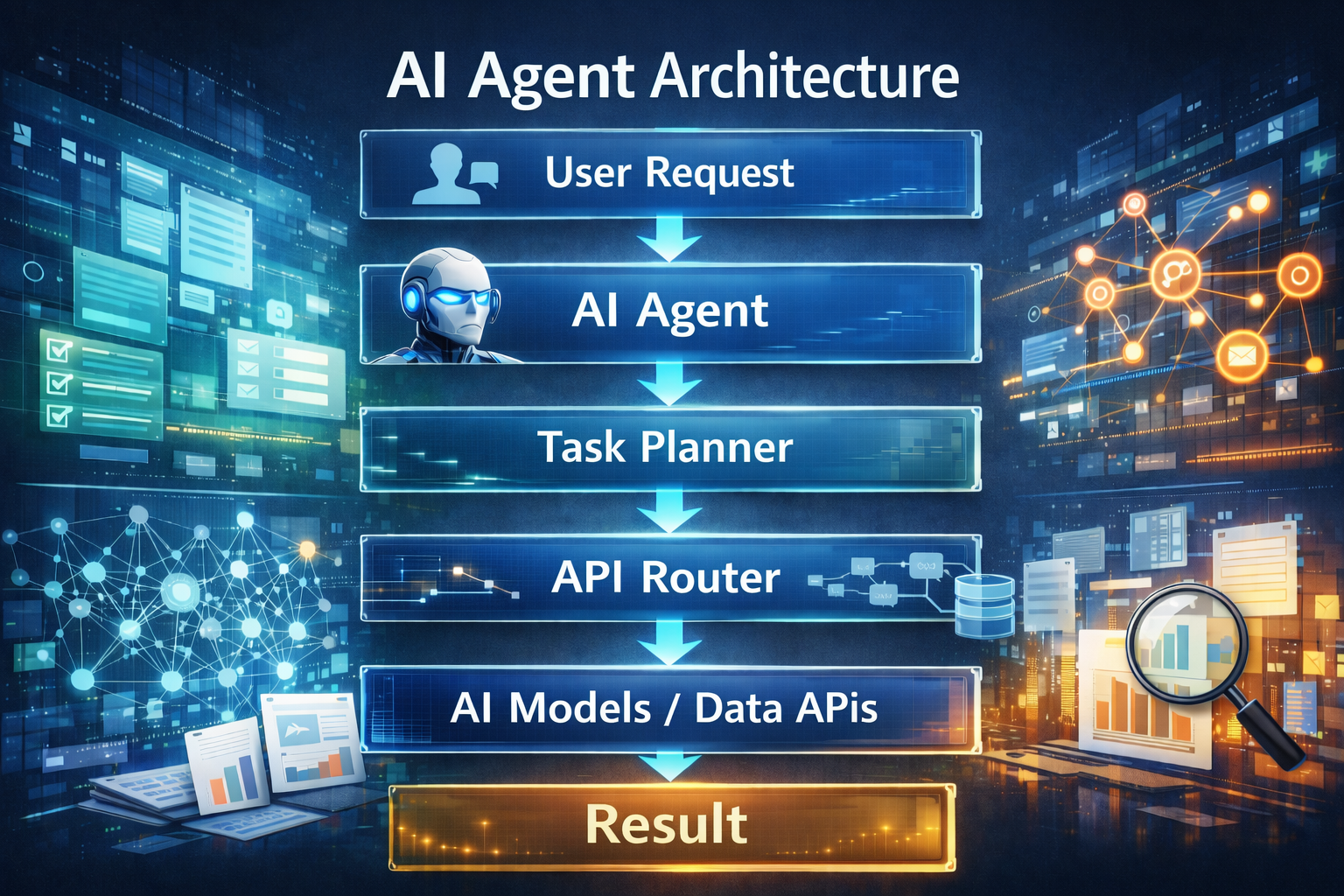
A typical AI agent architecture generally includes the following components:
Agent Core is responsible for understanding the task objective and defining an execution strategy.
Task Planner breaks complex tasks into multiple smaller subtasks.
API Router determines which API or AI model should be called.
AI Models provide capabilities such as language understanding, reasoning, or content generation.
External APIs provide services such as data access, search functions, or blockchain interaction.
Payment Layer manages automated payments for API usage.
This architecture allows AI agents to coordinate resources across different systems, enabling them to perform more complex automated tasks.
Basic Workflow of How AI Agents Call AI APIs
To enable automated AI applications to interact with APIs and different AI models or external services, an agent operates according to a structured workflow. From receiving a task to calling AI APIs and producing the final output, the process typically involves several stages, including task understanding, task decomposition, model invocation, and result processing.
-
Receive the Task
The AI agent receives a user request or a system triggered task, such as “analyze a specific market trend.”
-
Task Planning
The agent breaks the complex task into several smaller subtasks, for example:
-
Data collection
-
Information analysis
-
Content generation
-
Call the AI API
During the analysis or content generation process, the AI agent sends requests to AI model APIs. For instance, it may call a large language model to perform text generation or data analysis.
-
Receive the Response
After the API returns the result, the AI agent parses the response and determines the next action.
-
Execute the Next Task
The agent may continue calling other APIs or generate the final output.
This loop-based process forms the core mechanism that enables AI agents to operate automatically.
Typical Application Scenarios of AI Agent APIs
As AI agent technology continues to evolve, more applications are beginning to rely on AI APIs to build automated systems.
Automated Research Agents
Research oriented AI agents can automatically search for information on the internet and call AI APIs to generate research reports.
DeFi Analysis Agents
Within the Web3 ecosystem, AI agents can call on-chain data APIs together with AI model APIs to analyze market trends or generate trading strategies.
Automated Customer Service Systems
Some companies are using AI agents that call AI APIs to build intelligent customer service systems, enabling automated responses and issue analysis.
These examples demonstrate that AI agent APIs are becoming an important infrastructure layer for the next generation of internet services.
Barriers to Value Exchange in AI Services: Traditional Payments vs On-Chain Settlement
As AI agents gain the ability to automatically call various online services, a new challenge has emerged: how can AI agents pay for API usage?
Traditional internet APIs typically rely on payment methods such as:
-
Account registration
-
Linking a credit card
-
Prepaid balances
-
Monthly billing
This model is designed primarily for human users. For AI agents, however, it is not well suited because automated systems cannot easily complete traditional payment processes.
If AI agents need to continuously access paid APIs such as AI models or data services, a payment mechanism is required that can be executed automatically by machines.
Automatic API Payments: The Role of x402
The x402 protocol is an internet protocol standard designed to enable automated API payments. It extends the HTTP 402 Payment Required status code so that machines can automatically complete API payment processes.
In systems that support x402, the API calling workflow typically works as follows:
-
An AI agent sends a request to an API.
-
The API responds with HTTP 402 Payment Required.
-
The response includes the price information for the request.
-
The AI agent completes the payment using digital assets such as stablecoins.
-
The API returns the model response.
This mechanism allows AI agents to complete both API requests and payments without human intervention.
Compared with traditional payment systems, x402 provides several advantages:
-
Supports machine to machine (M2M) payments
-
Enables pay as you go pricing models
-
Does not require prepaid accounts
-
Better suited for automated AI systems
The Role of GateRouter in the AI Agent Ecosystem
In the AI agent ecosystem, payment is only one of the challenges. Another important issue is how to efficiently manage multiple AI models.
Different AI models vary in capability, cost, and response speed. For example:
-
Some models specialize in complex reasoning
-
Some models offer lower operational costs
-
Some models provide faster response times
In traditional architectures, developers often need to integrate APIs from multiple AI model providers individually, which increases system complexity.
GateRouter addresses this challenge by providing a unified AI model routing platform for AI agents. Through GateRouter, AI agents can access multiple AI models through a single API, automatically select the most suitable model based on the task, and dynamically optimize both cost and performance.
In addition, GateRouter supports the x402 automated payment protocol, allowing AI agents to pay API usage fees automatically using digital assets. This design positions GateRouter as a key infrastructure layer connecting AI models, automated payment systems, and AI agents within the broader AI ecosystem.
Advantages and Potential Risks of the AI Agent Calling Architecture
As automated AI applications continue to develop, AI agents calling external services through APIs has become a common system architecture. This approach allows AI agents to access AI models, data services, and blockchain applications, enabling the automated execution of complex tasks. However, while this architecture improves efficiency, it also introduces several potential challenges.
From an advantages perspective, the AI agent API architecture significantly enhances automation capabilities. AI agents can call different APIs to automatically complete multi step tasks such as collecting data, analyzing information, and generating results. In addition, API based architectures provide strong flexibility. Developers can combine different services, such as AI models, search services, and data APIs, into a single application, enabling the development of more sophisticated automated systems. By accessing multiple AI models through APIs, systems can also select the most suitable model based on task complexity, balancing performance and operational cost.
Despite these benefits, certain risks also exist. One major concern is cost management. If an AI agent frequently calls APIs without restrictions, particularly high performance AI models, operational costs may increase rapidly. Another issue involves security risks. AI agents typically interact with multiple external services, and insufficient permission management may lead to data leaks or misuse. Finally, the system may face external dependency risks. If an API service becomes unavailable or its interface changes, the entire automated workflow may be affected.
For these reasons, developers often need to integrate cost management, security controls, and reliable infrastructure when designing AI agent systems to ensure long term operational stability.
Conclusion
AI agents are becoming an important component of automated internet applications. By calling AI APIs, these intelligent systems can access AI models, data services, and blockchain applications to complete complex tasks.
Within the AI agent architecture, APIs serve as critical infrastructure that connects different systems. Through API calling mechanisms, AI agents can automatically execute tasks and continuously optimize their workflows.
However, as the AI agent economy evolves, the issue of automated payments is becoming increasingly important. The x402 protocol, by extending the HTTP 402 status code, provides a new solution for automated API payments.
At the same time, AI model routing platforms such as GateRouter integrate multi model access and automated payment capabilities, offering comprehensive infrastructure support for AI agents. As automated AI services become more widespread, platforms of this type may play an increasingly significant role in the future internet ecosystem.
FAQs
What is an AI Agent API?
An AI Agent API refers to the mechanism through which AI agents call AI models or external services via application programming interfaces. This allows AI systems to automatically access different resources and perform tasks.
Why do AI agents need APIs?
APIs enable AI agents to access AI models, data services, or blockchain applications, allowing them to automate complex tasks across different systems.
Can AI agents automatically pay for APIs?
In traditional internet environments, AI agents often cannot complete payment processes. However, with protocols such as x402, AI agents can automatically pay API usage fees using digital assets.
How can an AI agent call multiple AI models?
AI agents can use AI model routing platforms, such as GateRouter, to access multiple AI models through a unified interface and automatically select the most suitable model for a given task.
How does GateRouter help AI agents?
GateRouter is an AI model routing platform that allows AI agents to access multiple AI models through a single API. It also supports automated payment for API usage, helping developers build more automated AI application ecosystems.