Unlike early DeFi, which primarily relied on native on-chain assets, Ondo takes a differenOndot path. Its approach is closer to turning real-world financial assets into programmable on-chain instruments. It maps assets such as short-term U.S. Treasuries, ETFs, and equities onto the blockchain, then maintains usability and risk boundaries through compliance frameworks, custody arrangements, audits, and permission controls. This is the most defining difference between Ondo and traditional yield farming protocols.
From a technical perspective, Ondo is not just about “bringing assets on-chain.” It builds an integrated infrastructure that connects yield distribution, liquidity management, cross-chain interaction, compliance access, and security auditing. Ondo Chain aims to serve as a Layer-1 network for institutional-grade financial markets, while Ondo Global Markets transforms tokenized securities into on-chain assets that can be traded, transferred, and composed. Together, these form the backbone of its technology stack.
Ondo’s Asset Management Architecture and Smart Contract Applications
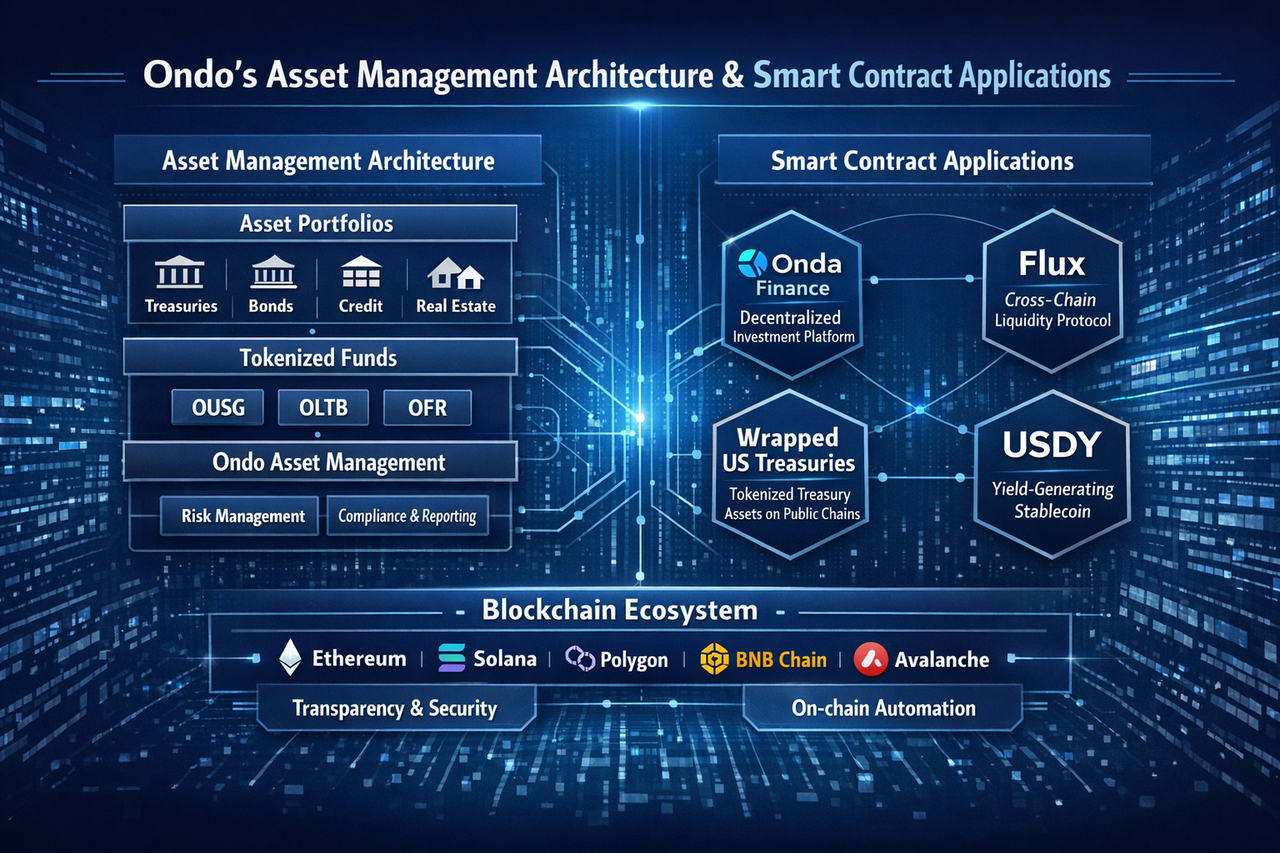
Ondo’s asset management structure can be divided into three layers. At the base are real-world assets. Above that are on-chain tokens. At the top are smart contracts responsible for issuance, redemption, pricing, and access control.
Take USDY as an example. According to official documentation, it is a tokenized note, historically issued by Ondo USDY LLC and later integrated into the Ondo Global Markets system. Different issuance batches may correspond to underlying assets such as short-term U.S. Treasuries, shares of the iShares Short Treasury Bond ETF, or bank demand deposits.
USDY comes in two versions: an accumulating version and a rebasing version called rUSDY. In the accumulating model, the token price increases over time as yield accrues. In the rebasing model, the token price remains close to one dollar, while yield is reflected through an increase in token balance within the holder’s wallet. Official documentation also states that eligible non-U.S. Individuals and institutions can deposit assets such as USDC through the platform to start earning yield.
OUSG, by contrast, is designed more for institutional cash management. According to official materials, it provides liquid exposure to short-term U.S. Treasuries and government-backed securities, with 24/7 tokenized subscriptions and redemptions. Investors can obtain OUSG instantly using USDC or PYUSD and redeem it at any time. However, OUSG is limited to Qualified Purchasers and verified Accredited Investors, who must complete KYC, AML, and sanctions screening.
At the execution layer, Ondo’s smart contracts do more than mint tokens. They handle pricing records, redemption processes, and address restrictions. Public contract pages reveal components such as USDY’s Redemption Price Oracle, blocklist mechanisms, and deployment addresses across chains. This shows that pricing, redemption, and blacklist controls are all incorporated into verifiable on-chain processes.
Decentralized Asset Allocation and Risk Control Mechanisms
Ondo’s risk control model is not fully decentralized in the traditional anonymous sense. Instead, it follows a hybrid approach that prioritizes compliance while executing on-chain.
For example, OUSG and USDY clearly define eligible participants. OUSG operates under Regulation D and Qualified Purchaser rules, while USDY is offered to non-U.S. persons under Regulation S. All participants must undergo anti-money laundering, counter-terrorism financing, and sanctions compliance checks.
At the asset level, Ondo emphasizes the distinction between “full backing” and “economic exposure” rather than direct ownership. Official documentation makes this clear: Ondo GM Tokens provide economic exposure to the value and dividends of underlying assets, but they are not stocks, ETFs, or ADRs, and do not grant holders legal ownership or redemption rights over those assets. USDY follows the same logic, representing exposure to short-term U.S. Treasuries rather than ownership of the bonds themselves. This design helps prevent users from mistaking on-chain tokens for legally recognized securities.
For institutions and regulated markets, this structure serves a clear purpose. It separates yield from ownership and distinguishes on-chain transferability from legal tradability. Currently, onboarding for Ondo Global Markets is limited to institutional participants, with retail access planned through a future web app. This reflects a controlled expansion strategy rather than an open, permissionless rollout.
How Ondo Improves Liquidity and Yield Optimization
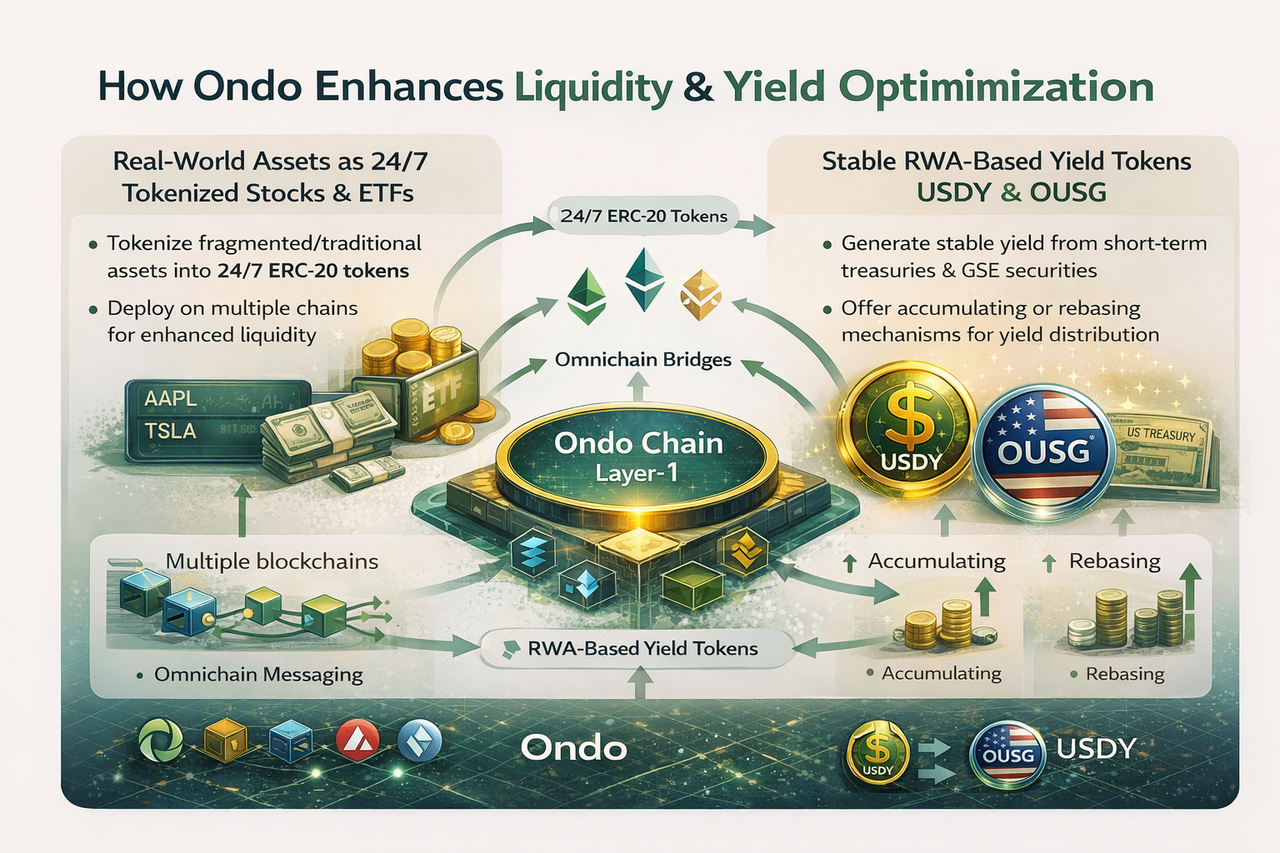
Ondo enhances liquidity by transforming assets that are traditionally fragmented, time-restricted, and difficult to combine into 24/7 transferable on-chain tokens. Official documentation states that tokenized stocks on Ondo are designed to closely track the liquidity of their underlying assets while minimizing slippage and price deviation. These assets are ERC20-compatible and can be held by wallets, smart contracts, and certain custodians.
As of March 2026, Ondo Global Markets offers more than 100 tokenized stocks and ETFs, covering individual equities, indices, and fixed-income ETFs. Earlier announcements also noted that since its launch in September 2025, the platform has continuously expanded its asset base and cross-chain deployment.
Yield optimization comes from two main sources. First, USDY and OUSG generate returns from relatively stable underlying assets such as short-term U.S. Treasuries and government-backed securities, rather than relying on the highly volatile incentives typical in DeFi. Second, USDY offers both accumulating and rebasing models, allowing users to receive yield either through price appreciation or increasing token balances, depending on their preference.
Ondo Chain further supports liquidity optimization at the infrastructure level. It is positioned as a Layer-1 network for institutional financial markets, featuring RWA as a security primitive, built-in oracles and proof-of-reserve systems, native omnichain messaging and bridging, and permissioned validators designed for asset managers and broker-dealers. In other words, Ondo is not just building yield products, but also a foundational network tailored for RWA liquidity and settlement.
In terms of security, Ondo states that its smart contracts have been audited by leading industry firms. The technical pages for OUSG and Global Markets are clearly labeled as audited. Additionally, Ondo publishes contract addresses, price oracles, and blocklist data, improving transparency and enabling independent verification by users and partners.
For fund security, Ondo does not rely on a single on-chain address. Instead, it combines custody, legal entities, and reporting systems. For example, OUSG’s underlying assets are invested in U.S. Treasury products. USDY documentation notes that its issuing entity follows an SPV structure used for borrowing, purchasing Treasuries, and holding bank deposits, and that the entity is registered as a money services business with FinCEN.
Regarding privacy, Ondo follows a model of minimal necessary disclosure within a compliance framework, rather than anonymity. Its privacy policy states that it collects user-provided information, automatically collects data, and blockchain-related information, using these for security, compliance, research, and service functions. For RWA and tokenized securities, this means privacy is not the primary goal. Compliance and traceability are essential for maintaining platform stability.
Future Development and Upgrades of Ondo Technology
Based on publicly available information, Ondo’s future direction is becoming increasingly clear. On one hand, it will continue expanding the range of tokenizable assets. On the other hand, it aims to build a cross-chain, compliant, and scalable financial network for trading and settlement. Ondo Global Markets already supports over 100 assets and will continue expanding across more chains. Ondo Chain positions itself as a native RWA network, aiming to unify lending, staking, cross-collateralization, and cross-chain settlement within a single framework.
Another clear trend is the gradual shift from an institution-first model toward broader user access. While onboarding for Ondo Global Markets is currently limited to institutions, retail access is planned via a future web app. Meanwhile, its products are already available on Ethereum mainnet, BNB Chain, and Solana, with continued expansion into additional markets and asset types.
Taken together, these developments show that Ondo is not simply adding more tokens. It is building what can be described as an on-chain asset management operating system. Tokens represent assets, smart contracts enforce rules, blockchain networks handle settlement, compliance frameworks manage access, and audits and custody ensure security. This integrated system is where its real technological value lies.
Summary
Ondo’s core technology is not about packaging a single asset into a token. It is about deconstructing and reassembling the yield, liquidity, and compliance of real-world assets into a programmable on-chain infrastructure. USDY addresses stable yield and accessibility, OUSG serves institutional cash management needs, Ondo Global Markets enables on-chain usability of stocks and ETFs, and Ondo Chain aims to provide the foundational network that supports it all.
In this sense, Ondo functions as a financial middleware layer for the RWA era. It connects traditional finance on the asset side, DeFi on the execution side, and regulated markets on the access side. As a result, yield is no longer just a short-term incentive, but a structured, composable, and continuously manageable on-chain capability.







