As applications such as decentralized finance, digital identity systems, and enterprise data platforms continue to expand, more use cases require blockchains to protect sensitive information while maintaining transparency. This trend has accelerated the development of privacy computing technologies and zero knowledge proofs, encouraging a new generation of privacy-focused blockchains to explore network architectures and economic models better suited for privacy environments.
Midnight, introduced by Input Output Global, aims to provide Web3 with privacy infrastructure that balances regulatory compatibility and data protection. Its token plus resource dual component model separates network ownership from computational resource consumption. This design helps make transaction costs more predictable while supporting complex privacy-based computations within decentralized applications.
Overview of Midnight’s Token Plus Resource Economic Model
Unlike most Layer 1 blockchains that rely on a single token, Midnight adopts a dual component economic structure known as the Token plus Resource model. This design separates the network’s capital asset from computational resource costs, making the system more suitable for privacy-oriented computing environments.
Within this structure, NIGHT functions as the core asset of the network. It operates as a public, unshielded native token used for governance, network security, and ecosystem incentives. Holding NIGHT also allows users to continuously generate DUST.
DUST operates as a network resource rather than a tradable token. It is used to pay transaction fees and execute zero knowledge smart contracts. Unlike traditional gas fees, DUST cannot be transferred between users or traded on markets. Instead, it is automatically generated through holding NIGHT.
This structure enables a distinct operational model within Midnight. Rather than spending NIGHT directly for transactions, users consume the DUST produced from their NIGHT holdings to access network computation.
NIGHT Token Supply Model
NIGHT functions as the native token of the Midnight network with a maximum supply of 24 billion tokens. The token exists both within the Midnight network and as a Cardano native asset, enabling interoperability between the two ecosystems.
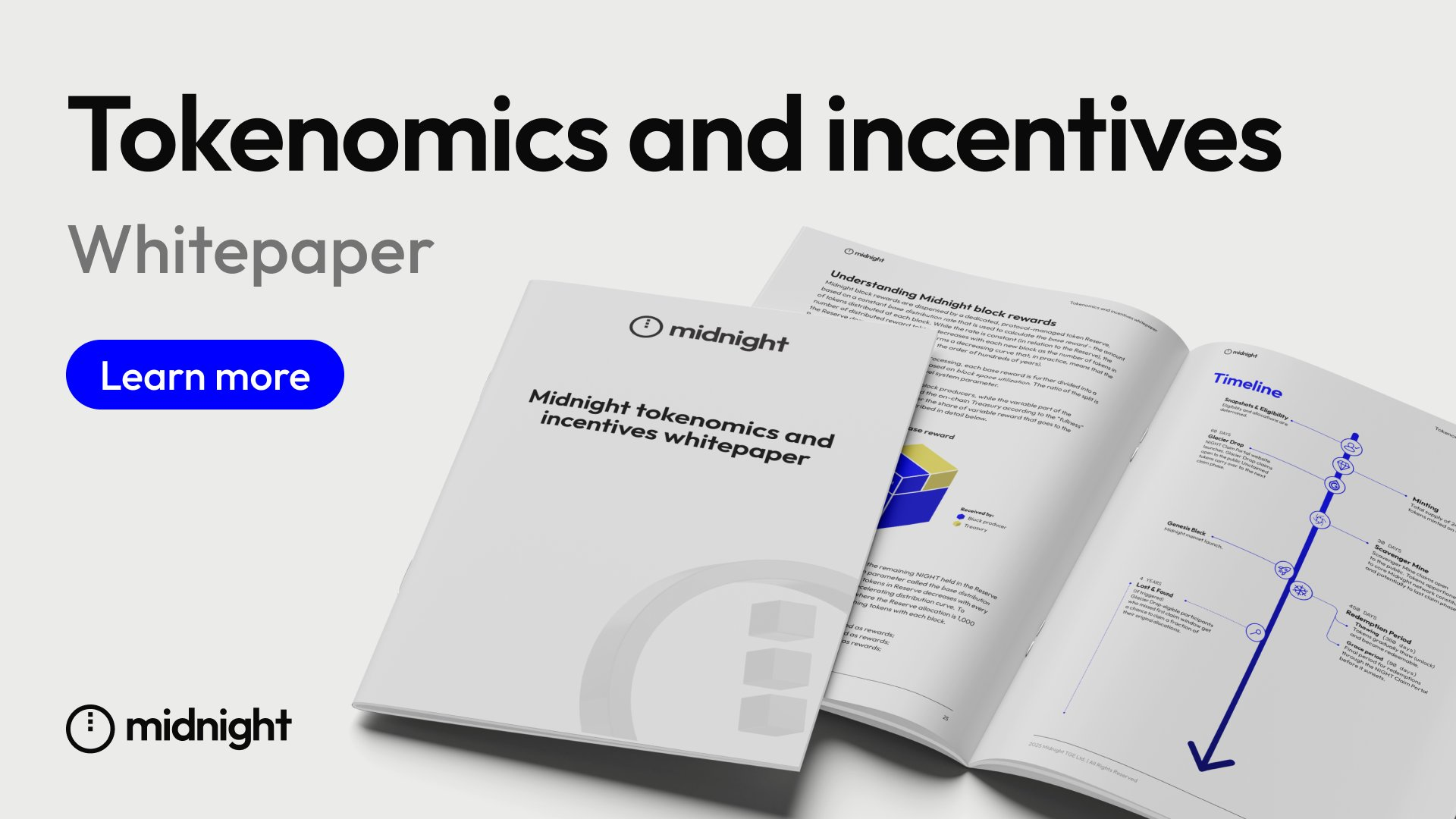
Distribution follows a community-oriented approach. Through mechanisms such as Glacier Drop and Scavenger Mine, the project distributes a significant portion of tokens to users across multiple blockchain ecosystems.
To reduce market volatility, some tokens are released gradually through a “Thawing” unlocking mechanism. The designed release schedule extends over approximately 450 days, with tokens unlocking quarterly. This gradual release aims to prevent sudden increases in circulating supply that could affect market stability.
In addition, the protocol distributes token rewards to block producers and network participants, helping maintain the security and stability of the blockchain network.
Core Functions of the NIGHT Token
Within the Midnight network, NIGHT performs three primary roles.
First, it supports network security and incentive mechanisms. Block producers receive NIGHT as rewards, encouraging nodes to maintain network operations and participate in block validation.
Second, NIGHT enables network governance. In the future, token holders will be able to participate in on-chain governance by voting on protocol upgrades and ecosystem development decisions.
Third, and most importantly within Midnight’s economic model, holding NIGHT continuously generates DUST resources. This design allows users to access network functionality without directly spending tokens for transaction fees. Instead, holding NIGHT provides the computational resources needed to use the network.
The DUST Resource Mechanism in Midnight
DUST functions as a special network resource used to pay transaction fees and execute privacy-enabled smart contracts. Compared with traditional blockchain gas systems, DUST introduces several distinctive characteristics.
First, DUST is automatically generated by holding NIGHT. The more NIGHT a user holds, the more DUST can be produced over time.
Second, DUST operates as a shielded resource, meaning its usage does not publicly reveal detailed transaction metadata. This design helps protect user privacy.
Third, DUST cannot be transferred or traded. It can only be generated by accounts holding NIGHT and then used to execute transactions. This restriction prevents DUST from becoming a speculative asset.
In addition, DUST exhibits renewable and decaying properties. After being used in transactions, DUST gradually regenerates over time, similar to a battery recharging. If left unused for long periods, some DUST may gradually decay.
Economic Relationship Between NIGHT and DUST
Within Midnight’s economic structure, NIGHT and DUST form a token-to-resource relationship.
Holding NIGHT can be understood as holding network capacity. Over time, an account automatically generates a certain amount of DUST, which can then be used to execute transactions or run smart contracts.
When users interact with the network, they consume DUST rather than NIGHT. This means that a user’s NIGHT holdings are not reduced through transactions, allowing the token to retain its governance role and long-term value.
This design also helps make transaction costs more predictable. Because network usage relies on DUST generated from NIGHT holdings, the direct link between transaction costs and token price volatility is significantly reduced.
Midnight’s Value Capture Mechanism
Midnight captures value primarily through the relationship between network usage demand and token ownership.
As more applications operate on the Midnight network, demand for transactions and computational resources increases. Since DUST is generated from NIGHT, users must hold a certain amount of NIGHT to obtain sufficient network resources.
In addition, NIGHT is connected to governance participation, block production rewards, and ecosystem funding mechanisms. These elements may influence the token’s long-term value within the network.
Over time, if Midnight becomes an important infrastructure layer for privacy-focused computation, growing demand for network resources could strengthen the role of NIGHT within the ecosystem.
Advantages and Risks of the Midnight Token Model
Midnight’s economic design offers several potential advantages.
One advantage is the separation between the token and transaction fees, which reduces uncertainty in network usage costs. Users can estimate their future computational capacity based on the amount of NIGHT they hold.
Another benefit is that the non-transferable nature of DUST helps prevent transaction fee markets from being influenced by speculative trading. This structure may also reduce the risk of network abuse.
The model can also improve developer experience. For example, application developers can hold NIGHT to generate DUST and use those resources to cover transaction costs for users, enabling a gasless-style application experience.
However, the model also presents certain challenges. The dual-component structure introduces additional complexity, requiring users to understand the relationship between NIGHT and DUST. Furthermore, the network’s value ultimately depends on ecosystem adoption, including growth in applications and developer activity.
Conclusion
Midnight adopts a distinctive token plus resource economic model. In this system, NIGHT functions as the public native governance token, while DUST operates as a privacy-preserving resource used to execute transactions and smart contracts.
By allowing NIGHT holders to generate DUST automatically, Midnight separates network ownership from usage costs, enabling privacy blockchains to provide more stable and predictable computational resources. As demand for privacy-focused computing grows and Web3 applications continue to expand, this token-plus-resource model may become an important design approach for future privacy blockchain networks.
FAQs
Is NIGHT a Privacy Coin?
No. NIGHT functions as a public (unshielded) native token, meaning its transaction information remains transparent on the network.
Is DUST a Token?
No. DUST is not a tradable token. It operates as a network resource used to pay transaction fees and execute smart contracts within the Midnight network.
What Is the DUST Mechanism in Midnight?
DUST represents computational resources within the Midnight network. It is used to pay transaction fees and run privacy-enabled smart contracts. Unlike traditional blockchain gas systems, DUST is automatically generated by holding NIGHT and cannot be transferred or traded.
Why Does Midnight Not Use NIGHT Directly for Transaction Fees?
Midnight separates network usage costs from token price through the DUST mechanism. This design improves fee predictability and reduces the impact of token price volatility on transaction costs.
What Happens When Users Hold NIGHT?
Holding NIGHT continuously generates DUST. These resources allow users to execute transactions and run smart contracts on the network.
Can DUST Be Traded?
No. DUST cannot be transferred or traded. It can only be used to pay for computational resources within the network.