In the AI industry, data remains the core resource that determines model performance. As large models move into more refined training stages, simply scaling data volume is no longer enough to drive improvements. High quality, verifiable data is becoming essential. However, traditional data labeling systems suffer from structural weaknesses in both incentive design and data credibility, creating room for new economic models to emerge.
Perle was introduced in this context, aiming to reshape how data is produced and how value is distributed through Web3. Compared to traditional centralized platforms, Perle moves contribution tracking, incentive allocation, and data pipelines on chain. This approach seeks to address issues such as lack of transparency, weak bargaining power for participants, and unsustainable incentives. Within this system, PRL serves as the core medium that drives the entire data economy network.
Overview of the Perle Project
Perle can be understood as an “on chain data coordination layer for enterprise AI.” Its goal is to build a data production infrastructure centered on human participation, with full verifiability and traceability. In this system, enterprises or developers submit specific data requirements, while globally distributed annotators and reviewers complete the tasks. Every contribution is recorded on chain, ensuring it can be tracked and audited.
From a technical perspective, Perle typically relies on high performance public blockchains such as Solana for settlement and ownership. Around the data production process, it builds modules for task distribution, result submission, quality verification, and reputation accumulation. Notably, PRL does not handle base layer consensus or gas payments. Instead, it focuses entirely on economic coordination within the human participation layer, aligning incentives across the ecosystem.
Core Functions of the PRL Token
Based on available information, PRL serves several key roles within the Perle economy:
-
Incentives and rewards: PRL is used to reward contributors who complete data annotation, review, and quality improvement tasks, encouraging consistent, high quality human input.
-
Access and participation: On the enterprise side, PRL may be required to access certain data products, unlock advanced features, or gain influence in governance and resource allocation.
-
Coordination and governance: PRL is positioned as a coordination layer token, aligning the long term interests of the foundation, investors, team, and community. Its design emphasizes participation and governance rather than network security.
Overall, PRL functions as a coordination token, connecting supply and demand while supporting governance and resource allocation across the ecosystem, rather than securing the underlying network.
PRL Token Distribution Structure
According to public information, the total supply of PRL is 1 billion tokens, distributed across the community, ecosystem, investors, and team. The structure clearly prioritizes ecosystem growth, allocating a significant portion to community and ecosystem development to support early adoption.
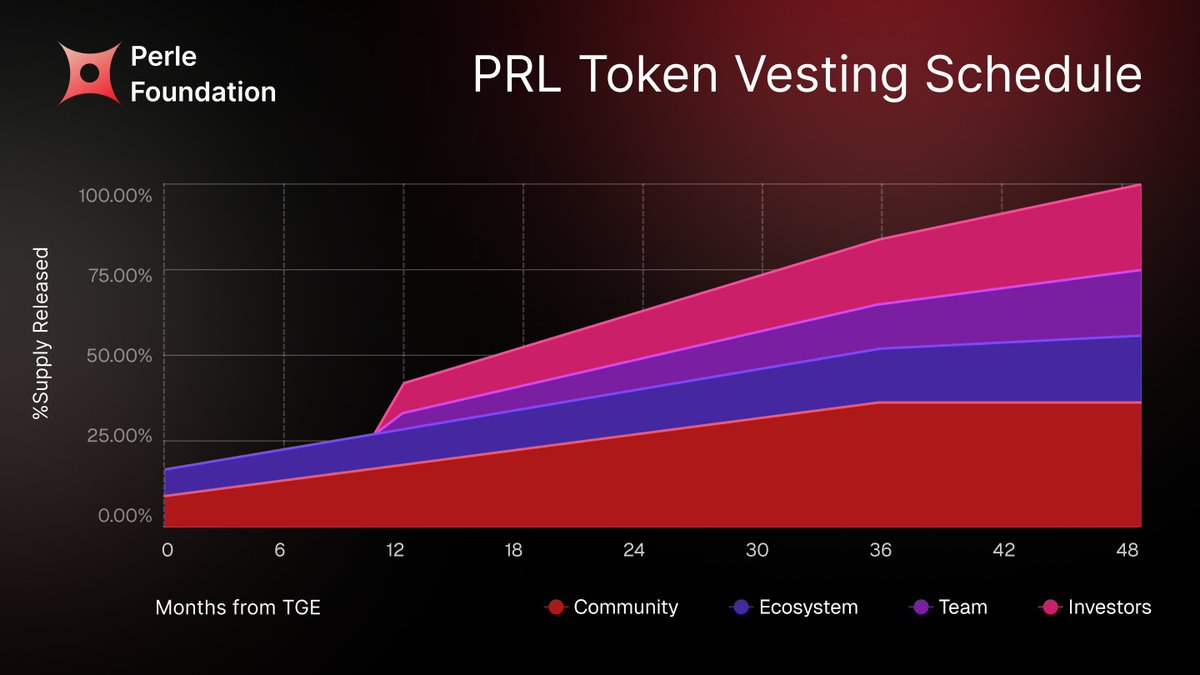
The community allocation is the largest and is released gradually over an extended period to support airdrops, task incentives, and user growth. The ecosystem fund supports partnerships, product development, and market expansion. In contrast, investor and team allocations are typically subject to longer lockups and linear vesting schedules, reducing short term sell pressure and reinforcing long term commitment.
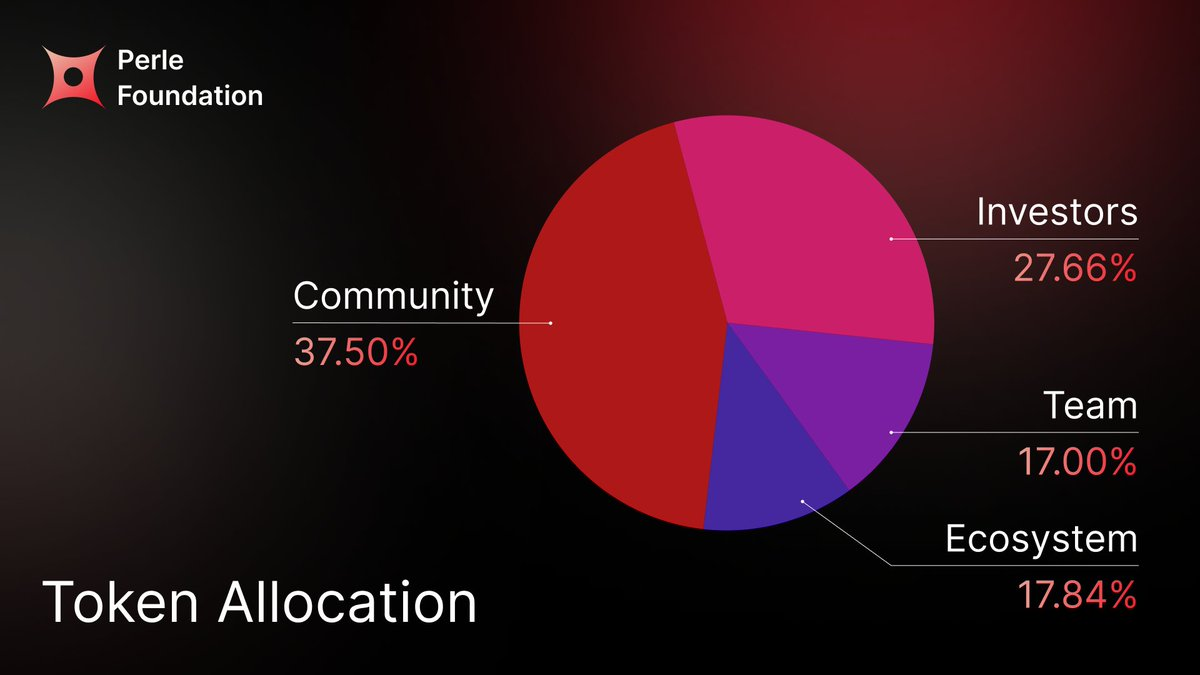
Specifically:
-
Community (37.5%): 7.5% unlocked at TGE, with the remainder released linearly over 36 months for airdrops, task incentives, and community rewards.
-
Ecosystem development (17.84%): About 10% unlocked at TGE to kickstart partnerships and ecosystem growth, with the rest released over 48 months for development and expansion.
-
Investors (27.66%): Subject to a 12 month cliff, followed by 36 months of linear vesting to reduce early sell pressure.
-
Team (17%): Also follows a 12 month cliff plus 36 month linear vesting, strengthening long term alignment.
Overall, this distribution approach helps release sufficient incentives early on to attract participants, while smoothing supply pressure over time through gradual vesting. However, as more tokens enter circulation, the market will need to absorb this supply, placing greater importance on sustained demand.
PRL Incentive Mechanism Design
PRL’s incentive system revolves around a cycle of data contribution, quality verification, and value feedback. Its core objective is to improve data quality through economic incentives.
Contributors earn PRL by completing annotation, review, or correction tasks, with rewards typically tied to task difficulty and output quality. This encourages participants to prioritize higher value tasks rather than simply increasing volume.
At the same time, Perle introduces an on chain reputation system to distinguish long term, reliable contributors from short term participants. High reputation accounts generally receive better task allocation and higher reward weighting, helping reduce low quality outputs and task farming behavior.
On the demand side, enterprises generate real usage demand by consuming platform data and services. If this demand continues to grow, it can form a positive feedback loop with supply side incentives.
PRL Value Capture Mechanisms
PRL’s value capture does not rely on base layer gas fees or staking yields. Instead, it comes from its role as a coordination and access layer within the data economy.
-
Access and usage: Enterprises may need to hold or spend PRL to access specific datasets or advanced features, creating structural demand for the token.
-
Governance and resource allocation: As the network evolves, PRL may be used in governance decisions or resource allocation, such as ecosystem funding or parameter adjustments. Holding PRL could therefore represent both economic potential and influence over network direction.
-
Reputation and incentives combined: For contributors, sustained high quality participation leads to both PRL rewards and reputation accumulation. Over time, this combination may unlock access to higher value tasks or deeper governance participation.
Ultimately, PRL’s value capture depends on the growth of data demand and the expansion of network usage.
The Flywheel Effect of Perle’s Tokenomics
Both the Perle team and external investors emphasize a flywheel model. The more high quality human participation and enterprise demand the network attracts, the more valuable it becomes, and the more effectively PRL can function.
This flywheel can be broken down as follows:
-
PRL incentives attract contributors, building high quality, auditable datasets.
-
High quality data draws enterprises and developers to use Perle for data sourcing and evaluation.
-
Enterprise demand generates real economic value, supporting PRL usage, buybacks, collateralization, or governance.
-
If part of this value flows back into incentive pools or ecosystem funds, it can further increase rewards and attract more high quality participants.
This creates a self reinforcing cycle where data quality, demand, and token value grow together.
Potential Risks and Challenges for PRL
Despite its coherent design, PRL faces several uncertainties.
First, the long term vesting schedule means a continuous increase in token supply. If demand does not grow at the same pace, this could create downward price pressure. Second, enterprise adoption remains uncertain. Without real usage scenarios, value capture may be limited.
In addition, the incentive mechanism must carefully balance short term rewards with long term engagement. Otherwise, behaviors such as farming and selling could weaken ecosystem stability. The limited availability of expert contributors may also become a bottleneck, as high quality data cannot be easily scaled.
Finally, regulatory and compliance factors could affect development, particularly in cross border data flows combined with token based incentives.
Conclusion
As the core token of the Perle network, PRL is designed to transform high quality human data contributions into sustainable economic activity through incentive and governance mechanisms. With a community and ecosystem focused distribution model and an incentive system centered on data production, Perle aims to build a long term value network connecting data supply and demand.
In the long run, Perle’s success depends on two key factors. First, its ability to continuously attract high quality data supply. Second, its ability to generate stable and growing enterprise demand. Only when both sides form a positive feedback loop can PRL achieve meaningful value capture.
FAQs
What is the primary use of the PRL token?
It is used to incentivize data contributors and serve as a medium of exchange within AI data transactions.
How does PRL capture value?
Through real demand generated by AI companies purchasing data, which supports token usage.
What are the key features of PRL’s incentive mechanism?
It emphasizes data quality and incorporates review and reputation systems into reward distribution.
Does PRL have long term value?
It depends on the growth of data demand and overall ecosystem adoption.
What are the main risks facing PRL?
They include insufficient demand, imbalanced incentives, and ongoing token inflation pressure.







