As the crypto market becomes increasingly institutionalized, trade sizes have grown significantly, with single orders often reaching millions or more. In this context, traditional order book–based execution methods have begun to show limitations, especially in low-liquidity or highly volatile conditions, where large trades can trigger price distortions and execution uncertainty.
To address these challenges, institutions are widely adopting a combined execution model that integrates RFQ with algorithmic trading. This approach not only improves execution efficiency but also reshapes the structure of the OTC market. From an industry perspective, RFQ + Algo Trading has become a key piece of infrastructure for institutions entering the crypto space and managing large-scale capital.
Core Challenges in Institutional Block Trading
When executing large trades, institutions are not simply concerned with getting filled. The real challenge lies in achieving high-quality execution while managing risk. Slippage, market impact, and fragmented liquidity are all critical factors that must be handled simultaneously.
In addition, liquidity in the crypto market is highly fragmented. Significant differences exist across platforms and market makers, making it difficult for any single venue to meet institutional needs. As a result, aggregating liquidity from multiple sources and executing it in a unified way becomes a central challenge.
RFQ: The First Step in Price Discovery
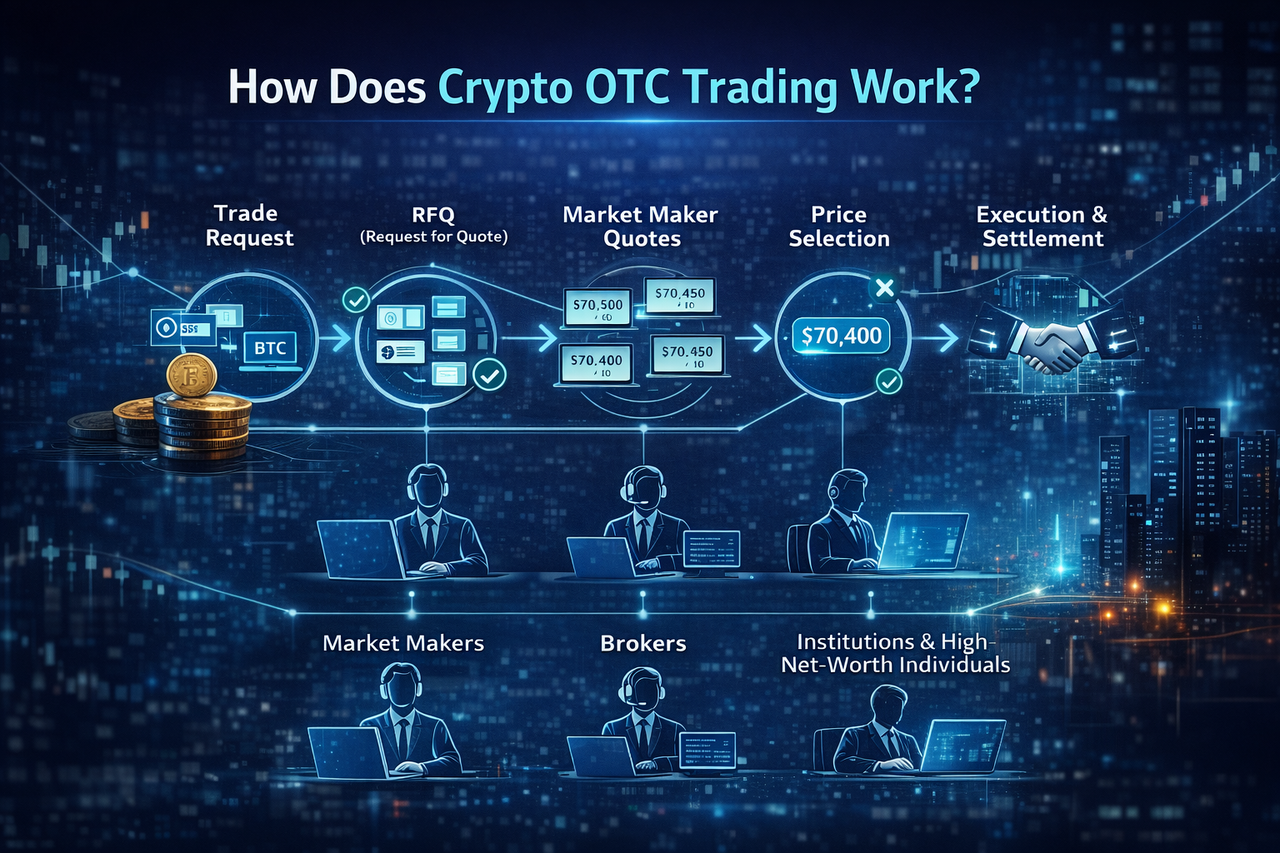
In practice, RFQ is typically the starting point of trade execution. Institutions send trade requests to multiple market makers or liquidity providers to receive competing quotes. This is not just a simple price inquiry, but a competitive pricing mechanism.
By collecting multiple quotes simultaneously, institutions can discover prices without revealing their market intent, thereby avoiding unnecessary impact on public markets. RFQ thus serves as the critical “entry point” for pricing in large trades.
Algo Trading: The Engine of Execution Optimization
If RFQ answers the question of where prices come from, algorithmic trading answers how to execute more effectively. In modern OTC systems, algorithmic trading is deeply embedded within the RFQ workflow.
Algorithms automatically distribute RFQ requests across multiple liquidity sources and analyze returned quotes within milliseconds. By evaluating factors such as price, depth, and response time, the system identifies the optimal execution path. It can also adapt dynamically to market conditions, continuously refining execution strategies.
RFQ + Algo Trading Execution Workflow
In institutional trading, these two components typically operate as an integrated system. The process begins with trade input, after which the system automatically generates RFQ requests and distributes them to multiple market makers.
Algorithms then filter and evaluate incoming quotes, combining them with real-time market data to make decisions. Once the optimal quote is identified, the trade is executed quickly and settled through custody or clearing systems.
The entire process is highly automated, delivering both execution quality and efficiency.
Core Technologies: Smart Routing and Liquidity Aggregation
Within this framework, Smart Order Routing and liquidity aggregation play essential roles. Because liquidity is fragmented, a single market maker often cannot provide the best price or sufficient depth. The system must dynamically select across multiple sources.
Liquidity aggregation allows institutions to access multiple quote streams simultaneously, while smart routing determines the optimal match among them. This mechanism is gradually transforming the OTC market from a “point-to-point” trading model into a networked liquidity system.
Differences from Traditional Execution Methods
Compared with traditional manual OTC trading, the biggest shift in RFQ + Algo Trading is automation and data-driven decision-making. Processes that once relied on manual negotiation and experience are now handled by systems, significantly reducing time costs and operational risk.
At the same time, this model improves execution consistency, enabling institutions to maintain stable performance across different market conditions.
Advantages and Potential Risks
The combination of RFQ and algorithmic trading provides a more efficient execution pathway for institutions. It enables large trades to be completed without disrupting market prices, while competitive quoting improves pricing outcomes.
However, this model is not without risks. It depends heavily on system stability, and technical failures can affect execution. There is still reliance on liquidity providers, and algorithmic models must be continuously refined to adapt to changing market conditions.
Use Cases
This execution model is primarily suited for large transaction scenarios, such as institutional asset allocation, fund rebalancing, and treasury management for projects. In these cases, trade size is large, and there is a strong need for price stability and execution certainty.
For high-frequency or small trades, traditional exchange matching mechanisms remain more efficient.
Conclusion
The integration of RFQ and algorithmic trading is redefining how large trades are executed in the crypto market. By separating and then recombining price discovery and execution optimization, this model improves efficiency while reducing market impact and slippage risk. As the market continues to evolve, this institutional-grade execution framework is set to become a core component of crypto financial infrastructure.
FAQs
Do RFQ and algorithmic trading have to be used together?
Not necessarily, but they are commonly combined in institutional trading to achieve better execution outcomes.
Is algorithmic trading fully automated?
In most cases, execution is automated, but human oversight and strategy adjustments are still required.
Why do institutions rely on this model?
Because it allows large trades to be executed without significantly impacting market prices.
Can retail traders use RFQ + Algo Trading?
In theory, yes, but the barriers to entry are high, and it is primarily designed for institutional users.
Will this model become mainstream in the future?
As the market matures and technology advances, its importance is expected to continue growing.