Unlocking Syndicate: Cutting-Edge Opportunities Made Simple for Beginners

Beginner
Quick Reads
Last Updated 2026-03-28 09:12:12
Reading Time: 1m
Get up to speed on Syndicate’s latest updates and price movements. This beginner’s guide offers a straightforward overview of the SYND launch, token distribution, and key market opportunities.

What Is Syndicate?


Image: https://syndicate.io/

Across the blockchain ecosystem, a growing number of projects advocate for “putting infrastructure in the hands of developers and the community.” Syndicate (SYND) exemplifies this approach by providing a scalable appchain architecture that gives developers greater control over network operations, sequencing, and economic models. In short, for those interested in the Web3 space, Syndicate stands as a notable case study in next-generation appchain innovation.

Latest Developments: Mainnet Launch and Token Issuance

Syndicate recently achieved a major milestone: the mainnet went live and the Token Generation Event (TGE) was completed. SYND tokens debuted at an initial price of about $1.86, with a fully diluted valuation (FDV) of around $1.86 billion. Roughly 92% of tokens were minted at genesis, while the remaining 8% will be released gradually over the next four years. This transition marks Syndicate’s shift from a conceptual project to live operations, signaling clear momentum in its development.

Current Price and Market Data Overview
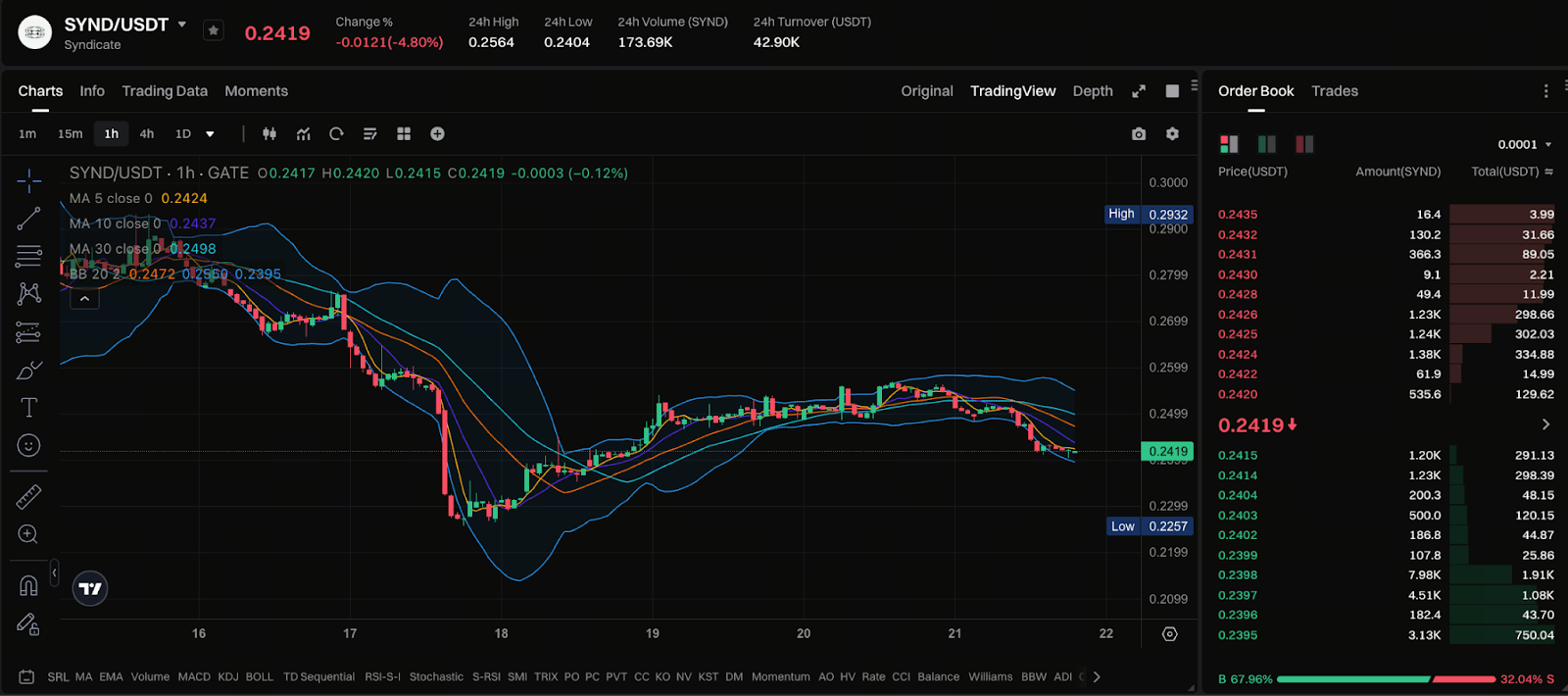

Image: https://www.gate.com/trade/SYND_USDT

Currently, SYND’s price is experiencing significant volatility, falling roughly 5% in the past 24 hours and over 30% in the past week. This pattern reflects an “early price discovery” phase. The current market price is around $0.24 per token, with factors such as token release schedules and ecosystem development speed playing key roles in short-term price movement.

For risk-averse investors—particularly newcomers—it’s essential to monitor Syndicate’s real-world ecosystem growth rather than chasing market hype.

Three Key Considerations for Beginners

  • Token release schedule: The majority of SYND tokens have already been minted, with the remainder unlocking over four years. Beginners should be mindful of potential sell pressure during these unlock periods.
  • Ecosystem and community growth: While Syndicate’s architecture is technically robust, sustained developer and community engagement is critical. Track real-world application and community activity for insight into long-term prospects.
  • Market environment impact: Broader crypto market trends, regulatory developments, and capital flows can all affect SYND’s price. Beginners should manage their positions carefully and diversify their investments.

Summary

Syndicate is an appchain project worth close attention, having successfully launched its mainnet and issued tokens. Despite sharp price fluctuations, it offers valuable research opportunities for newcomers interested in the future of Web3 infrastructure. If you’re considering Syndicate, start by studying its ecosystem architecture, monitoring community progress, and allocating capital cautiously. This article is for informational purposes only and does not constitute investment advice.

Author: Max
Disclaimer
* The information is not intended to be and does not constitute financial advice or any other recommendation of any sort offered or endorsed by Gate.
* This article may not be reproduced, transmitted or copied without referencing Gate. Contravention is an infringement of Copyright Act and may be subject to legal action.

Related Articles

Gold Price Forecast for the Next Five Years: 2026–2030 Trend Outlook and Investment Implications, Could It Reach $6,000?
Beginner

Gold Price Forecast for the Next Five Years: 2026–2030 Trend Outlook and Investment Implications, Could It Reach $6,000?

Analyze current gold price trends alongside authoritative five-year forecasts, integrating an evaluation of market risks and opportunities. This gives investors insight into the potential trajectory of gold prices and the main drivers expected to shape the market over the next five years.
2026-03-25 18:13:30
AI-Native Settlement Layers: How United Stables Is Building the Next Financial Rail
Beginner

AI-Native Settlement Layers: How United Stables Is Building the Next Financial Rail

Stablecoins were originally designed as dollar substitutes within exchanges, primarily used for asset pricing and trade settlement. As on-chain financial ecosystems have matured, their role has expanded beyond simple payments to include collateral assets, cross-chain liquidity mediums, and unified settlement units. In particular, as AI systems and automated agents begin to participate directly in economic activity, demand has risen sharply for programmable value units capable of instant settlement. This shift is pushing stablecoins toward the role of foundational financial infrastructure.
2026-03-25 03:16:17
Aster vs Hyperliquid: Which Perp DEX Will Prevail?
Beginner

Aster vs Hyperliquid: Which Perp DEX Will Prevail?

Aster and Hyperliquid are the two representative protocols of the "purpose-built L1 path" within the current decentralized perpetual exchange (Perp DEX) sector. As a pioneer in the field, Hyperliquid has built a deep liquidity moat through its highly mature order book architecture and strong community consensus. Conversely, Aster, as a rising challenger, seeks to leapfrog the competition in high-performance trading through more aggressive multi-chain aggregation logic, private transaction modules, and an underlying execution environment optimized for 2026 market demands.
2026-03-24 11:58:33
DePIN Identity Network and Real World Applications: How Humanity Protocol Brings on-chain Identity Into the Physical World
Beginner

DePIN Identity Network and Real World Applications: How Humanity Protocol Brings on-chain Identity Into the Physical World

Most Web3 identity systems remain confined to on-chain environments and struggle to achieve meaningful adoption in real world settings. Through a DePIN architecture and physical verification hardware, Humanity Protocol aims to bring decentralized identity into access control systems, hospitality, public services, and offline events, allowing on-chain identity to function not just as a digital credential, but as foundational infrastructure for real world access.
2026-03-25 07:40:53
Aerodrome Tokenomics: How ve(3,3) Powers Base's Most Profitable DEX
Beginner

Aerodrome Tokenomics: How ve(3,3) Powers Base's Most Profitable DEX

AERO is the native token of Aerodrome Finance, a core decentralized exchange and liquidity protocol in the Base ecosystem. It is primarily used for liquidity incentives and ecosystem operations. veAERO is a governance NFT that users receive by locking AERO, representing both voting power and the right to share protocol revenue. Through a dual track structure of AERO as a utility token and veAERO as a governance credential, Aerodrome separates liquidity usage value from long term governance power, allowing participants to act as liquidity providers, governance decision makers, and revenue sharers within the same system.
2026-03-25 06:40:31
How Does Kite Work? An In-Depth Look at Kite's Identity and Programmable Permission Architecture
Beginner

How Does Kite Work? An In-Depth Look at Kite's Identity and Programmable Permission Architecture

Kite is an EVM compatible Layer 1 blockchain network that runs on proof of stake. It is designed to give AI agents verifiable identity, programmable permissions, and real time settlement in an on-chain execution environment. In Kite's design, AI is no longer only a tool that follows instructions. It becomes an economic participant with independent on-chain identity and direct control over assets. Within secure and auditable infrastructure, an AI agent can complete payments, call services, and coordinate tasks autonomously, making Kite a foundational layer for the emerging agent economy.
2026-03-25 06:02:34