Sponsored Content. Hands-on Review by Bitcoin.com.
WhiteBIT Coin (WBT) sits at the core of one of Europe’s largest cryptocurrency exchanges – but it has grown beyond the typical exchange token model.
Launched in August 2022 at approximately $1.90, WBT later traded above $60 during its 2025 expansion phase, marking a significant period of price appreciation as the WhiteBIT ecosystem broadened through partnerships, product development, and geographic expansion. Over the same period, broader crypto market movements, including Bitcoin, provide useful context for evaluating WBT’s price trajectory within the broader digital asset landscape.
Since launch, WBT has evolved into the native asset of Whitechain, WhiteBIT’s proprietary blockchain network. It now supports trading incentives, ecosystem rewards, structured token burns, and broader infrastructure expansion. That progression makes WBT more layered than a simple fee-discount token.
This hands-on review examines how those layers connect – from token supply mechanics to user-level utility, network design, expansion milestones, and the practical considerations investors and platform users should keep in mind.
A Utility Token First, a Blockchain Asset by Extension
WBT is fundamentally a platform-integrated utility asset. It began as a centralized exchange token and now functions as the base coin of Whitechain, while remaining deeply embedded in the WhiteBIT ecosystem.
The token operates across Ethereum ( ERC20), Tron (TRC20), and Whitechain. That multi-network structure enables interoperability while gradually concentrating activity within Whitechain itself.
The key framing is straightforward: WBT’s strongest value proposition lies in active participation within WhiteBIT. For traders and ecosystem users, it can reduce costs and unlock platform features. For passive holders with no engagement, much of its functional utility becomes secondary.
Tokenomics: Fixed Supply With Structured Unlocks
WBT has a maximum supply of 400 million tokens, with no intention to mint beyond that cap. The original allocation included private sale tokens, launchpad tokens, ecosystem and operational funds, and a substantial treasury reserve.
The treasury allocation of 200 million tokens follows a staged unlock schedule over several years. Rather than entering circulation at once, these tokens are released in rounds, including a tranche of approximately 81.5 million tokens tied to a March 2026 unlock window.
Two dynamics run in parallel:
- A capped long-term supply ceiling.
- Structured unlocks that can influence circulating supply over time.
The market impact of these releases depends on how tokens are deployed – whether for ecosystem development, liquidity, partnerships, or other operational purposes – and how demand evolves alongside that supply.
Burn Mechanics: Revenue-Linked and Recurring
One of WBT’s more distinctive structural features is its buyback-and-burn program. WhiteBIT states that it conducts weekly burns funded by a portion of exchange-generated revenue – specifically, 33% of trading fees (spot, margin, futures) and 5% of other exchange income, such as withdrawal and AML-related fees.
The long-term objective is to burn at least half of the total token supply.
Recently published burn entries show a consistent cadence, often weekly, with burn sizes reflecting business activity. This design links token supply reduction to exchange performance.
However, the company reserves the right to adjust the burn amount and frequency. The program is structured and recurring, but it remains a company-managed policy rather than an immutable on-chain rule.
Utility: Owning vs Holding
WBT’s practical value is divided into two mechanisms: Owning and Holding.
Owning refers to keeping WBT on the main balance, primarily unlocking trading fee discounts that scale with the amount held.
Holding involves locking WBT on the platform to access broader benefits, which may include:
- Enhanced referral rewards
- Maker-fee discounts
- Free daily ETH and ERC20 withdrawals
- Free daily AML checks
- Participation in SoulDrop reward distribution
- Bonuses on certain USDT lending plans
- Multiple deposit address generation
- Access to WhiteBIT Launchpad (subject to minimum thresholds)
For active traders, fee reductions alone can materially impact operating costs. For compliance-sensitive users, AML tools and withdrawal allowances can also provide practical value.
However, these benefits are platform-defined and subject to change. WBT’s utility is strongest when paired with ongoing participation in the ecosystem.
SoulDrop and Internal Rewards
SoulDrop is WhiteBIT’s rewards distribution mechanism built around WBT Holding levels. Rewards are calculated over fixed 30-day periods and vary by the user’s Holding tier. Higher tiers correspond to higher reward percentages within the system’s defined parameters.
Funding sources include network transaction commissions on Whitechain and designated ecosystem allocations. The structure positions SoulDrop as a loyalty and participation incentive within the WhiteBIT environment rather than a traditional staking yield derived from external network validation.
Participation typically requires meeting Holding thresholds and completing identity verification steps. As with other platform incentives, parameters may evolve over time.
Whitechain Architecture: Performance by Design
Whitechain uses a Proof-of-Authority (PoA) consensus model. In this structure, a defined group of authorized validators produces blocks and validates transactions. In Whitechain’s case, validators are authorized nodes associated with WhiteBIT.
PoA prioritizes speed, predictable throughput, and operational efficiency. It reflects a governance structure centered on performance and coordinated control rather than open validator competition.
Whitechain also employs a burn-and-mint process when migrating WBT between Ethereum, Tron, and Whitechain. Issuance on Whitechain corresponds to verifiable burns on other networks, with manual verification processes in place. This design emphasizes supply integrity while reinforcing WhiteBIT’s operational role in maintaining the network.
For some users, this controlled architecture enhances reliability. For others prioritizing maximum decentralization, it represents a tradeoff.
Expansion Milestones and Market Visibility
Market visibility for WBT has expanded alongside several high-profile company initiatives.
The token’s price history reflects several distinct phases since launch. After trading in the single-digit range through much of 2023, WBT gradually moved higher during early to mid-2024. The most pronounced phase of price acceleration began in October 2024, when the token broke out sharply and established a higher trading range that carried through 2025, culminating in a peak near $64.43 by December 2025. This period aligned with a series of expansion announcements and ecosystem developments.
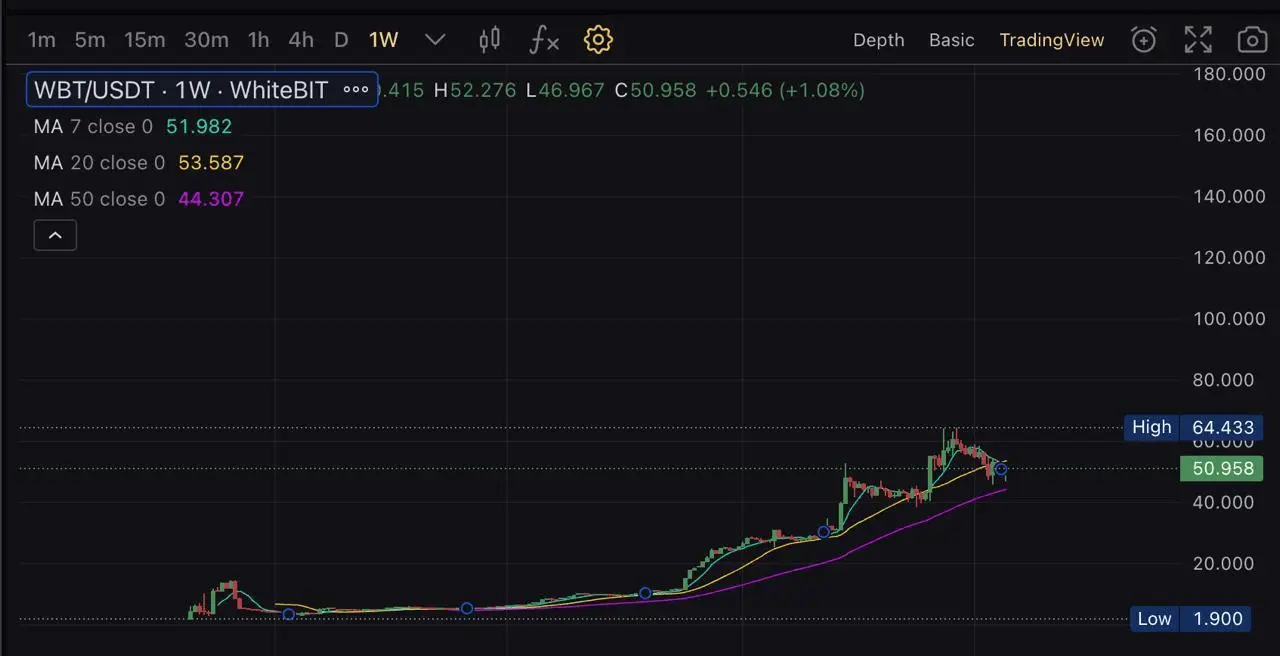
WBT/ USDT price since launch (Source: TradingView)
WhiteBIT announced major partnerships, including a multi-year agreement with Juventus FC. It also highlighted strategic cooperation initiatives in Saudi Arabia aligned with Vision 2030 ambitions. In late 2025, WhiteBIT launched WhiteBIT US as a New York-based entity, signaling a push into the American market.
Additionally, WBT’s inclusion in multiple S&P cryptocurrency indices increased its institutional visibility and benchmark presence.
Kraken has listed WBT on its platform, with trading commencing on March 5, 2026. This listing extends WBT’s reach beyond the WhiteBIT ecosystem, offering broader access to global market participants.
Alongside partnerships, WhiteBIT emphasized product development, including growth in Nova debit card usage, expansion of its Whitepool mining infrastructure, the introduction of portfolio margin for institutional users, hedge-mode functionality for futures trading, and infrastructure capable of handling high operational throughput.
These developments provide context for WBT’s 2025 growth cycle. While past price performance does not determine future outcomes, ecosystem expansion and increased visibility coincided with heightened market attention around the token.
Closing Perspective
WhiteBIT Coin is not positioned as a neutral base-layer cryptocurrency competing solely on decentralization. It is an ecosystem token designed to integrate utility, incentives, and revenue-linked supply mechanics within the WhiteBIT platform.
For active WhiteBIT users, WBT can operate as a cost-management tool, access layer, and participation mechanism. For broader market participants, it represents exposure to the growth trajectory, governance model, and supply strategy of a centralized exchange expanding into its own blockchain infrastructure.
WBT’s long-term strength ultimately depends on sustained platform usage, disciplined supply management, and the continued alignment between token incentives and ecosystem growth.
WhiteBIT Coin: https://bit.ly/4udWpAM
WhiteBIT: https://bit.ly/40SSziR
_________________________________________________________________________
Bitcoin.com accepts no responsibility or liability, and shall not be liable, whether directly or indirectly, for any loss, damage, claim, cost, or expense of any kind, whether actual, alleged, or consequential, arising out of or in connection with the use of, or reliance upon, any content, goods, or services referenced in this article. Any reliance placed on such information is strictly at the reader’s own risk.


