Circle Internet Group’s stock has reentered the market’s spotlight this month, and the reaction from traders has been swift.
Stablecoin Economics Sends Circle Stock Soaring
Shares of Circle Internet Group Inc. (NYSE: CRCL)—the company behind the USDC stablecoin—have more than doubled in the past month, trading around $120 to $124 in this week and jumping roughly 7% to 8% during today’s sessions. That kind of move usually requires either a miracle, a mania, or a spreadsheet that made analysts spit out their coffee. In this case, it appears to be the spreadsheet.
The spark came Feb. 25 when Circle reported fourth-quarter and full-year 2025 earnings that beat Wall Street expectations. The market responded the way a reality show judge reacts to a surprise audition: loud, dramatic and slightly over the top. Shares leapt about 30% to 35% in a single session—Circle’s biggest daily jump since its 2025 IPO—and the momentum hasn’t exactly cooled since.
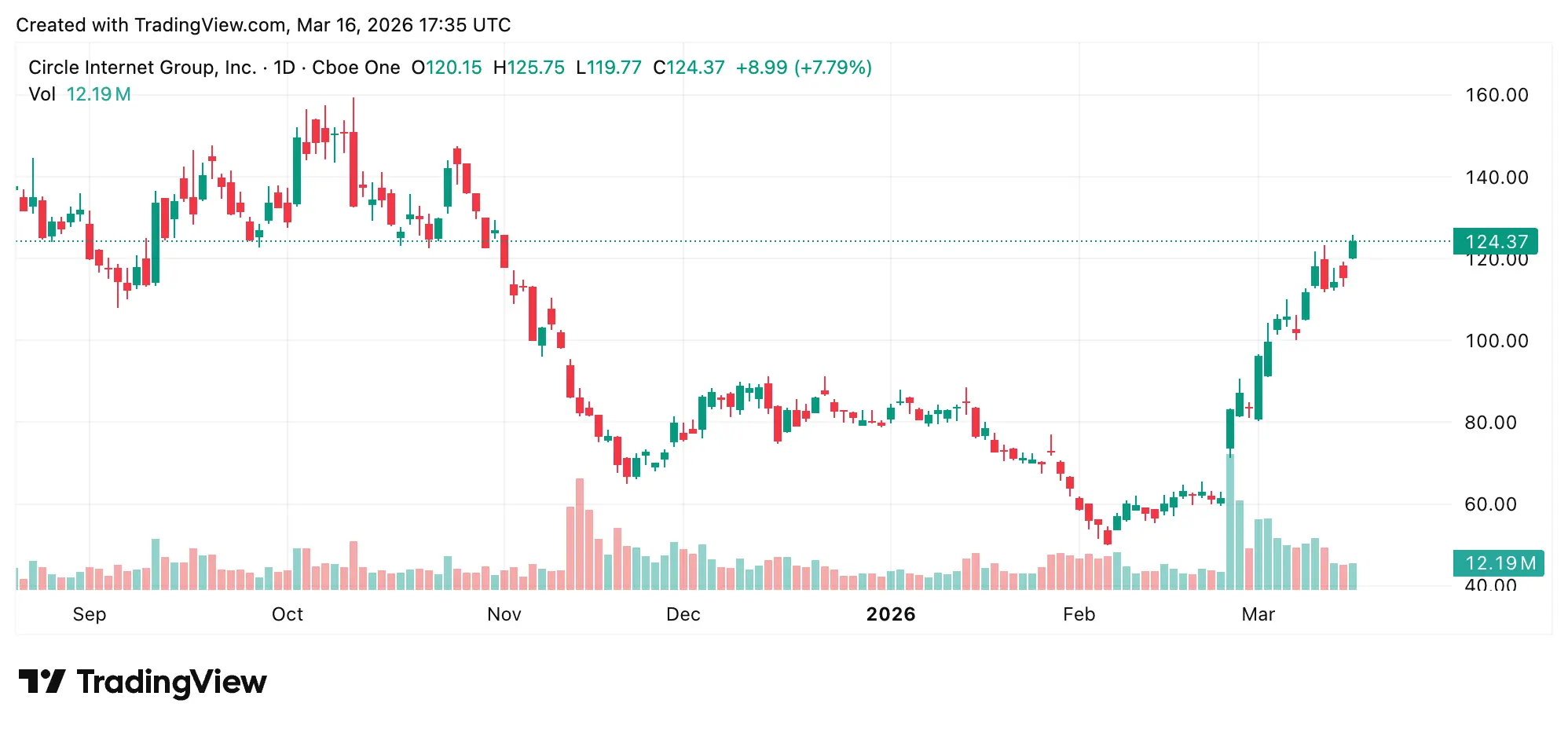 Circle shares on Monday, March 16, 2026. Image source: Tradingview.
Behind the rally is the growing use of USDC, a dollar-pegged stablecoin circulating across more than 30 blockchains. By the end of 2025, USDC circulation reached $75.3 billion, up 72% from a year earlier, while average circulation rose 100%. In other words, a lot more digital dollars are sloshing around than they were a year ago.
Circle shares on Monday, March 16, 2026. Image source: Tradingview.
Behind the rally is the growing use of USDC, a dollar-pegged stablecoin circulating across more than 30 blockchains. By the end of 2025, USDC circulation reached $75.3 billion, up 72% from a year earlier, while average circulation rose 100%. In other words, a lot more digital dollars are sloshing around than they were a year ago.
Transaction activity told a similar story. USDC processed about $11.9 trillion in onchain transaction volume in the fourth quarter alone, a 247% increase year over year. Those numbers suggest stablecoins are being used for far more than speculative trading—think payments, treasury management and settlement rails quietly doing the financial system’s backstage work.
Circle’s revenue followed the money. The company reported $770 million in total revenue and reserve income for the quarter, up 77% from the prior year and ahead of Wall Street estimates near $739 million. Most of that—$733 million—came from income generated by reserves backing USDC.
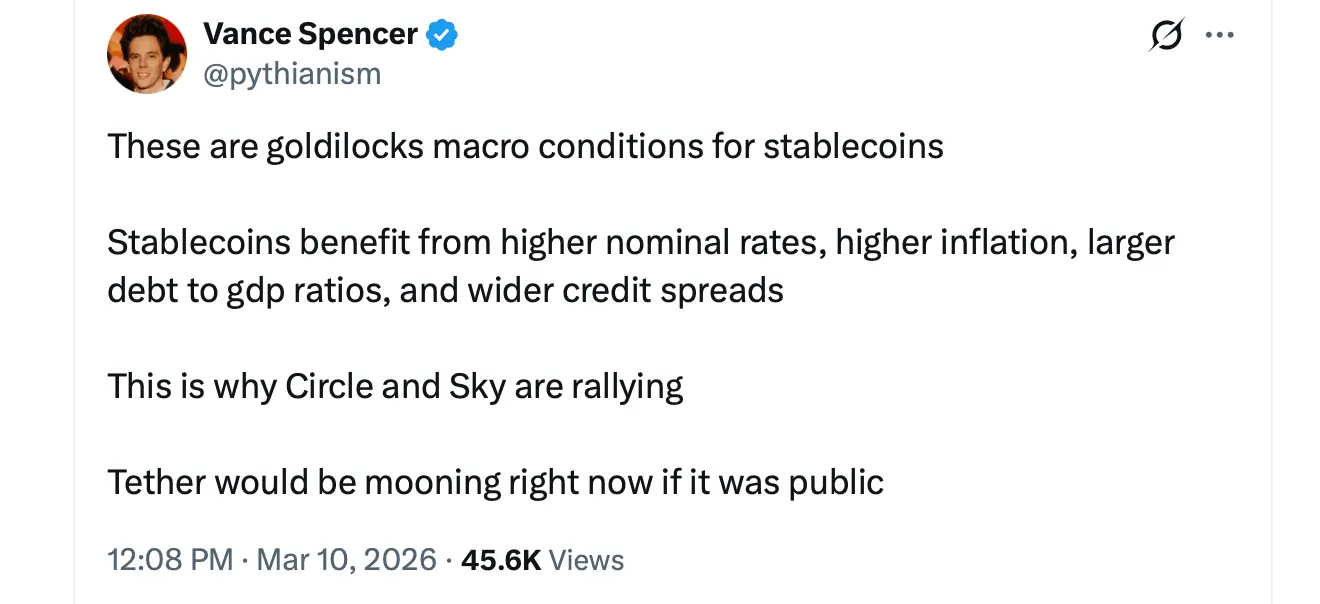 Image source: X
Net income from continuing operations reached $133 million, while adjusted EBITDA climbed to $167 million, up more than fourfold from a year earlier. Earnings per share attributable to common shareholders came in at $0.56 basic and $0.43 diluted, compared with essentially nothing the year before.
Image source: X
Net income from continuing operations reached $133 million, while adjusted EBITDA climbed to $167 million, up more than fourfold from a year earlier. Earnings per share attributable to common shareholders came in at $0.56 basic and $0.43 diluted, compared with essentially nothing the year before.
For context, Circle’s stock history reads like a dramatic three-act play. The company went public June 5, 2025, pricing shares at $31 and opening near $69 before closing its debut day around $83. The stock briefly touched nearly $299 during its early post-IPO excitement before tumbling toward roughly $50 earlier this year. Now it’s staging a comeback that would make a washed-up rock band proud.
Some say part of the explanation is macroeconomics doing what macroeconomics does best—messing with expectations. Stablecoin issuers generate significant income from interest on the Treasury securities and cash reserves backing their tokens. When interest rates stay higher for longer, those reserves throw off more income.
Meanwhile, stablecoins are quietly evolving into financial infrastructure rather than a crypto sideshow. USDC is used in payment systems, prediction markets, tokenized asset trading and enterprise settlement networks. The company also reported growth in active wallets, which climbed 59% to 6.8 million.
Wall Street analysts have noticed. Several firms have lifted price targets or upgraded the stock in recent weeks, citing stablecoin growth, tokenization trends and broader adoption of blockchain payment rails. A short squeeze—where bearish traders rush to cover positions as prices rise—has likely added fuel to the move.
None of this means the story is risk-free. Circle’s revenue model is sensitive to interest rates; if yields fall sharply, the income from reserves shrinks. The company also shares a substantial portion of that reserve income with partners, including Coinbase, which historically receives about 56%.
Competition is another obvious factor. Tether’s USDT still dominates the stablecoin market by circulation, and new entrants—from banks to fintech firms—are exploring their own dollar-pegged tokens as regulators gradually outline clearer rules for the sector.
Then there’s the valuation debate. When a stock doubles in a month, skeptics inevitably arrive with calculators and raised eyebrows.
Still, one thing is clear: stablecoins are no longer just a crypto curiosity whispered about on trading desks. They’re increasingly part of the financial system’s plumbing—and for the moment, investors seem perfectly happy to bet on the company selling the pipes.
FAQ 🔎
- **Why is Circle’s stock rising in 2026?**Circle’s shares jumped after earnings showed strong growth in USDC circulation, transaction volume and reserve-income revenue.
- **What does Circle actually do?**Circle issues the USDC stablecoin and earns income primarily from interest on the reserves backing that digital dollar.
- **How big is the USDC stablecoin market share?**USDC represents roughly a quarter of the global stablecoin market, trailing only Tether’s USDT.
- **Why do interest rates matter for Circle’s business?**Higher interest rates increase the yield on Treasury reserves backing USDC, which boosts Circle’s primary revenue stream.
Disclaimer: The information on this page may come from third parties and does not represent the views or opinions of Gate. The content displayed on this page is for reference only and does not constitute any financial, investment, or legal advice. Gate does not guarantee the accuracy or completeness of the information and shall not be liable for any losses arising from the use of this information. Virtual asset investments carry high risks and are subject to significant price volatility. You may lose all of your invested principal. Please fully understand the relevant risks and make prudent decisions based on your own financial situation and risk tolerance. For details, please refer to
Disclaimer.


