FOMO is sweeping the entire crypto industry. From exchanges to security firms, companies are rushing to launch AI-driven services. This article is based on a report from Tiger Research, providing an in-depth look at the logic behind their current market entry, compiled and written by Dynamic Zone.
(Background recap: NVIDIA GTC2026 full coverage: AI demand reaches trillions of dollars, computing power jumps 350 times, OpenClaw turns every company into AaaS)
(Additional background: Strategy’s holdings turn profitable, unrealized gains of $120 million, Saylor: BTC is the biggest beneficiary of the AI era)
Table of Contents
Toggle
- Key Highlights
-
- Crypto companies are rolling out AI services across the board
-
- How crypto firms are embracing AI
- 2.1. Research & Analysis
- 2.2. Trading
- 2.3. Security / Auditing
- 2.4. Payment Infrastructure
-
- Why crypto companies are entering AI now
Key Highlights
- Exchanges, security, payments, and research firms are simultaneously deploying AI service strategies
- Unlike previous cycles, this time leading players like Coinbase and Binance—already with stable revenue—are taking the lead—AI has shifted from a narrative theme to a real operational need
- Motivations across sectors vary: exchanges focus on preventing user churn; security firms aim to fill audit blind spots; payment infrastructure targets the emerging smart agent economy
- Having a feature is different from actually using it—AI FOMO and competitive pressure are pushing adoption beyond actual demand
- Genuine needs coexist with competitive anxiety—distinguishing “value-creating adoption” from “listing-driven adoption” is the key
1. Crypto companies are rolling out AI services across the board
AI is currently the most watched sector in the global market. General tools like ChatGPT and Claude have long integrated into daily life, while platforms like OpenClaw further lower the technical barriers to building AI agents.
Though the crypto industry was a bit slow, it is now actively integrating AI into every vertical.
What specific AI services are these companies offering? And why are they entering at this moment?
2. How crypto firms are embracing AI
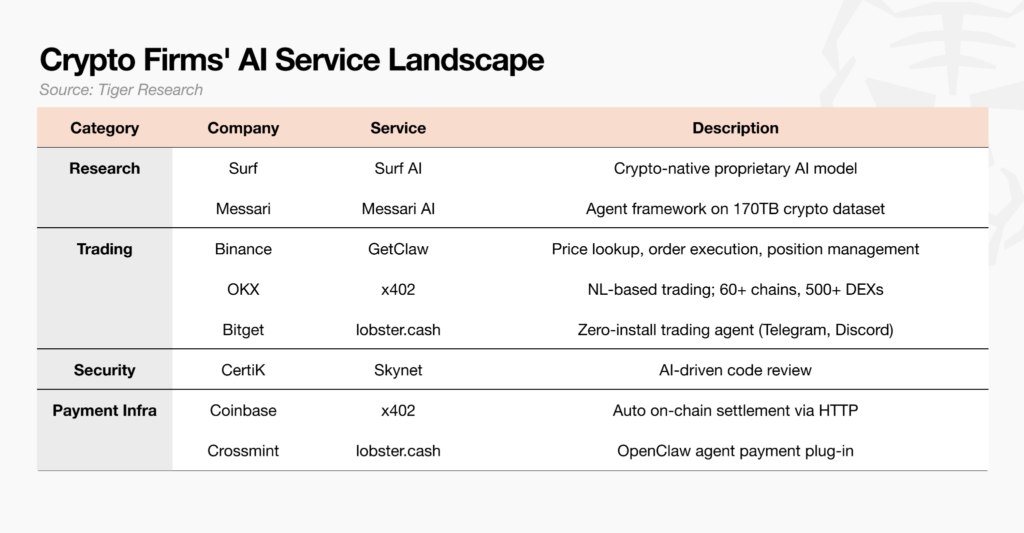
2.1. Research & Analysis
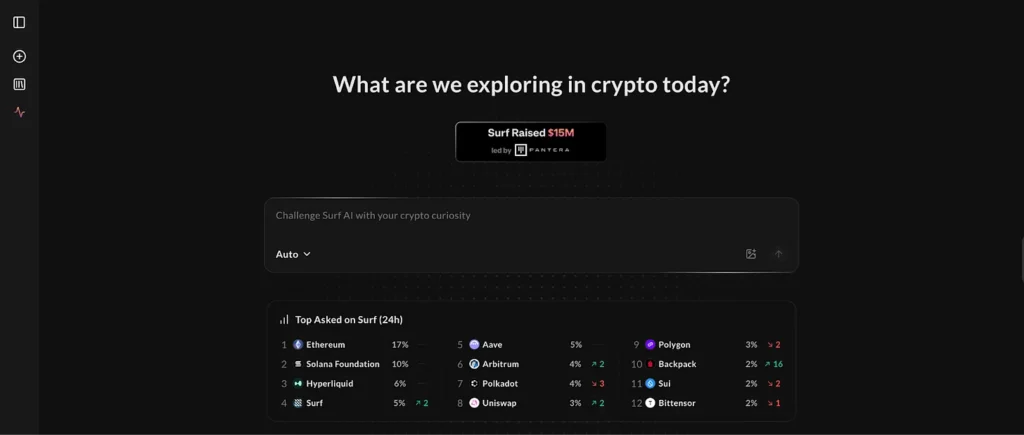
A structural pain point in crypto research is the dispersion of on-chain data, community sentiment, and key metrics across various platforms, making verification extremely difficult. Meanwhile, general AI models still have high error rates when handling crypto-related queries.
Projects like Surf are attempting to solve this by integrating scattered data sources to create crypto-specific AI research tools. Among all AI applications, research analysis has the lowest barrier—no coding or trading experience required.
2.2. Trading

Exchanges are leading the way in applying AI to trading.
Their approaches vary: some directly provide users with access to their own trading data; others enable users to command AI agents via natural language, completing the entire process from analysis to execution in one go.
APIs are no longer new; exchanges have offered them for years. The real innovation now is adding an interface layer: MCP and AI Skills allow non-technical users to call exchange functions through AI agents, making tools once only accessible to developers available via natural language.
This aligns closely with shifts happening on the community side. More non-developers are building automated trading strategies through AI agents—no coding needed—simply describing a strategy, and the agent builds and runs the algorithm.
For exchanges, this is both an opportunity and a threat. As AI-enabled user groups grow, platform stickiness may decline because agents can execute trades anywhere. The core logic for exchanges embracing AI is straightforward: attract users quickly and keep them on their platform.
Trading involves real assets and demands higher judgment and responsibility than research. But as barriers lower, this domain is opening up to ordinary users.
2.3. Security / Auditing

Long reliant on manual, line-by-line review, smart contract auditing is time-consuming, costly, and inconsistent across auditors. Now, AI is embedded throughout the workflow: it scans code first, then human auditors perform targeted deep reviews, improving speed and coverage without replacing human oversight.
CertiK is a prime example. Previously criticized for audits that missed post-attack vulnerabilities—those incidents occurred outside the audit scope. Auditing is essentially static code review at a point in time, not continuous monitoring.
CertiK has used AI to fill this gap: importing real-time monitoring post-audit and publicly displaying dashboards. Since expanded coverage is driven by AI rather than manpower, both CertiK and audited projects benefit.
In cybersecurity, AI’s role isn’t to overhaul existing services but to extend human capabilities: improve audit precision in real-time and cover blind spots after audits. For blockchain security firms, AI is a tool to patch existing weaknesses, not a new business line.
2.4. Payment Infrastructure
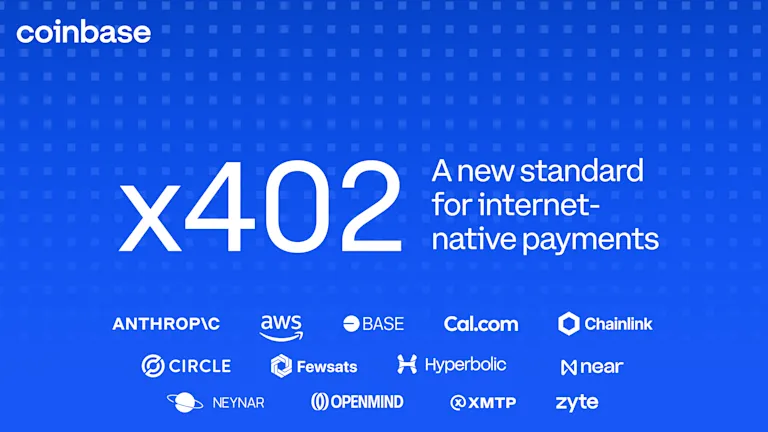
For AI agents to participate in economic activities, they need corresponding payment channels—API fees, data purchases, procurement of services from other agents. The most natural payment method is a stablecoin-linked on-chain wallet.
Two models are emerging: one embeds payments into HTTP requests, enabling automatic on-chain settlement when agents access paid APIs; the other involves dedicated payment plugins for agents, allowing payments only within pre-set permissions and limits.
Payment infrastructure is most closely related to stablecoins. But since the payers are AI agents rather than humans, no fully commercialized model has yet materialized.
USDC issuer Circle is also gaining attention. The company released a proposal exploring integration of its Gateway payment infrastructure with the x402 protocol, inviting developers and researchers to participate and contribute.
While the market is still immature, funding has begun to price in this narrative. One of the key drivers behind Circle’s stock rise is the AI agent payment storyline. The timeline for payment infrastructure implementation will be longer than other sectors, but it has already established itself as one of the most prominent macro themes in the current market.
3. Why crypto companies are entering AI now
When ChatGPT launched in November 2022, both AI and crypto were unprepared. AI models, though impressive, couldn’t reliably perform tasks; the crypto market was mired in a trust crisis following the FTX collapse.
Since then, AI has advanced rapidly. Over the past year, all mainstream models have significantly improved in capability and practicality. In contrast, the crypto industry has only “borrowed” AI—meme coins themed around AI, incomplete AI agents, rampant marketing hype. Decentralized AI infrastructure projects have proliferated, but objectively, quality varies widely compared to native AI services.
The gap continues to widen. On the AI side, foundational tools like MCP (enabling agents to call external tools directly) and OpenClaw (making no-code agent building possible) have made the agent era tangible. Crypto firms are only now starting to move.
What’s different this time is who is moving—not new startups just slapping AI labels on their products, but established players with mature revenue models: Coinbase, Binance, Bitget. They have no reason to treat AI services as marketing gimmicks. Their motivation isn’t current revenue but fear of falling behind—FOMO.
This urgency is evident in Coinbase CEO Brian Armstrong’s actions: he issued a company-wide mandate for all engineers to integrate AI programming tools within a week, or face termination.
But calm assessment is also necessary. Take automated trading—agents can check prices and suggest strategies, but how many users truly dare to let their agents trade with real money? Has x402 been practically deployed in the real world?
Ultimately, embracing AI in crypto isn’t about chasing trends. The AI era is already visible; firms are moving to avoid being left behind. Having a feature and actually using it are still different, but who is taking action—and how—is the real question.
Imagine the AI industry as a swimming pool filling with water. The earliest entrants can’t swim—they’re just pretending. Now, the ones jumping in are top surfers who once represented their country. No one knows how high the water will rise or if the pool will turn into an ocean. But the crypto industry won’t drown in this water.