Author: Cooper Duschang Source: CoinMetrics Translation: Shan Ouba, Jinse Finance
Key Points
-
Transactions are influenced by multiple external parties before execution, creating the maximum extractable value (MEV) opportunity.
-
Block building is a highly competitive market; transaction flow and transaction ordering are key to gaining and maintaining market share.
-
Transaction ordering is crucial for both traders and block builders, as both rely on it to maximize value.
Introduction
Transactions on public blockchains like Ethereum are first packaged into blocks and then added to the chain by validators. During this process, a transaction must go through multiple steps and roles before final confirmation, usually first entering a public pending queue called the mempool.
Because the mempool is public, competing transactions and professional bots can pay higher fees to gain priority within the block. Block builders arrange transaction order based on these fees and capture the maximum extractable value (MEV) opportunities.
MEV refers to the additional value gained through reordering, including, or excluding transactions within a block, similar to high-frequency traders using order flow information and adjusting their strategies based on pending transactions to profit.
This article focuses on key aspects of the transaction process: who constructs blocks on Ethereum, how transactions are ordered, and some challenges faced when using the mempool system.
MEV Supply Chain
This section introduces the core intermediary roles affecting the transaction lifecycle and how they create MEV opportunities.
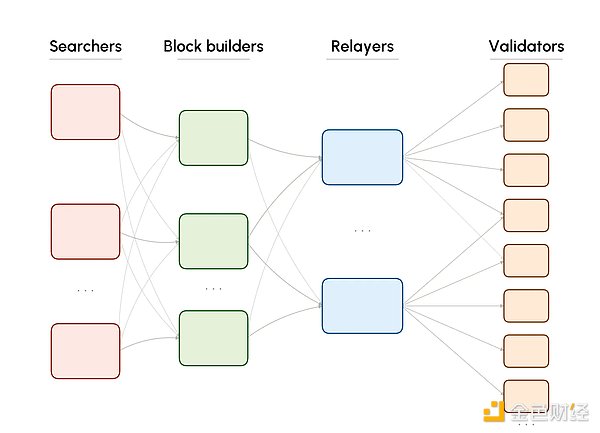
Participants in the Ethereum MEV ecosystem
The MEV chain begins with searchers. Searchers scan DeFi protocols and public transactions to find profitable MEV opportunities. Not all MEV is malicious: some are arbitrage bots maintaining tight trading spreads and asset pegs; others employ more harmful strategies, such as sandwich attacks on decentralized exchanges.
Searchers bundle original transactions with their own transactions into “bundles” and send them to block builders, ensuring transactions are executed in a specified order.
Block builders aggregate transactions from the public mempool, private order flows, and searcher bundles to assemble blocks. Different builders receive different MEV bundles, so the total fee and included transactions vary, directly affecting their bidding power in the auction to get their block included on-chain. Builders submit bids through relayers, who coordinate with validators. Builders need to share part of the block’s value with these participants to increase their chances of having their block selected.
Validators / Block proposers are the final decision-makers on which block gets added to the chain. Each round of block proposal selects a validator as the proposer, usually choosing the block with the highest bid among the builder submissions. The proposer rotation mechanism prevents a small number of nodes from controlling too much network activity; too few block proposers increase the risk of censorship, while too many can strain network connectivity and overall performance.
Sandwich Attack Example
A sandwich attack occurs when a user’s target transaction is sandwiched between a malicious front-run transaction and a back-run transaction. Bots front-run the target to interfere with its execution, often not holding the affected tokens afterward, then back-run to exit at a better price, profiting from the price difference.
In Ethereum block #24,650,612, a transaction was subjected to a sandwich attack, allowing the bot to profit while the user received a worse exchange rate.
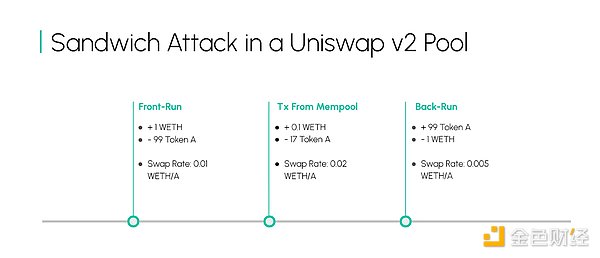
- User initiates a WETH to Token A swap, which enters the mempool and waits 10 seconds.
- Searchers detect that this transaction will impact the Uniswap V2 pool and can front-run to change the exchange rate.
- The bot submits a larger WETH to A swap (front-run).
- The front-run executes first, causing imbalance in the pool, so the user gets less A for more WETH.
- The bot then submits a back-run transaction to swap A back to WETH and realize profit.
Block builders execute these transactions in the order requested by the searchers because the searchers paid higher priority fees, increasing the total block value and enabling builders to bid higher in auctions, thus increasing the likelihood of their block being validated.
Who Are the Block Builders?
Ethereum’s block building follows the proposer - builder separation (PBS) model: builders use a 12-second block time to optimize transaction ordering and extract value through fees. Every 12 seconds, an auction occurs where builders transfer part of the block’s value to the leading validator; the highest bidder wins, and the validator publishes their block, while the builder receives the remaining fees.
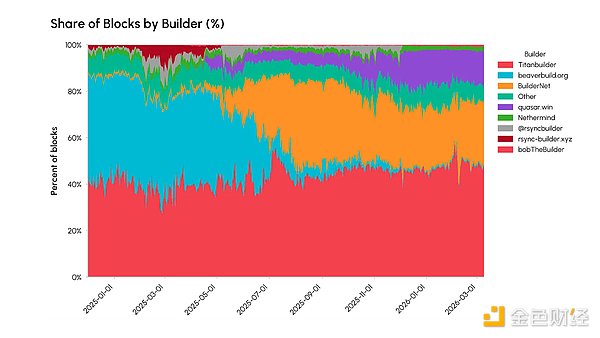
Currently, block building is concentrated among a few entities, posing a risk of centralization. The two largest builders by market share are:
-
Titan Builder: 47.6%
-
BuilderNet: 26.0%
BuilderNet aims to decentralize by sharing the received transactions with underlying builder groups. It does not compete for transaction flow but instead optimizes ordering algorithms and provides a neutral execution environment.
How Much Do Block Builders Pay Validators?
The value within a block directly influences the builder’s bid in the auction. Builders with high-value transactions can bid more to validators to win the block, creating a flywheel effect: the more often a builder wins block proposals, the more users prefer to send transactions directly to it, further centralizing transaction selection.
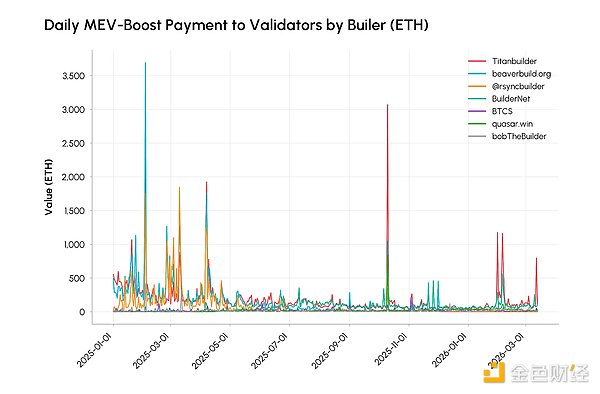
Auctions are conducted via MEV-Boost: relayers share block bids with validators, who select the winning block and broadcast it to the network.
Beaverbuild and Titanbuilder were once the two largest Ethereum builders, holding the most valuable order flows and thus able to pay validators more ETH to win block proposals. Later, Beaverbuild partnered with BuilderNet to share transaction flow, causing a significant drop in their MEV-Boost value.
Overall, validator daily earnings have declined, reflecting network optimization efforts. By 2026, only BuilderNet and Titanbuilder will have daily MEV-Boost values exceeding 500 ETH. The industry is pushing for private transaction submissions or skipping mempool to reduce malicious MEV; meanwhile, the proliferation of Layer 2 solutions and competing chains also impacts transaction volume on Ethereum.
How Do Incentives Affect Block Packaging?
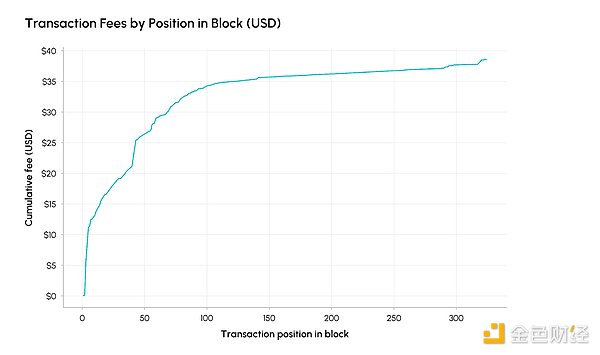
Transaction ordering within a block not only affects execution sequence but also determines the block’s value. The ordering algorithm considers factors such as network fees, priority fees, transaction size, and value to other participants.
In block #24,120,201, over half of the total block value (network fee + priority fee) was concentrated in the top 44 transactions (only 12.5% of all transactions). This vividly illustrates the builder’s incentive logic: to include high-value transactions to win the block auction. When adding subsequent transactions, resource constraints and order flow considerations come into play.
Conclusion
Ethereum’s unique transaction execution mechanism—with a target block time of 12 seconds—provides builders with time to optimize blocks and bid to validators, while also giving searchers opportunities to capture MEV.
Block builders are strongly motivated to include MEV transactions because they increase block value. However, factors such as transaction flow, block size limits, computational constraints, and bid speed collectively restrict builders from executing transactions in an ideal order and controlling the entire transaction supply chain.


