
Ethereum Liquidity Staking Protocol Lido Releases 2025 Annual Report, Revealing Total Revenue Drop to $40.5 Million, Down 23% from $52.4 Million in 2024. The report states that the revenue decline is mainly driven by two structural factors: net staking fund outflows (users actively withdrawing assets) and the continuous compression of the network-wide annual percentage rate (APR).
Dual Causes of Revenue Decline
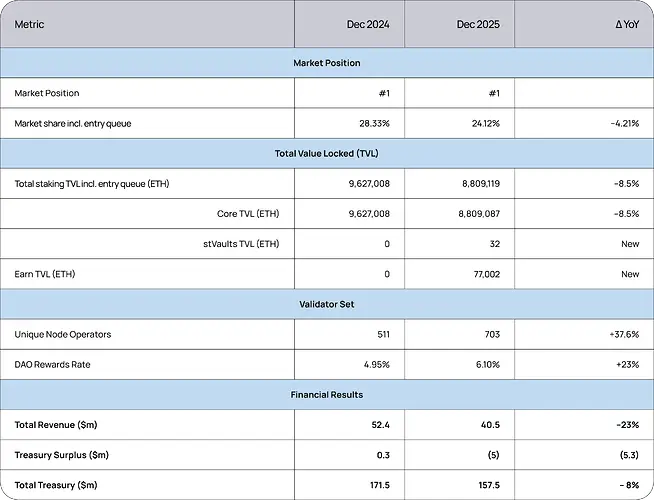 (Source: Lido Research)
Lido clearly points out two revenue decline pathways in its annual report. First, the net staking fund outflows directly reduce the protocol’s management base, narrowing the pool of distributable staking rewards; second, the compression of the network APR results from the increasing number of Ethereum validators, which dilutes individual stakers’ yields and further reduces incentives for new funds to enter the protocol.
The report indicates that in 2025, the Ethereum staking market experienced a “structural shift,” with network APR compression, funds shifting from Simple LST to exchanges and institutional staking, and increased competition collectively shrinking the overall size of Lido’s market segment. Lido emphasizes that this is not just a redistribution of market share but a contraction of its most robust segment itself.
Three Major Directions of LST Market Fund Migration
According to Lido’s annual report, funds originally in the Simple LST segment are shifting toward the following channels:
Exchange Staking: Centralized exchanges offer a one-stop operation experience, attracting retail funds.
Institutional Low-Risk Staking: Institutional investors prefer regulated, operationally controllable staking channels over on-chain protocols.
High APR Seekers (APR-maxis): Some users are turning to higher-yield strategies aiming for staking returns above the market average.
These migration trends pose dual pressures on Lido: not only eroding its existing user base but also constricting the space for growth within its original market.
Transformation Strategies: Layoffs, LDO Buybacks, and Institutional Focus
Facing ongoing revenue pressures, Lido completed a 15% staff reduction in August 2025 to ensure long-term financial sustainability. The protocol also clearly states that its core strategy for 2025 is to expand beyond core staking and to launch differentiated products for institutional investors and high-yield users.
Regarding token buybacks, Lido is evaluating initiating an LDO token repurchase plan, expected to be executed in Q2 2026. Under the proposed plan, staking rewards generated by the protocol will be used to buy back LDO tokens from the open market and deploy them into DAO-held LDO/wstETH liquidity positions, creating a cycle of protocol revenue and token demand. The final plan is subject to DAO governance approval.
In the institutional market, WisdomTree, managing assets worth $140 billion, has launched an Ethereum ETP in Europe using Lido’s decentralized protocol as the staking reward source, marking the first significant example of Lido’s institutional deployment.
Frequently Asked Questions
Why did Lido’s revenue decline in 2025?
Lido’s annual report cites two core reasons: user asset withdrawals leading to net staking fund outflows, reducing management scale; and the ongoing compression of network-wide staking yields (APR) due to increasing validator numbers, shrinking the protocol’s reward pool. Both factors together caused total revenue to decrease by 23% compared to 2024.
How does the LDO token buyback plan work?
According to Lido’s proposed scheme, the protocol will use the staking rewards generated to buy back LDO tokens from the open market and deploy the repurchased tokens into DAO-held LDO/wstETH liquidity positions. The plan is expected to start in Q2 2026, with final approval pending DAO governance.
What is the significance of WisdomTree’s partnership with Lido?
WisdomTree, with about $140 billion in assets under management, launched an Ethereum ETP in Europe using Lido’s protocol as the staking reward source. This marks the first major case where a traditional asset management firm uses a decentralized staking protocol as the underlying infrastructure for an ETP, signifying substantial progress in Lido’s institutional market deployment.
Disclaimer: The information on this page may come from third parties and does not represent the views or opinions of Gate. The content displayed on this page is for reference only and does not constitute any financial, investment, or legal advice. Gate does not guarantee the accuracy or completeness of the information and shall not be liable for any losses arising from the use of this information. Virtual asset investments carry high risks and are subject to significant price volatility. You may lose all of your invested principal. Please fully understand the relevant risks and make prudent decisions based on your own financial situation and risk tolerance. For details, please refer to
Disclaimer.


