
CFTC Establishes Innovation Task Force to Integrate AI, Crypto, and Prediction Markets, Coordinating with SEC to Redefine U.S. Digital Financial Order.
Regulatory Shift Toward Proactive Guidance: CFTC Forms Innovation Task Force to Establish New Order
On March 24, the U.S. Commodity Futures Trading Commission (CFTC) Chairman Michael S. Selig officially announced the formation of a new “Innovation Task Force” (ITF). This initiative aims to create clear “roadmap rules” for companies developing emerging technologies in the U.S. derivatives market, ensuring products develop in compliance with regulations.
Led by Selig’s senior advisor Michael J. Passalacqua, who has extensive experience in cryptocurrency from Simpson Thacher & Bartlett and previously served as chief legal counsel for the SEC’s Crypto Task Force.
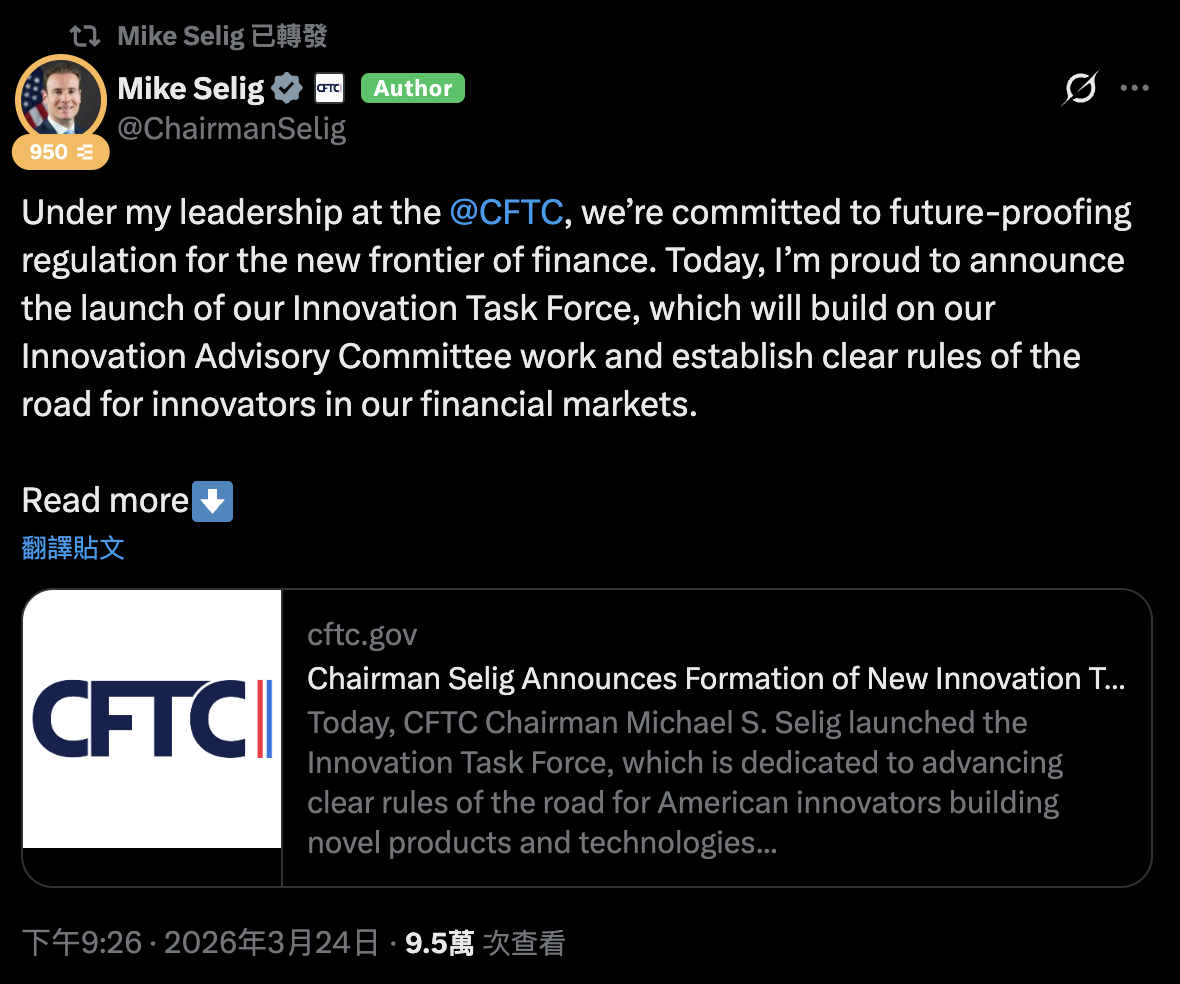
Image source: X/@ChairmanSelig
CFTC Chairman Michael S. Selig announced the formation of the new “Innovation Task Force” on March 24.
This move reflects a shift in regulatory stance, with legislative bodies attempting to retain domestic talent through forward-looking frameworks. Chairman Selig emphasized that establishing clear regulatory pathways can promote responsible innovation and prevent U.S. market participants from being marginalized during financial transformation. The core mission of the ITF is to implement the commission’s innovation agenda and coordinate across federal agencies. This action symbolizes regulators’ efforts to transform scattered enforcement actions into a predictable policy system, providing legal support for developers at the financial frontier.
Three Major Tech Vertical Industries Included, AI and Prediction Markets Under Core Regulation
The Innovation Task Force’s scope focuses precisely on three vertical industries:
- Cryptocurrency assets and blockchain technology
- Artificial Intelligence (AI) and autonomous systems
- Prediction markets and event contracts
Selig stated at the Digital Asset Summit in New York that these three industries are currently the fastest-growing core sectors in the derivatives market. The ITF will work closely with the “Innovation Advisory Committee” (IAC), established in January this year. The IAC boasts over 30 industry leaders, including Nasdaq CEO Adena Friedman and Tarek Mansour, CEO of prediction market leader Kalshi, representing cross-industry expertise.
Further Reading
CFTC Innovation Committee Announces 35 Members! Integrating Traditional Finance + Crypto Industries, Covering DeFi and VC
This new regulatory framework replaces the old Technology Advisory Committee, providing market participants with direct communication channels with regulators. In AI, the group will study how automated trading strategies impact market stability; in prediction markets, efforts focus on clarifying the boundaries between regulated event contracts and illegal gambling. As overlaps among technology, market structure, and regulation increase, the ITF aims to establish standardized procedures, offering clearer guidance before product launches, reducing compliance costs and legal risks for companies.
Two Agencies Moving Toward Consensus Framework, Breaking Regulatory Deadlock Across Five Asset Classes
Coordination between the two major U.S. regulators, SEC and CFTC, is significantly strengthening. On March 17, the SEC issued a policy clarification stating that most digital assets do not constitute securities. The document introduces a five-category asset classification model, dividing digital assets into digital commodities, collectibles, tools, stablecoins, and securities. The CFTC has indicated it will align with this framework and continue enforcing the Commodity Exchange Act (CEA). This collaborative stance provides unprecedented legal clarity for blockchain infrastructure and tokenization developers long caught in jurisdictional disputes.
Although the federal CLARITY Act is currently stalled in the Senate over issues like stablecoin yields, the establishment of the ITF serves as an administrative guide. Chairman Selig, leveraging his dual roles at SEC and CFTC, aims to bridge policy gaps. This proactive approach seeks to set operational standards ahead of comprehensive congressional consensus. Through regular meetings with the SEC Crypto Task Force, the ITF is weaving a regulatory network covering DeFi and new trading mediums, ensuring the U.S. maintains a competitive edge in global financial technology.
Further Reading
SEC Issues Guidance! Promoting Token Classification Framework—What Are the Industry Impacts?
No More Fragmented Approaches! SEC and CFTC Sign Historic Cooperation, Coordinating Crypto Regulation
Intensified Legal Battles Over Prediction Market Jurisprudence: Federal vs. Local Power Struggles
Prediction markets are becoming a frontline in regulatory conflicts. With rising usage of platforms like Kalshi and Polymarket, clashes between federal regulators and local governments have intensified. Nevada and Arizona have recently challenged prediction markets through legal means, claiming potential violations of local gambling laws.
In response, Chairman Selig has taken a firm stance, publicly stating he will defend CFTC’s jurisdiction over such markets in court. The ITF’s involvement has formalized these disputes, planning to implement stricter review mechanisms for contracts related to politics, sports, and even terrorism risks.
To align with federal regulation, prediction market platforms have begun self-regulation. Kalshi has implemented the IC360 identity verification system, proactively banning political figures from participating; Polymarket has partnered with Palantir to develop AI monitoring systems to prevent insider trading. Additionally, the CFTC has signed a memorandum of understanding with Major League Baseball (MLB) to safeguard the integrity of sports betting contracts. The ITF consolidates these scattered efforts under a unified policy umbrella, aiming to establish a sustainable framework that protects investors while fostering technological innovation in the new digital financial frontier.
Disclaimer: The information on this page may come from third parties and does not represent the views or opinions of Gate. The content displayed on this page is for reference only and does not constitute any financial, investment, or legal advice. Gate does not guarantee the accuracy or completeness of the information and shall not be liable for any losses arising from the use of this information. Virtual asset investments carry high risks and are subject to significant price volatility. You may lose all of your invested principal. Please fully understand the relevant risks and make prudent decisions based on your own financial situation and risk tolerance. For details, please refer to
Disclaimer.


