
Solana meme coin WHITEWHALE experienced a sharp sell-off on March 27, with the coin’s price dropping rapidly from a peak market cap of more than $181 million; the single-day decline exceeded 55%. The token’s quoted price fell to about $0.012, and its market cap dropped below $15 million. The immediate trigger for the market’s collapse was when the coin’s core community leader, “The White Whale,” announced that he would be exiting the crypto Twitter community.
A 55% Drop in a Single Day: The Departure of Key Figures Reveals Structural Weaknesses in the Community Token
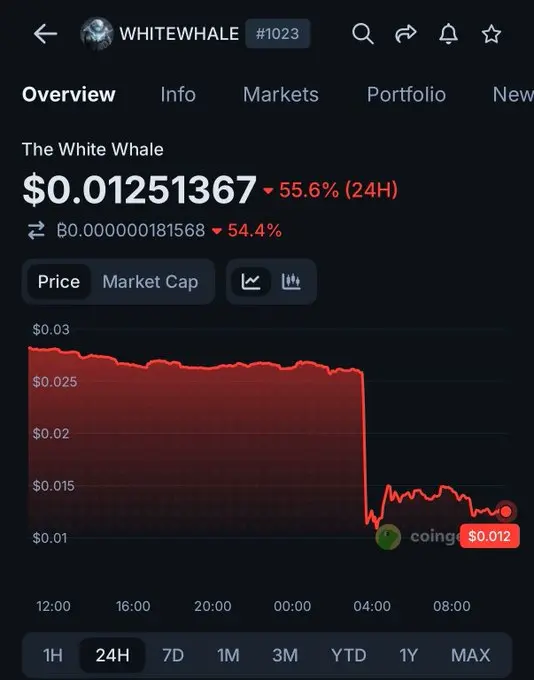
(Source: CoinGecko)
WHITEWHALE’s collapse this time clearly shows the core structural risks of meme coins—when market confidence in a coin is highly tied to a single person, any change by that person can destroy holders’ confidence in a very short period of time.
In his resignation statement, “The White Whale” was candid about multiple personal crises: a family crisis involving his children, worsening mental health, and day after day of intense pressure coming from the community. He wrote in the statement: “Long ago I understood that if you’re not doing well yourself, you can’t help anyone. And now, my situation is very bad. Admitting that isn’t a big deal.”
Notably, earlier this month in an interview with BeInCrypto, he had explicitly said, “It’s impossible not to leave.” The rapid reversal of his stance within just a few weeks shows that the pressure he was bearing far exceeded what he had presented externally.
How an Anonymous Trader Became the Ultimate Responsibility Holder for WHITEWHALE
The WHITEWHALE token first appeared in October 2025, and “The White Whale” was not its original creator. In December 2025, he found fraudulent projects operating under his name that harmed his reputation, and immediately took the initiative—buying the tokens, injecting liquidity, and leading a community takeover operation.
In his interview with BeInCrypto, he clearly explained his role positioning: “I take the ultimate responsibility for the token named after me. DAOs and other organizational structures often create an illusion of democracy in this space, and that democracy actually rarely exists. You trust Jeff to manage HyperLiquid properly, and you trust The White Whale to manage the token named after him properly.” This pattern of personal credibility being tightly tied to the token is also the root reason why the market’s reaction today was so intense.
Parting Actions: Locking $13 Million Worth of Tokens and Business Continuity Arrangements
At the same time that “The White Whale” announced his exit, he publicly revealed two specific actions:
Permanent Token Lock: Permanently lock 500 million WHITEWHALE tokens, involving an amount of about $13 million—equivalent to half of the token’s 1 billion fixed supply—permanently exiting circulation. He called it “the best parting gift I can give you.”
Business Continuity Arrangements: Hand over community social media operations to colleague Vincenzo Maiett; the operation of the decentralized exchange (DEX) liquidity pool (LP) will be taken over by the LP expert he trusts, while he himself will “continue overseeing from behind the scenes.”
“The White Whale” also provided an explanation for the fundamental reason behind his exit: “Pump.fun is a cancer in this space—you and I both know it, yet you still can’t stop being obsessed with it. I choose to leave so that this space won’t take more things from me that I’m not willing to give up.” Whether the community can stay cohesive without a central figure remains the biggest unknown for current WHITEWHALE holders.
Frequently Asked Questions
Who is “The White Whale,” and what is his actual relationship to the WHITEWHALE token?
“The White Whale” is an anonymous crypto trader and not the original creator of the WHITEWHALE token. In December 2025, he took the initiative to step into the community—buying the tokens, injecting liquidity, and leading the community takeover—becoming the token’s most core pillar figure, backing the token with his personal credibility.
What impact does the $13 million token lock have on the market?
This lock removes 500 million tokens—50% of the total supply (1 billion)—permanently taking them out of the circulating market. In theory, supply compression is beneficial for long-term scarcity, but short-term market reaction shows that holders’ panic at the key figure’s departure far outweighs the positive expectations brought by reduced supply.
What structural risks in meme coins does this incident by WHITEWHALE reveal?
This case is a typical presentation of “key-figure dependency risk”—when market confidence in a token is tightly tied to personal credibility, any change from that person can trigger extreme market reactions. A single-day 55% drop combined with a 1,000% surge in trading volume is a direct reflection of the endogenous fragility within this type of community-driven token.
Disclaimer: The information on this page may come from third parties and does not represent the views or opinions of Gate. The content displayed on this page is for reference only and does not constitute any financial, investment, or legal advice. Gate does not guarantee the accuracy or completeness of the information and shall not be liable for any losses arising from the use of this information. Virtual asset investments carry high risks and are subject to significant price volatility. You may lose all of your invested principal. Please fully understand the relevant risks and make prudent decisions based on your own financial situation and risk tolerance. For details, please refer to
Disclaimer.


