
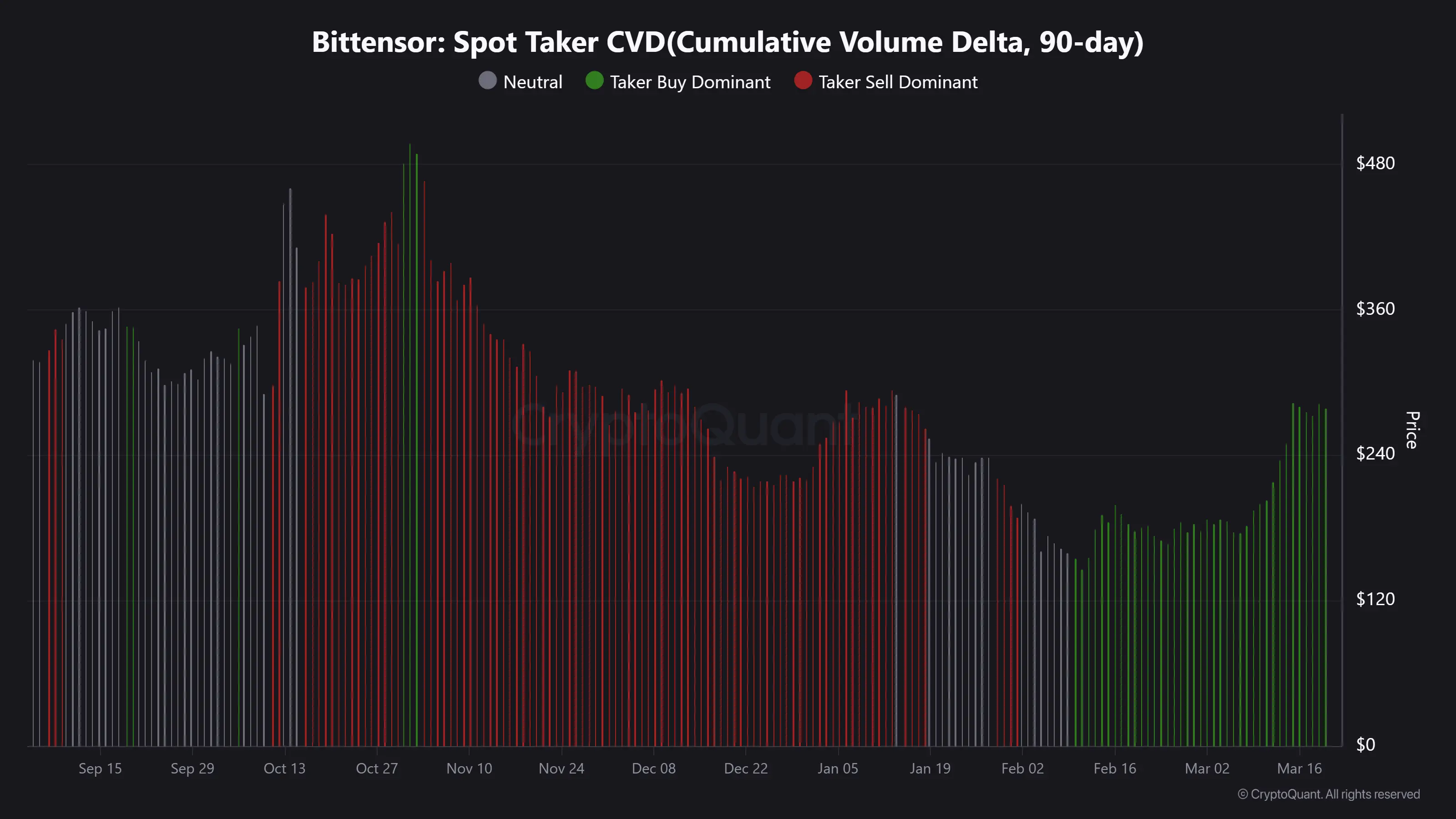
Bittensor (TAO) has rebounded since hitting an approximate $154 low in February, and is currently trading around $330. CryptoQuant data shows that the 90-day spot cumulative volume delta (CVD) indicator has remained consistently positive: Bittensor subnetwork ecosystem token market cap has broken $1.4 billion. However, analysts warn that spot, futures, and retail participation are all warming up in sync—“when everything heats up at the same time, the risk increases.”
Flipping Spot CVD to Go Long: On-Chain Arguments for Real Buying Support
 (Source: CryptoQuant)
The key support for this round of Bittensor’s rebound comes from changes in on-chain structure. CryptoQuant’s 90-day spot CVD indicator measures the power balance between active buyers and active sellers on spot exchanges—over the past several months, the charts had been showing red bars dominated by sellers; now, for several weeks in a row, they have flipped to green bars dominated by buyers, and the trend has persisted for weeks.
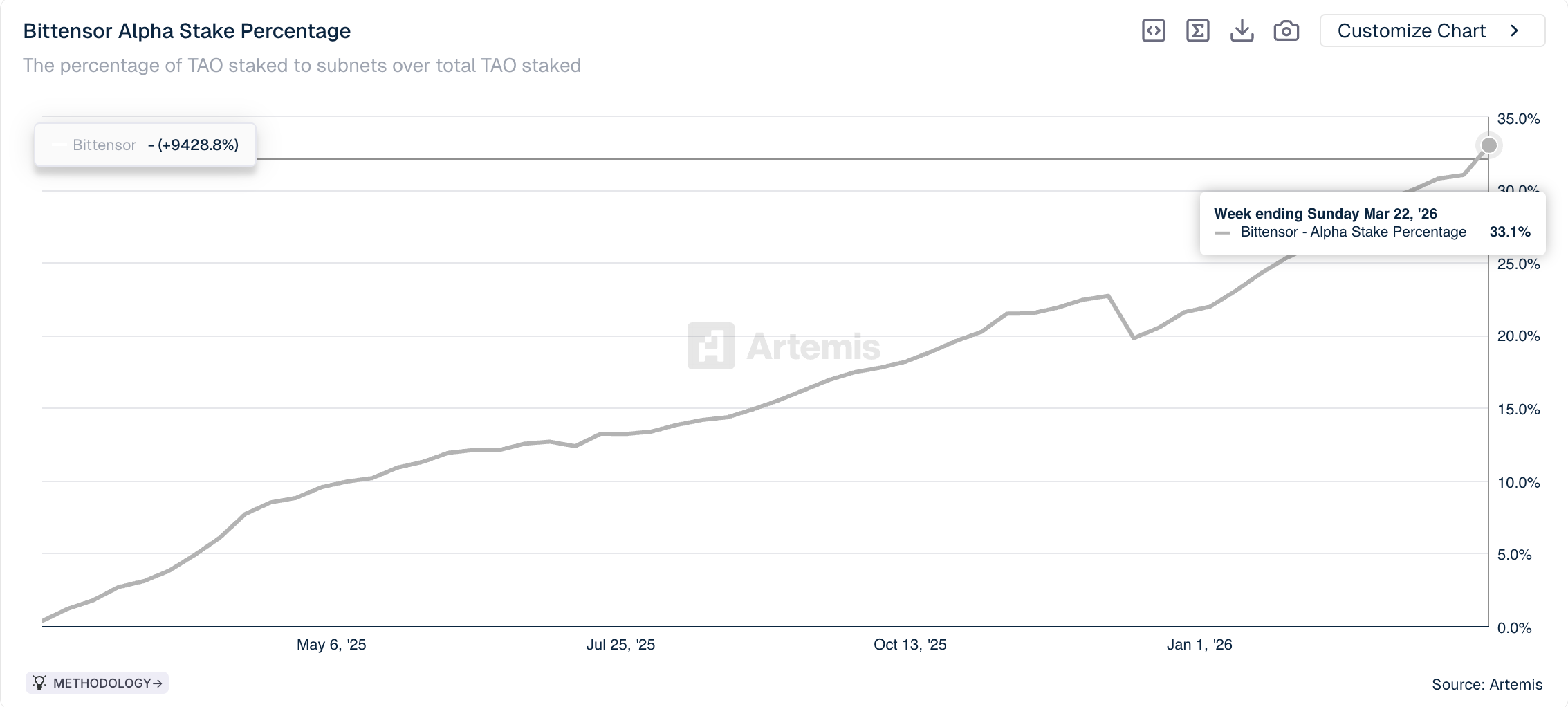
A sustained flip of CVD to positive suggests that TAO’s price increase this time is not driven only by derivatives leverage, but rather by genuine open-position demand that is absorbing supply—indicating a healthier type of uptrend structure. Bittensor subnetwork staking data also corroborates this: the amount of TAO staked to subnetworks has surpassed 33% of the total staked amount, reflecting that participants’ confidence in the subnetwork economic model is rising significantly.
The Ecosystem Explodes: Subnetwork Token Market Cap Breaks $1.4 Billion
 (Source: Artemis)
The scope of beneficiaries in this market cycle goes far beyond TAO itself. According to CoinGecko data, the total market cap of subnetwork tokens in the Bittensor ecosystem has surpassed $1.4 billion, and in the past 30 days, nearly all subnetwork tokens have posted double-digit monthly gains.
This broad-based rise at the ecosystem level is fundamentally different in nature from a “fake bull market” where only the native token climbs on its own—it is closer to synchronized capital inflows across the entire network, showing that the market’s long-term allocation intention toward Bittensor’s decentralized AI computation model is shifting positively.
Analysts Issue a Warning: Triple-Heat Synchronization Means Risk Is Expanding
However, CryptoQuant analyst Maartunn issued an important warning about the current price action. He noted that three dimensions of Bittensor trading activity are warming up in sync:
Spot trading volume rising: reflects increased participation from retail and institutions in the spot market; typically a positive signal for trend confirmation
Futures trading volume climbing: accumulation of leveraged positions—if the market reverses, it will magnify the magnitude of downside volatility
Retail participation heating up: usually a characteristic of late bull-market retail capital chasing the trend; historically, it often concentrates near the top
“When everything heats up at the same time… the risk increases,” Maartunn wrote. He clearly pointed out that this does not necessarily mean an immediate reversal will occur, but it indicates that the current uptrend may have entered a “zone where downside risk is increasing.” At this point in time, the real demand signals represented by spot CVD need to be weighed equally against the leverage accumulation risks represented by rising futures and retail heat.
FAQ
What is Bittensor, and why is it classified as a decentralized AI coin?
Bittensor is a decentralized AI computing network that allows individuals or institutions to contribute, trade, and consume AI computing power and model capabilities on-chain. TAO is its native token, used for network incentive mechanisms, staking, governance, and the pricing and exchange of subnetwork computing resources. It is currently one of the largest decentralized AI infrastructure projects by scale.
What reference value does a CVD flip have for analyzing TAO’s price trend?
CVD (Cumulative Volume Delta) measures the accumulated difference between aggressive buy orders and aggressive sell orders on spot exchanges. A sustained flip of CVD to positive means that aggressive buying exceeds aggressive selling—an important tool for identifying “real spot demand driving” versus “pure leverage-driven pumping.” Since TAO’s 90-day CVD flipped positive from the $154 bottom, this rebound has shown some support from genuine spot demand, rather than being only a derivatives-driven hype trade.
Why does triple-indicator synchronized warming count as a risk signal?
When spot, futures, and retail all see rising heat at the same time, it means the market is synchronously accumulating potential sell pressure across multiple dimensions. Retail capital chasing the trend typically appears in the late stage of a bull market, and the piling up of open futures contracts can intensify the liquidation cascade when the行情 reverses. The core view of analyst Maartunn is that warming in a single dimension is normal, but triple synchronized warming indicates that overall market fragility has increased significantly.
Disclaimer: The information on this page may come from third parties and does not represent the views or opinions of Gate. The content displayed on this page is for reference only and does not constitute any financial, investment, or legal advice. Gate does not guarantee the accuracy or completeness of the information and shall not be liable for any losses arising from the use of this information. Virtual asset investments carry high risks and are subject to significant price volatility. You may lose all of your invested principal. Please fully understand the relevant risks and make prudent decisions based on your own financial situation and risk tolerance. For details, please refer to
Disclaimer.


