An independent Bitcoin miner using CKpool solo-mining software successfully mined the 944,306th Bitcoin block on April 9, earning the full block reward of 3.128 BTC (about $222,012). This includes 3.125 block subsidies and 0.003 transaction fees. The block contained 6,755 transactions.
A miracle in numbers: How 70TH of hash power can outmatch the entire Bitcoin network
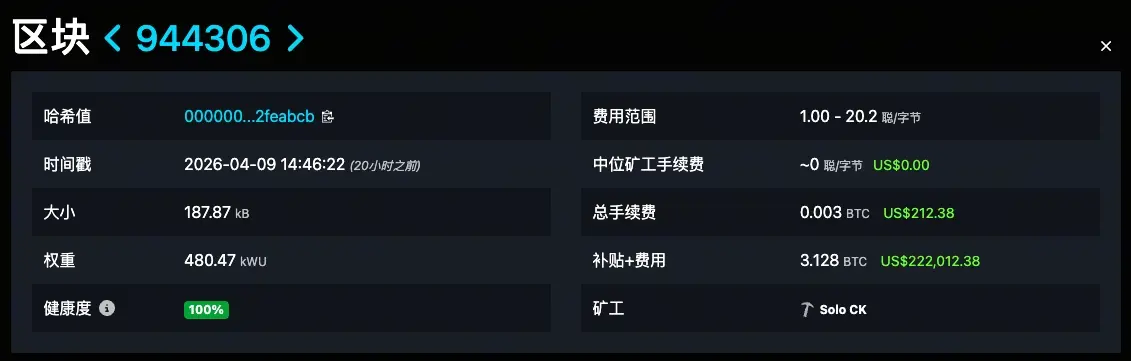 (Source: Mempool)
70 TH/s of hash power is roughly equivalent to the hash rate of the 2019 Bitmain Antminer S17+ mining rig, which is already considered older hardware on the market. This figure accounts for about 0.0000069% of the total hash power of the Bitcoin network—put another way, for every block the entire network mines, the probability that this mining rig contributes is about 1 in 38B.
Con Kolivas wrote in his congratulations to the miner: “Congratulations to the miner bc1q~edvj with only 70 TH/s of hash power for successfully solving the 313th solo block on eusolo.ckpool.org!” This means there are already 313 solo miners on the CKpool platform who have mined blocks, but for any individual miner, such moments are still statistical miracles.
The reality for solo miners: the second time this month, with only 22 times in the past year
This month’s second instance: This is the second time in April that a record of a solo miner successfully mining a block has appeared. On April 3, a CKPool pool member with hash power of 230 TH/s also mined 3.139 BTC (about $210k).
Overall for the past year: According to data compiled by Bennet, over the entire past year, solo miners collectively mined only 22 blocks, accumulating 69.24 BTC.
Network hash power backdrop: In Q1 2026, total Bitcoin network hash power fell 6% from 1,066 EH/s to 1,004 EH/s. But even with hash power declining, the probability that solo miners find blocks remains close to zero for most people.
CKpool platform cumulative count: This is the 313th block mined by a solo miner in CKpool’s records, showing that while this phenomenon is rare, it will still keep occurring statistically within the world’s vast base of miners.
The decentralized spirit of the Bitcoin network: Why solo miners matter
These events receive widespread attention not only because of the large rewards, but because they showcase a core feature of Bitcoin’s network design: regardless of hash power, any node that participates in mining theoretically has a chance to mine the next block. This decentralized randomness ensures that even when hash power is dominated by large mining pools, the existence of solo miners still has real significance. However, the lucky miner’s success also clearly highlights the harsh reality—given today’s total network hash power, 70 TH/s of hash power on average needs 300 years of continuous operation to “expect” a success like this.
Frequently asked questions
Why was this miner able to mine a Bitcoin block with such low hash power?
The essence of Bitcoin mining is a random process—each hash computation is an independent trial. No matter how high or low the hash power is, every node has a chance, at any moment, to “luckily” find a valid solution. This miner’s 70 TH/s accounts for only 0.0000069% of the network’s total. But at that moment, his mining rig happened to be the first to find a hash value that met the difficulty target.
What are the main differences between solo mining and pool mining?
In pool mining, multiple miners combine their hash power and share rewards proportionally; income tends to be more stable, but each share is smaller. Solo mining means the miner independently attempts—once successful, the miner enjoys the entire block reward (this case is 3.128 BTC). However, the waiting time to mine a block can be measured in years or even hundreds of years, during which most miners earn little to nothing.
How does declining Bitcoin network hash power affect solo miners?
In Q1 2026, total Bitcoin network hash power dropped 6% from 1,066 EH/s to 1,004 EH/s. A decrease in hash power means the network-wide mining difficulty may be adjusted downward accordingly, which theoretically slightly increases each miner’s relative chance of success. However, for solo miners whose hash power is less than one-millionth of the network’s total, this change has a negligible impact on real mining outcomes.
Disclaimer: The information on this page may come from third parties and does not represent the views or opinions of Gate. The content displayed on this page is for reference only and does not constitute any financial, investment, or legal advice. Gate does not guarantee the accuracy or completeness of the information and shall not be liable for any losses arising from the use of this information. Virtual asset investments carry high risks and are subject to significant price volatility. You may lose all of your invested principal. Please fully understand the relevant risks and make prudent decisions based on your own financial situation and risk tolerance. For details, please refer to
Disclaimer.


