Cambodia’s parliament passed legislation targeting compounds used to defraud victims through scams, including those involving cryptocurrency.
In a Friday notice, the Senate of the Kingdom of Cambodia announced that the chamber had unanimously approved the draft law with no amendment, with 58 senators voting yes. According to reports, the draft bill, which would still need the king’s approval before becoming law, imposed prison time between two to five years and up to $125,000 in fines for certain crimes, or twice the time in prison and penalties if part of a gang or targeting multiple victims.
“The draft law stipulates the establishment of criminal rules to fill the gaps and deficiencies in the current law, which will contribute significantly to addressing challenges that pose serious risks to social security, the economy and citizens, including affecting Cambodia’s reputation, as well as improving the effectiveness of the fight against fraud through technological systems, aiming to contribute to the preservation and protection of public security and order, and improving the effectiveness of cooperation in combating this crime,” said a translation of the Friday Senate notice on the bill.
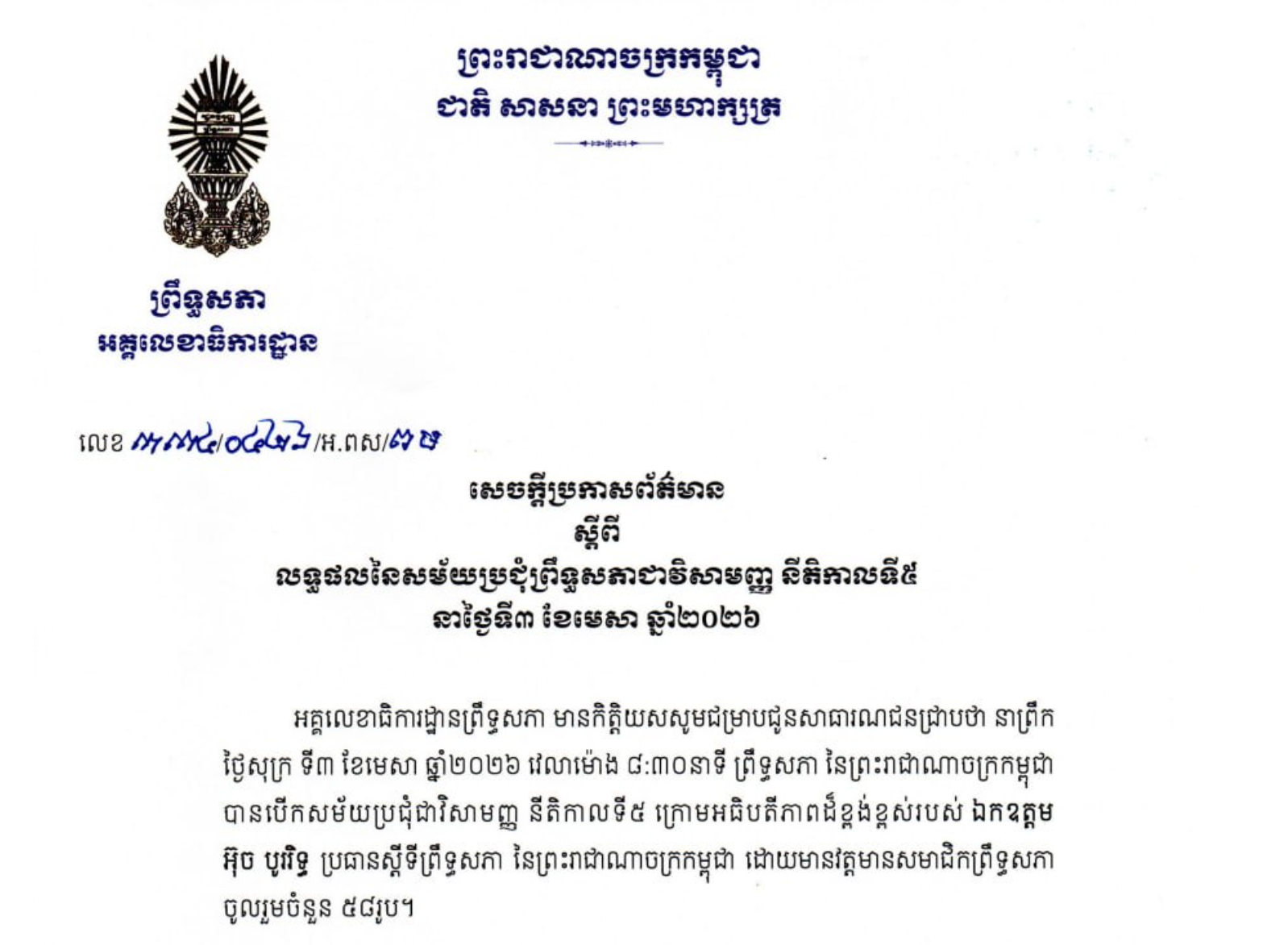
_Friday notice announcing the crypto bill’s passage. Source: _Senate of the Kingdom of Cambodia
According to a 2025 report from the US State Department, Cambodia’s government “frequently downplayed scam operation cases as labor disputes,” never arresting or prosecuting any owner or operator of a suspected scam compound. The Cambodian operations are just some of many across parts of Southeast Asia, where compounds are alleged sources of forced labor.
**Related: **__UK sanctions $20B scam market by cutting ‘legitimate’ crypto ties
The passage of the bill followed UK authorities sanctioning the operators of a Cambodia-based scam center, and the country extraditing to China the leader of a criminal syndicate with alleged tied to scam compounds. Cambodia’s national assembly advanced the bill on March 30, with all 112 members voting yay.
What happens in these scam compounds?
According to a 2024 UN News report that explored a compound in the Philippines, scam centers like the ones targeted under the Cambodian bill were massive undertakings, with facilities designed so that the residents would never need to leave. Although many of the workers were responsible for carrying out the scams, they were also “trafficked here, held against their will” and “exposed to violence” in the compounds.
“The people who work here are basically fenced off from the outside world,” said the report. “All their daily necessities are met. There are restaurants, dormitories, barbershops and even a karaoke bar. So, people don’t actually have to leave and can stay here for months.”
**Magazine: **__Your guide to surviving this mini-crypto winter
Cointelegraph is committed to independent, transparent journalism. This news article is produced in accordance with Cointelegraph’s Editorial Policy and aims to provide accurate and timely information. Readers are encouraged to verify information independently. Read our Editorial Policy https://cointelegraph.com/editorial-policy
- #Law
- #Cambodia
- #Crimes
- #Scams
- #Regulation
Disclaimer: The information on this page may come from third parties and does not represent the views or opinions of Gate. The content displayed on this page is for reference only and does not constitute any financial, investment, or legal advice. Gate does not guarantee the accuracy or completeness of the information and shall not be liable for any losses arising from the use of this information. Virtual asset investments carry high risks and are subject to significant price volatility. You may lose all of your invested principal. Please fully understand the relevant risks and make prudent decisions based on your own financial situation and risk tolerance. For details, please refer to
Disclaimer.
Related Articles
Circle CEO: Due to the “moral dilemma,” the Drift hacker incident, which was not frozen, resulted in the theft of USDC
Circle CEO Jeremy Allaire addressed criticism at a news conference regarding the previously unfrozen stolen USDC, emphasizing that the company will only freeze wallets under law enforcement instructions. In addition, he said Circle is in communication with U.S. lawmakers, hoping to establish a “safe harbor” mechanism for stablecoin issuers.
GateNews44m ago
Hong Kong’s first batch of stablecoin issuers is out! Among 36 applicants, only 2 were granted licenses: HSBC and Tingdian Finance
The Hong Kong Monetary Authority has announced the first batch of stablecoin issuer licenses, approving Dingdian Financial Technology, led by HSBC Bank and Standard Chartered Bank. This regulatory framework is designed to protect users’ rights and interests, promote the application of compliant stablecoins, address financial pain points, and foster the development of Hong Kong’s digital assets.
CryptoCity2h ago
SEC and CFTC Fast-Track US Crypto Oversight Using Interpretive Rules to Bypass Lengthy Rulemaking
U.S. regulators are accelerating crypto oversight by using interpretive rules, signaling a faster policy rollout strategy that prioritizes immediate clarity over traditional rulemaking processes.
Key Takeaways:
Government Accountability Office (GAO) highlights fast-track crypto rules, boosting
Coinpedia2h ago
South Korea’s Board of Audit and Inspection requires that digital assets be included within the scope of property reviews related to basic pension benefits.
South Korea's Board of Audit and Inspection has recommended including digital assets within the asset calculation scope for basic old-age pensions, to prevent high-income earners from receiving pensions meant for low-income seniors. The Ministry of Health and Welfare expressed agreement, saying that digital assets should be treated as property with economic value.
GateNews4h ago
European Central Bank backs ESMA with centralized oversight of crypto regulation, and bearish signals for Bitcoin emerge
The European Central Bank has officially supported transferring regulatory authority over crypto-asset service providers to the European Securities and Markets Authority, marking an important step in the process of consolidating crypto oversight. This change is intended to unify regulatory standards, reduce fragmentation issues, and strengthen compliance requirements, but it is expected to increase the compliance burden for small and medium-sized businesses. The market reacted negatively, and confidence in Bitcoin’s price outlook declined.
MarketWhisper5h ago


