How Gate DEX Balances User Convenience with Asset Security

Beginner
Quick Reads
Last Updated 2026-03-25 14:03:31
Reading Time: 1m
Gate DEX adopts a non-custodial approach integrated with TEE security architecture, allowing users to retain full control over their on-chain assets while experiencing seamless trading. This article examines the security framework and product strategy behind Gate DEX.

Why Security Is a Persistent Issue in On-Chain Transactions
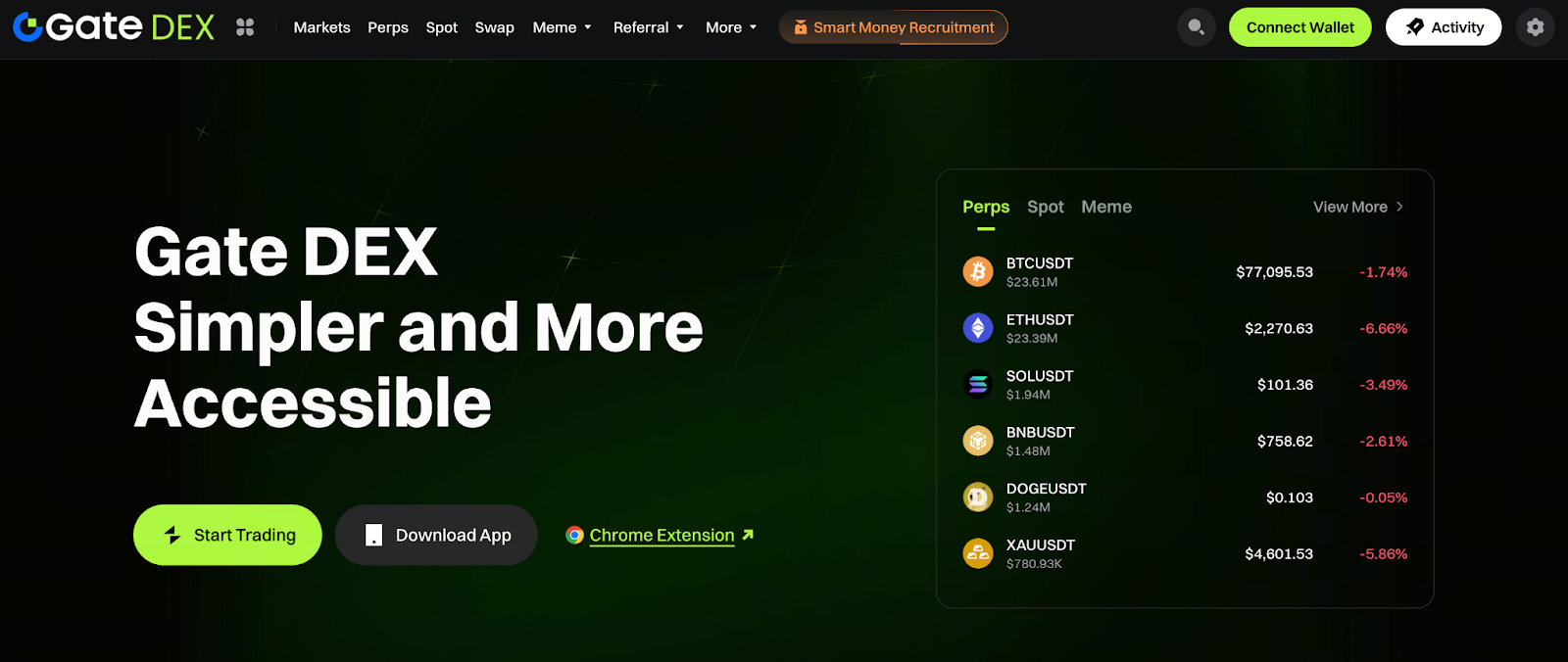

Image: https://web3.gate.com/

In the Web3 ecosystem, asset security remains a top concern for users. Unlike centralized exchanges, decentralized trading gives users full control over their assets, but it also places greater responsibility on them for managing operations.

Any errors in private key management, wallet authorization, or signing can be irreversible. As a result, ensuring security while reducing operational complexity is a core challenge for DEX products.

The Security vs. User Experience Dilemma in Decentralized Trading

The challenge with traditional DEXs isn’t a lack of security, but rather an overemphasis on security mechanisms that make operations cumbersome. Frequent signature confirmations and complex wallet switching processes discourage everyday users from long-term engagement.

This creates a classic dilemma: the higher the security, the greater the barriers to entry; the simpler the experience, the more users worry about asset safety.

Gate DEX’s product design seeks to strike a new balance between these competing priorities.

Gate DEX’s Non-Custodial Asset Model

With Gate DEX, user assets always remain in their own wallets, and the platform never takes custody of user funds. This gives users complete control over their assets. Compared to centralized platforms, this approach reduces concentration risk and aligns with the core principles of decentralized finance.

Users can execute on-chain transactions without transferring assets to a platform account, minimizing the operational costs associated with asset migration.

How TEE Architecture Improves the Trading Experience

Gate DEX’s wallet system is built on Trusted Execution Environment (TEE) technology. TEE executes critical operations in an isolated, secure environment, ensuring sensitive data is protected from external access.

For users, the importance of this technology isn’t about understanding its technical details, but about benefiting from enhanced asset security and fewer manual steps.

Users maintain non-custodial control while enjoying a more seamless trading experience.

Why Most Users Still Find DEXs Challenging

Many users still see DEXs as “complex” or “cumbersome” because early product designs catered primarily to technical users rather than mainstream traders.

Complicated wallet operations and repeated authorization and signing steps make on-chain transactions lengthy, reducing users’ willingness to stick with the platform.

How Gate DEX Lowers the Security Barrier for Users

Gate DEX has optimized onboarding and trading flows. The platform supports one-click login via Gate account, Google account, or wallet, enabling users to quickly enter the on-chain trading environment.

During trading, unnecessary interruptions are minimized, and advanced options like limit orders are supported, making the experience closer to traditional exchange models.

These improvements do not compromise security; instead, they reduce the operational burden for users.

The Evolving On-Chain Trading Experience

As on-chain trading grows, DEX products are shifting from technical tools to mainstream trading platforms. Users’ dual needs for convenience and security are driving ongoing product innovation.

Gate DEX is focused on maintaining the advantages of decentralization while delivering a trading experience that supports long-term use.

The future mainstream adoption of decentralized trading will largely depend on whether more users embrace this balance.

Author: Max
Disclaimer
* The information is not intended to be and does not constitute financial advice or any other recommendation of any sort offered or endorsed by Gate.
* This article may not be reproduced, transmitted or copied without referencing Gate. Contravention is an infringement of Copyright Act and may be subject to legal action.

Related Articles

What is Fartcoin? All You Need to Know About FARTCOIN
Intermediate

What is Fartcoin? All You Need to Know About FARTCOIN

Fartcoin (FARTCOIN) is a representative meme coin within the Solana ecosystem based on an AI-driven narrative. Its core concept originated from an experiment aimed at exploring the "boundaries between AI Agents and humor." More than just a digital asset with social attributes, the project deeply couples absurd humor culture with on-chain financial logic by integrating autonomous AI interaction models.
2026-04-04 22:01:19
Gold Price Forecast for the Next Five Years: 2026–2030 Trend Outlook and Investment Implications, Could It Reach $6,000?
Beginner

Gold Price Forecast for the Next Five Years: 2026–2030 Trend Outlook and Investment Implications, Could It Reach $6,000?

Analyze current gold price trends alongside authoritative five-year forecasts, integrating an evaluation of market risks and opportunities. This gives investors insight into the potential trajectory of gold prices and the main drivers expected to shape the market over the next five years.
2026-03-25 18:13:30
Aster vs Hyperliquid: Which Perp DEX Will Prevail?
Beginner

Aster vs Hyperliquid: Which Perp DEX Will Prevail?

Aster and Hyperliquid are the two representative protocols of the "purpose-built L1 path" within the current decentralized perpetual exchange (Perp DEX) sector. As a pioneer in the field, Hyperliquid has built a deep liquidity moat through its highly mature order book architecture and strong community consensus. Conversely, Aster, as a rising challenger, seeks to leapfrog the competition in high-performance trading through more aggressive multi-chain aggregation logic, private transaction modules, and an underlying execution environment optimized for 2026 market demands.
2026-03-24 11:58:33
AI-Native Settlement Layers: How United Stables Is Building the Next Financial Rail
Beginner

AI-Native Settlement Layers: How United Stables Is Building the Next Financial Rail

Stablecoins were originally designed as dollar substitutes within exchanges, primarily used for asset pricing and trade settlement. As on-chain financial ecosystems have matured, their role has expanded beyond simple payments to include collateral assets, cross-chain liquidity mediums, and unified settlement units. In particular, as AI systems and automated agents begin to participate directly in economic activity, demand has risen sharply for programmable value units capable of instant settlement. This shift is pushing stablecoins toward the role of foundational financial infrastructure.
2026-03-25 03:16:17
Aerodrome Tokenomics: How ve(3,3) Powers Base's Most Profitable DEX
Beginner

Aerodrome Tokenomics: How ve(3,3) Powers Base's Most Profitable DEX

AERO is the native token of Aerodrome Finance, a core decentralized exchange and liquidity protocol in the Base ecosystem. It is primarily used for liquidity incentives and ecosystem operations. veAERO is a governance NFT that users receive by locking AERO, representing both voting power and the right to share protocol revenue. Through a dual track structure of AERO as a utility token and veAERO as a governance credential, Aerodrome separates liquidity usage value from long term governance power, allowing participants to act as liquidity providers, governance decision makers, and revenue sharers within the same system.
2026-03-25 06:40:31
Hybrid Collateral Stablecoins: Inside United Stables' Stability and Yield Architecture
Beginner

Hybrid Collateral Stablecoins: Inside United Stables' Stability and Yield Architecture

In the early stages of the crypto market, traditional stablecoins mainly relied on single-reserve or single-collateral models. Their primary focus was price stability and payment convenience, which allowed them to become foundational tools for on-chain trading and capital flows. As the market has entered a more mature financial phase, however, this structure has begun to reveal limitations, including high concentration risk and the difficulty of balancing liquidity with yield. These constraints have driven the evolution toward multi-layer collateral and portfolio-based designs, such as the dual-layer hybrid collateral architecture proposed by United Stables, which seeks to redefine the underlying logic of stable assets.
2026-03-25 03:17:39





