The business value of an AI compute network does not simply come from owning GPU resources. The real key is whether those resources can be turned into services that are billable, callable, and sustainably delivered. For developers, enterprises, and AI Agent applications, computing costs, service availability, and payment efficiency all affect the platform’s revenue structure.
This issue usually involves six layers: the compute marketplace, AI services, enterprise customers, fee settlement, revenue distribution, and growth variables. The official AITECH Cloud Network page emphasizes its enterprise grade AI computing infrastructure, highlighting features such as Tier III availability, 99.98% uptime, transparent marketplace pricing, and decentralized computing infrastructure.
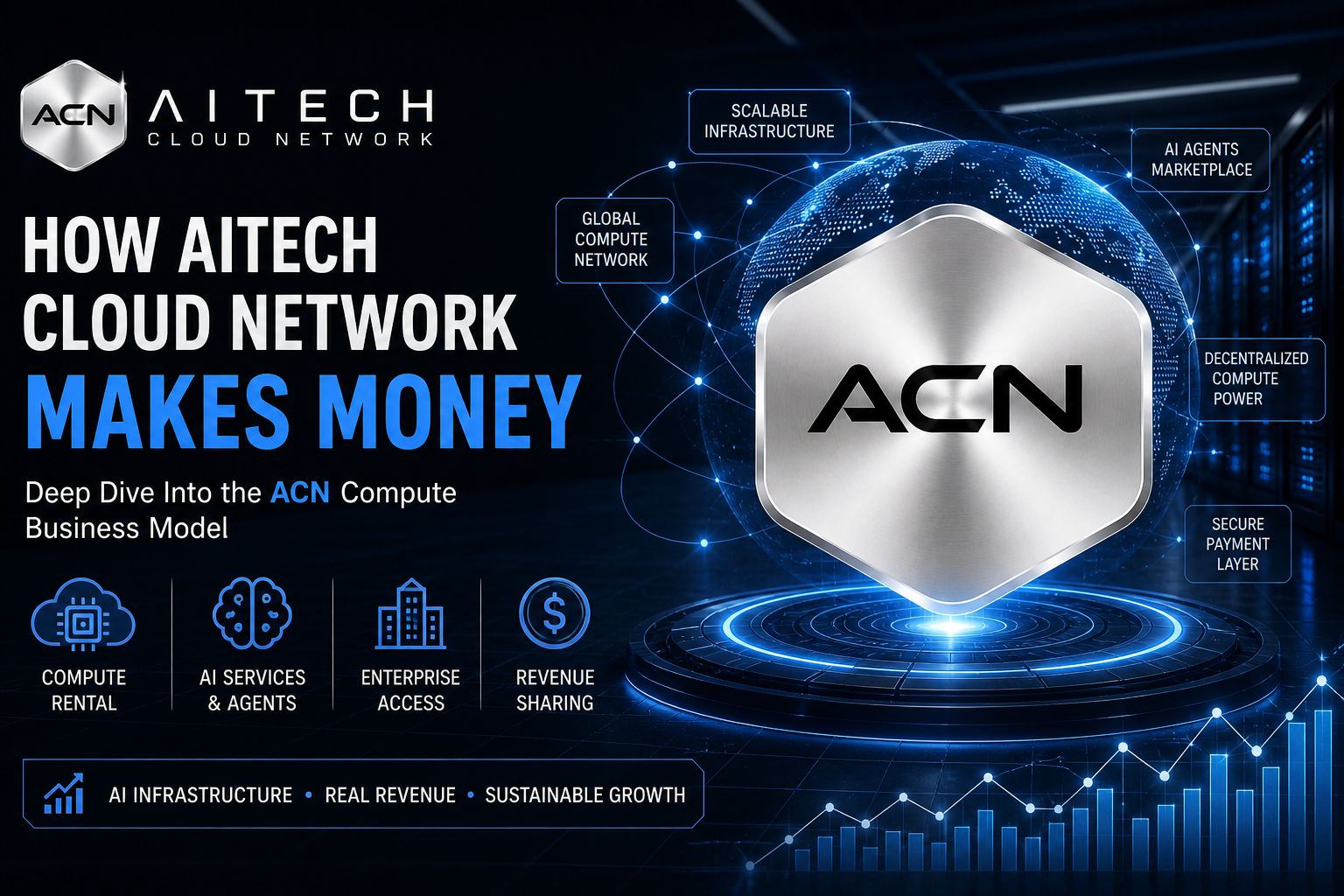
What Is ACN’s Business Model?
ACN’s business model can be understood as an infrastructure fee model built around AI compute power and intelligent services. At its core, it integrates GPU computing, Agent services, and blockchain settlement into a unified commercial loop.
Structurally, the network first provides computing resources and service access points. Users then call compute power or AI tools based on the task type. Payments and settlement are completed through the platform, and revenue ultimately flows among service providers, the platform, and ecosystem participants. The official website describes it as a unified network that provides access to high performance computing and supports the creation of scalable AI and Agent systems.
The importance of this model is that revenue does not depend on a single token narrative. Instead, it is built on compute usage and AI service calls. In other words, the more frequently the network is used, the more opportunities the platform has to generate revenue through service fees, resource scheduling, and ecosystem settlement.
How Compute Leasing Generates Revenue for the Network
Compute leasing is the most direct revenue source for an AI compute network. Its core logic is that users pay for GPU resources, inference tasks, or large scale computing needs.
In the specific process, users first choose the compute resources they need, such as AI training, model inference, or data processing tasks. The system then matches computing capacity based on task scale, resource type, and usage time. Next, users complete payment, and the platform assigns the task to the corresponding computing resources. Finally, the delivery of compute power generates revenue and supports network operations.
From a commercial perspective, the closer compute leasing is to real demand, the clearer the revenue model becomes. AITECH Cloud Network externally emphasizes enterprise scale AI compute infrastructure, which shows that its commercial foundation is not aimed only at on chain users, but also covers developers and enterprise customers that need stable computing resources.
How AI Services Are Charged and How Pricing Models Are Designed
AI service fees can be understood as on demand pricing for model calls, Agent workflows, data processing, and automation tasks. The core idea is to break complex AI capabilities into service units that users can directly purchase and call.
In the usage process, users first enter an AI service or Agent tool portal and choose a model, workflow, or automation task. The system then calculates fees based on service complexity, number of executions, resource consumption, and calling method. Users complete payment, the platform executes the task and returns the result. Finally, service calls become part of the platform’s revenue.
| Revenue Module |
User Behavior |
System Behavior |
Revenue Source |
| Compute leasing |
Selects GPU resources |
Schedules computing capacity |
Resource usage fees |
| Agent Forge |
Creates or calls Agents |
Executes workflows |
Service call fees |
| Enterprise access |
Uses stable infrastructure |
Provides permissions and services |
Enterprise service fees |
| Platform settlement |
Pays service fees |
Completes distribution and records |
Transaction and service revenue |
This table shows that AITECH Cloud Network’s fee logic is not a single subscription model. Instead, it is jointly formed by compute power, AI Agents, enterprise services, and the settlement system. Official development updates also mention that Agent Forge supports two access methods, standard API keys and x402 payments, allowing developers and Agents to connect to services in different ways.
How Enterprise Customers Access the ACN Network and Pay
When enterprise customers access the ACN network, they usually focus on stability, resource availability, service costs, and compliant access methods. In practical terms, enterprises are not simply buying compute power once. They are using AI computing capability as part of their business systems.
In the access process, enterprises first choose compute power, AI Agents, or data processing services according to their business needs. The system then provides access permissions, API interfaces, or platform tools. Next, enterprises pay based on actual usage, service packages, or contract terms. Finally, the platform generates revenue through continuous service delivery.
The importance of this mechanism is that enterprise customers often have more stable and more frequent computing needs. Compared with individual users, enterprise scenarios are more likely to create recurring revenue, such as model inference, customer service automation, data analytics, workflow execution, and dedicated compute configurations.
How Revenue Is Distributed Across the Ecosystem
Revenue distribution is an important part of judging whether a business model can operate effectively. Its core lies in whether the platform can establish a clear value flow among service providers, infrastructure participants, and ecosystem mechanisms.
Mechanically, users first pay fees for compute power or AI services. The platform then identifies revenue attribution based on service type, such as computing resources, Agent execution, or platform tools. Part of the revenue is used to reward service providers, while another part may be used for platform operations, ecosystem development, or token mechanisms. Ultimately, revenue distribution affects whether participants are willing to continue providing resources and services.
In official materials, the Compute Marketplace and Agent Forge are key areas of ongoing development. Related updates mention that the platform is advancing payment integration, infrastructure, and feature development. This shows that revenue distribution is not only related to token economics, but also directly tied to product functionality, service delivery, and developer participation.
Commercial Sustainability and Key Growth Factors
The sustainability of the business model ultimately depends on compute demand, enterprise adoption, Agent service usage, and the platform’s delivery capability. The core point is that revenue must come from continuous usage, not one time traffic.
Structurally, growth in AI applications first creates demand for compute power. Developers and enterprises then call computing resources and Agent services through the platform. Service usage generates fees, which then support platform operations and ecosystem incentives. Finally, the business model can remain sustainable only if service quality, pricing efficiency, and delivery capability stay stable.
Key limitations should also be viewed objectively. The AI compute market is highly competitive, and traditional cloud computing platforms have strong resources and established customer bases. At the same time, decentralized compute networks still need to prove their pricing, stability, and service experience. Whether ACN’s business model can scale depends on whether it can continuously connect computing resources, Agent tools, and enterprise demand.
Conclusion
AITECH Cloud Network’s revenue logic revolves around compute leasing, AI service calls, Agent Forge, enterprise customer access, and platform settlement. Its commercial process can be summarized as follows: users submit compute or service requests, the system schedules compute power or Agent tools, users complete payment, and the platform delivers services and distributes revenue.
Overall, ACN’s business model does not rely solely on the token. It depends on the real use of AI compute power and intelligent services. Compute demand, enterprise access, Agent service calls, pricing models, and service stability are the key variables that affect the sustainability of its revenue.
FAQs
How Does AITECH Cloud Network Make Money?
AITECH Cloud Network mainly generates revenue through AI compute leasing, Agent Forge service calls, enterprise infrastructure access, and platform settlement. Its business model is built on the use of computing resources and AI services.
Why Is Compute Leasing a Main Revenue Source?
Compute leasing directly corresponds to frequent needs such as AI training, model inference, and data processing. Users pay for GPU resources and computing time, so the higher compute usage is, the clearer the platform’s revenue potential becomes.
How Does Agent Forge Generate Revenue?
Agent Forge can generate revenue through AI Agent creation, workflow execution, API calls, and paid services. When users or developers call Agent services, the platform can charge based on task execution or resource consumption.
Why Are Enterprise Customers Important?
Enterprise customers usually need stable compute power, API access, automation tools, and continuous services, making them more likely to generate long term revenue. The degree of enterprise adoption directly affects the stability of the platform’s business model.
What Are the Key Risks of ACN’s Business Model?
The main risks include competition in the compute market, hardware and operating costs, the pace of enterprise adoption, service stability, and platform usage. If real service demand is insufficient, both revenue growth and the token mechanism may be affected.







