ETFs: More Than Just Risk Diversification
Traditionally, most investors have viewed ETFs as vehicles for index tracking, long-term portfolio allocation, and risk diversification.
The core value of these products lies in reducing trading frequency and minimizing emotional interference, making them well-suited for investors seeking stability over time.
But market dynamics are changing. Short-term volatility is now the norm, and capital increasingly prioritizes efficiency over mere stability. In this environment, traditional ETFs often lack the responsiveness and flexibility needed by trading-focused participants. As a result, leveraged ETFs have emerged as a compelling alternative.
Gate Leveraged ETF Tokens: Delivering Derivative Exposure Through a Spot Trading Experience
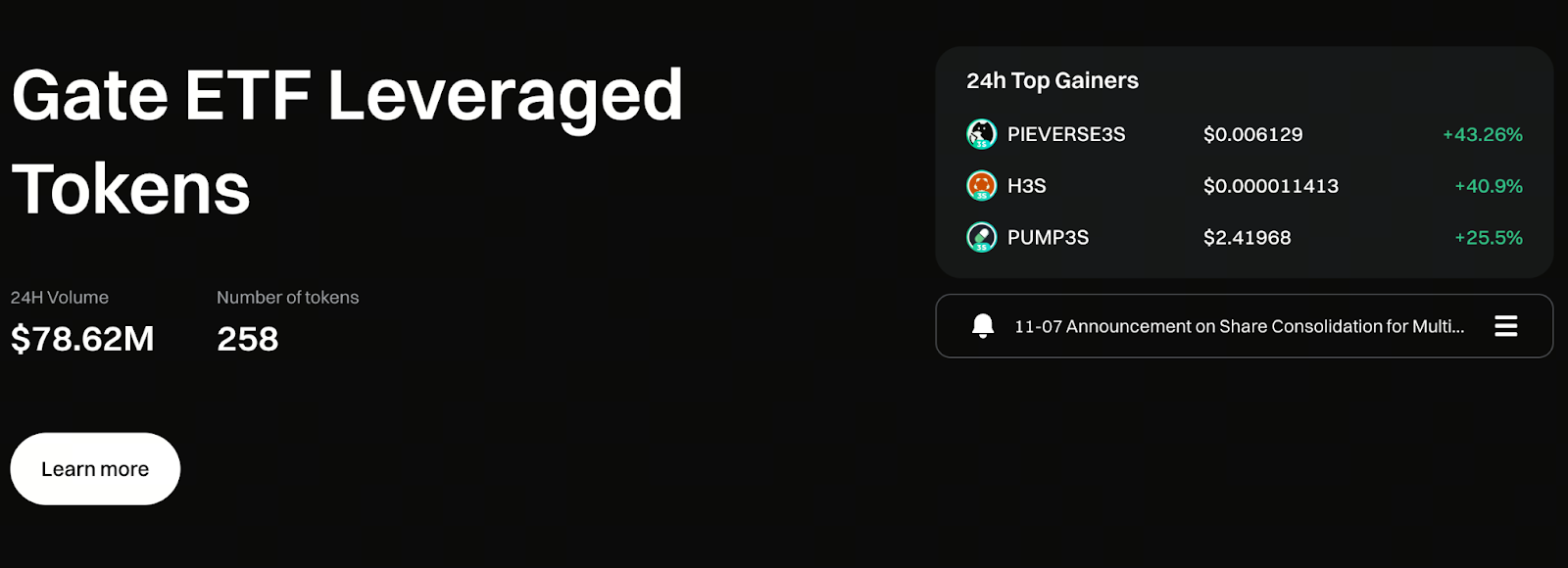
Gate Leveraged ETF Tokens are fundamentally backed by perpetual contract positions. However, users interact with these tokens entirely through spot trading, eliminating the need to manage margin, monitor liquidation prices, or account for borrowing costs. Instead, users simply buy or sell tokens to establish leveraged exposure.
This structure offloads the complexity of derivatives to the platform, allowing traders to focus solely on market direction and timing. It’s especially advantageous for those unfamiliar with contract trading but eager to amplify market movements.
Start trading Gate Leveraged ETF Tokens now: https://www.gate.com/leveraged-etf
Dynamically Maintained Leverage Ratios
Contrary to popular belief, the leverage ratio in leveraged ETFs is not permanently fixed. Gate Leveraged ETFs use the following mechanisms to closely align product performance with the target leverage:
1. The system utilizes perpetual contract positions as the underlying and adjusts exposure based on market volatility.
2. The platform rebalances positions at set intervals to prevent excessive deviation from the target leverage during volatile market conditions.
This process is seamless for users but is critical to ensuring product integrity and performance.
Leverage Without the Complexity of Contracts
For many traders, the real challenge of contract trading lies in complex risk management—not leverage itself. Leveraged ETFs shift this responsibility to the platform. Users don’t need to track margin levels or worry about forced liquidation due to insufficient collateral. That said, risk does not disappear; it’s repackaged and reflected directly in token prices, rather than through liquidation events. This allows traders to focus more on market direction when making decisions.
Practical Advantages of Leveraged ETFs
In trending markets, leveraged ETFs can magnify price movements, enabling capital to achieve greater efficiency in a shorter timeframe. Thanks to the rebalancing mechanism, when markets move consistently in one direction, product performance can be further amplified. With an operational flow identical to spot trading, leveraged ETFs serve as a bridge between spot and derivatives, lowering the psychological barrier for trying new strategies.
Key Structural Features and Limitations
Leveraged ETFs are not all-purpose solutions. Because price swings are magnified, the rebalancing mechanism can cause “decay” during sideways or choppy markets, resulting in performance that may lag behind expectations.
Additionally, leveraged ETF returns won’t precisely match the underlying asset’s performance multiplied by the leverage factor. Position adjustments, volatility paths, and transaction costs all impact final outcomes. For this reason, leveraged ETFs are generally not suitable for long-term holding.
The Role of Daily Management Fees
Gate Leveraged ETFs charge a daily management fee of 0.1% to cover the costs of opening and closing contract positions, funding rates, hedging, and the unavoidable slippage incurred during rebalancing. This fee is not an added penalty—it’s a necessary cost for maintaining product functionality and is standard across the leveraged ETF market.
Best Used for Strategic Trading, Not Passive Holding
Leveraged ETFs are not designed to replace spot investments. Instead, they serve as strategic tools best paired with clear trading logic, defined entry and exit plans, and robust risk controls—not long-term buy-and-hold strategies. When users understand their structural features and deploy them in specific market scenarios and timeframes, leveraged ETFs can deliver meaningful efficiency advantages.
Conclusion
Leveraged ETFs are not intended to make investing easier—they’re built to make strategy execution more direct. They amplify both market moves and the significance of each trading decision. For traders who understand market rhythms and actively manage risk, leveraged ETFs are powerful tools for optimizing capital efficiency. However, overlooking their volatility and cost structures can result in risks that exceed expectations.