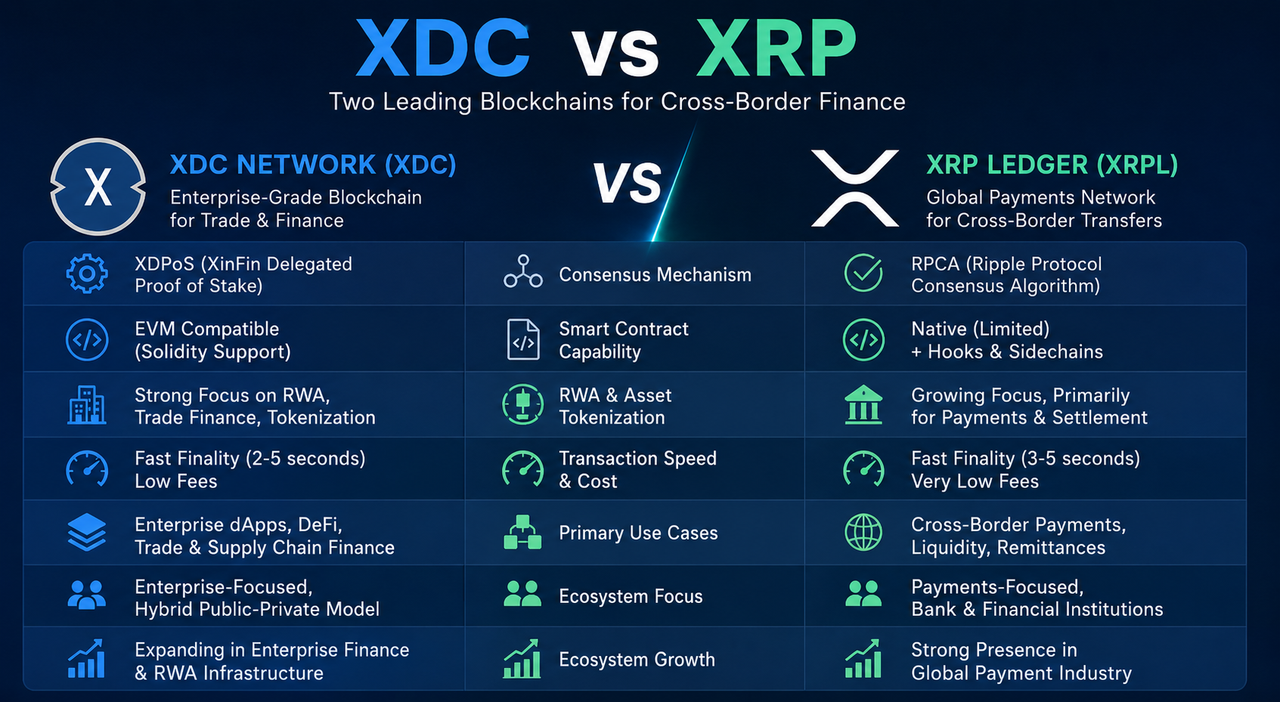
XDC and XRP are both widely adopted in cross-border payments and financial infrastructure, making them frequent subjects of comparison. While both target international settlements and institutional blockchain applications, they differ significantly in their underlying architecture, Smart Contract capabilities, asset tokenization strategies, and ecosystem positioning.
As blockchain technology expands from crypto asset trading into real-world financial systems, more enterprises are seeking highly efficient, low-cost, and programmable on-chain financial networks. Within this context, XDC and XRP represent two distinct approaches in financial blockchain: XDC emphasizes enterprise-grade Smart Contracts and RWA infrastructure, whereas XRP focuses on building a global payment network and cross-border liquidity.
How Do the Core Positionings of XDC and XRP Differ?
Although XDC and XRP are both finance-oriented blockchains, their development paths diverge.
XDC prioritizes enterprise-grade blockchain infrastructure, aiming to support trade finance, RWA, and enterprise collaboration through Smart Contracts, on-chain assets, and hybrid architectures. Its network is focused not just on payments, but also on building robust on-chain financial systems.
In contrast, XRP is dedicated to payment networks and liquidity management, with the goal of streamlining international payments and reducing settlement costs for cross-border transfers. XRP serves as a global payment bridge, rather than a comprehensive Smart Contract financial platform.
In short, XDC is centered on “enterprise on-chain finance,” while XRP is all about the “global payment network.”
What Sets the Consensus Mechanisms of XDC and XRP Apart?
XDC leverages the XDPoS (XinFin Delegated Proof of Stake) mechanism, securing its network and confirming transactions through validator node staking and Byzantine Fault Tolerance (BFT).
The XRP Ledger uses the Ripple Protocol Consensus Algorithm (RPCA), where a Unique Node List (UNL) collectively achieves network consensus. Both mechanisms are designed for high efficiency and low latency, but their implementations are fundamentally different.
XDPoS closely resembles traditional PoS systems, relying on node staking and validation to maintain network operations. RPCA, on the other hand, adopts a federated validation structure, prioritizing rapid payment confirmations.
| Comparison Dimension |
XDC |
XRP |
| Consensus Mechanism |
XDPoS |
RPCA |
| Node Model |
Validator Node Staking |
UNL Validation |
| Smart Contract Support |
Full EVM |
Limited |
| Main Side |
Enterprise Finance/RWA |
Payment Settlement |
| Enterprise Privacy Support |
Supported |
Limited |
How Do XDC and XRP Differ in Smart Contract Capabilities?
Smart Contract functionality is one of the most prominent distinctions between XDC and XRP.
XDC is fully compatible with the Ethereum Virtual Machine (EVM), enabling developers to write Smart Contracts in Solidity and seamlessly migrate Ethereum-based tools and applications. As a result, XDC supports DeFi, DAO, NFT, and advanced RWA protocols.
By contrast, the XRP Ledger does not natively support full EVM compatibility. While XRPL is gradually introducing features like sidechains and Hooks, its programmability remains primarily payment-focused.
This means that for scenarios requiring sophisticated asset logic and automated financial protocols, XDC typically offers greater scalability.
How Do XDC and XRP Compare in the RWA Sector?
Real World Asset (RWA) tokenization has become a major trend in blockchain, but XDC and XRP place different emphases in this field.
XDC is focused on enterprise-grade asset tokenization and on-chain financial infrastructure, frequently used in scenarios such as digital bonds, trade finance, supply chain notes, and real estate tokenization. Thanks to its Smart Contract support and hybrid architecture, XDC can manage complex asset logic and institutional collaboration needs.
While XRP is also moving into institutional finance and asset tokenization, its ecosystem remains primarily centered on payments and liquidity. As a result, XDC is more often positioned as an RWA infrastructure blockchain compared to XRP.
Both XDC and XRP deliver high performance and low trading fees, offering transaction costs that are noticeably lower than those of traditional Smart Contract blockchains.
Their optimization priorities, however, differ. XRP is optimized for payment throughput and instant settlement, making it especially effective for cross-border remittances. XDC, meanwhile, focuses on enterprise Smart Contracts and on-chain financial applications, providing greater flexibility for complex transaction logic.
| Comparison Dimension |
XDC |
XRP |
| Trading Fee |
Low |
Low |
| Transaction Confirmation Speed |
Fast |
Fast |
| Smart Contract Capability |
Strong |
Moderate |
| RWA Support |
Strong |
Moderate |
| Core Application |
Enterprise Finance |
Global Payments |
How Does Ecosystem Development Differ Between XDC and XRP?
XRP enjoys strong recognition in the cross-border payments space and has long been associated with international payment networks, giving it significant brand influence.
XDC’s ecosystem, while smaller, has seen growing attention in trade finance and institutional on-chain finance as RWA and enterprise blockchain adoption accelerate.
Additionally, XDC’s EVM compatibility lowers the barrier for developer migration, making it easier to integrate with existing Smart Contract ecosystems. XRP’s ecosystem remains concentrated on payments and financial liquidity.
Are XDC and XRP Direct Competitors?
XDC and XRP do overlap in certain areas, such as cross-border payments and institutional financial infrastructure, and are often viewed as similar financial blockchains.
However, they are not direct competitors. XRP is primarily a payment and liquidity network, while XDC is geared toward enterprise-grade Smart Contracts and RWA infrastructure. Their respective market demands and application focuses are clearly distinct.
As blockchain continues to integrate with real-world finance, multiple financial blockchains are likely to coexist, each serving different roles in the financial infrastructure landscape.
Summary
XDC and XRP are both finance-oriented blockchain networks with strong relevance in cross-border payments and institutional finance. Nonetheless, they differ markedly in technical architecture, Smart Contract capabilities, and ecosystem focus.
XDC emphasizes enterprise-level Smart Contracts, RWA, and on-chain financial infrastructure, supporting complex financial applications through XDPoS and EVM compatibility. XRP, on the other hand, is dedicated to global payments and liquidity, enabling rapid, low-cost cross-border settlements via RPCA.
As demand for real-world asset tokenization and institutional blockchain solutions continues to rise, XDC and XRP are poised to play distinct roles in enterprise finance and global payments, respectively.
FAQs
Are XDC and XRP the same blockchain?
No. XDC and XRP are separate blockchain networks with different consensus mechanisms and technical architectures.
Do both XDC and XRP support cross-border payments?
Yes. Both support cross-border payment use cases, but XDC is more focused on enterprise finance and Smart Contracts, while XRP is centered on payment liquidity.
Does XDC support Smart Contracts?
Yes. XDC is EVM-compatible and can run Solidity Smart Contracts.
Does XRP support EVM?
No, the XRP Ledger is not natively EVM-compatible and has limited Smart Contract capabilities.
Which is better suited for RWA?
XDC is generally considered better suited for RWA and enterprise on-chain finance due to its support for Smart Contracts and complex asset logic.
Are trading fees high on XDC and XRP?
No, both offer low transaction fees and are considered high-performance financial blockchains.
Are XDC and XRP designed for banks?
Yes. Both are relevant to financial institution use cases, though their service directions and technical priorities differ.







