The privacy pool based on Vitalik’s research paper has officially launched on the Mainnet. A perfect balance between on-chain privacy and Compliance?
Written by: KarenZ, Foresight News
On April 1st, the on-chain privacy infrastructure 0xbow announced the official launch of the Privacy Pools mainnet. Privacy Pools draws on the research of Ethereum co-founder Vitalik Buterin and others, providing Ethereum users with a token mixing solution that protects on-chain privacy while distinguishing itself from illicit funds.
This article will introduce the concept of Privacy Pools, its origins, developer team, operating mechanism, and its potential impact on the industry.
What are Privacy Pools ###?
Privacy Pools is a new type of blockchain privacy tool designed to provide users with the ability to conduct anonymous transactions while ensuring the compliance of the source of funds.
Unlike traditional mixing services (such as Tornado Cash), Privacy Pools are designed to protect user privacy while preventing illegal funds from mixing into the transaction pool through Zero-Knowledge Proofs (ZKP) and Association Set Provider (ASP).
This mechanism not only meets the privacy needs of ordinary users but also responds to the compliance requirements of regulatory agencies, providing a viable path that balances privacy and legality for the DeFi ecosystem.
Who proposed Privacy Pools? Who released it?
The concept of Privacy Pools originated from a research paper co-authored in 2023 by Vitalik Buterin, Jacob Illum (Chief Scientist at Chainalysis), Matthias Nadler (Ph.D. candidate at the University of Basel), Fabian Schär (Professor at the University of Basel’s Center for Innovative Finance), and Ameen Soleimani (Privacy Pools).
This paper explores how to achieve a balance between privacy and Compliance on the blockchain, proposing a new privacy-enhancing protocol called Privacy Pools based on smart contracts, and explaining how the privacy pool technology serves as a neutral infrastructure to ensure that public blockchains comply with regulatory requirements across jurisdictions.
The Rrivacy Pools protocol was released by the 0xbow team. 0xbow is a startup focused on blockchain privacy and Compliance infrastructure. The main team members include:
- Co-founder Zak Cole: also co-founder of the BTCFi project corn, managing partner of Number Group, and author of EIP-6968.
- Strategic Advisor Ameen Soleimani: Co-founder of Reflexer Finance and IranUnchained, previously worked at companies such as ConsenSys and Filter.
The investors in this project include Number Group, Vitalik, BanklessVC, Public Works, and several angel investors.
After the launch of Privacy Pools Mainnet, Vitalik and Ethereum core developer Tim Beiko both deposited 1 ETH into the privacy pool to show their support.
How do Privacy Pools work?
The Privacy Pools architecture consists of the contract layer, the zero-knowledge layer, and the Association Set Provider (ASP) layer. The contract layer manages assets and state, the zero-knowledge layer ensures privacy, and the ASP layer provides compliance functionality.
Specifically, using zero-knowledge proofs allows users to prove that they belong to a set of approved depositors without revealing their complete transaction history.
The ASP serves as a compliance layer tool, approving deposits that meet predefined standards and verifying that all private withdrawals come solely from approved deposits. The ASP consists of two parts:
-
Service Stack: A modular service that continuously monitors, records, and classifies on-chain activities, assessing the user’s credibility based on their on-chain behavior.
-
On-Chain Instances: including Public Registry and ZKP Verifier. The Public Registry stores and manages ASP data through smart contracts, achieving seamless integration with blockchain protocols; the ZKP Verifier is responsible for validating zero-knowledge proofs, ensuring that the compliance verification process of transactions remains private.
The operation mechanism of ASP is to continuously monitor on-chain transactions and regularly update the “associated set”. Users can prove that their transactions belong to the compliance set by generating zero-knowledge proofs (ZKP) without disclosing specific transaction details. Developers can use ASP to define rule-based access controls to filter user eligibility (such as excluding users associated with illegal activities), thus achieving a balance between privacy and compliance.
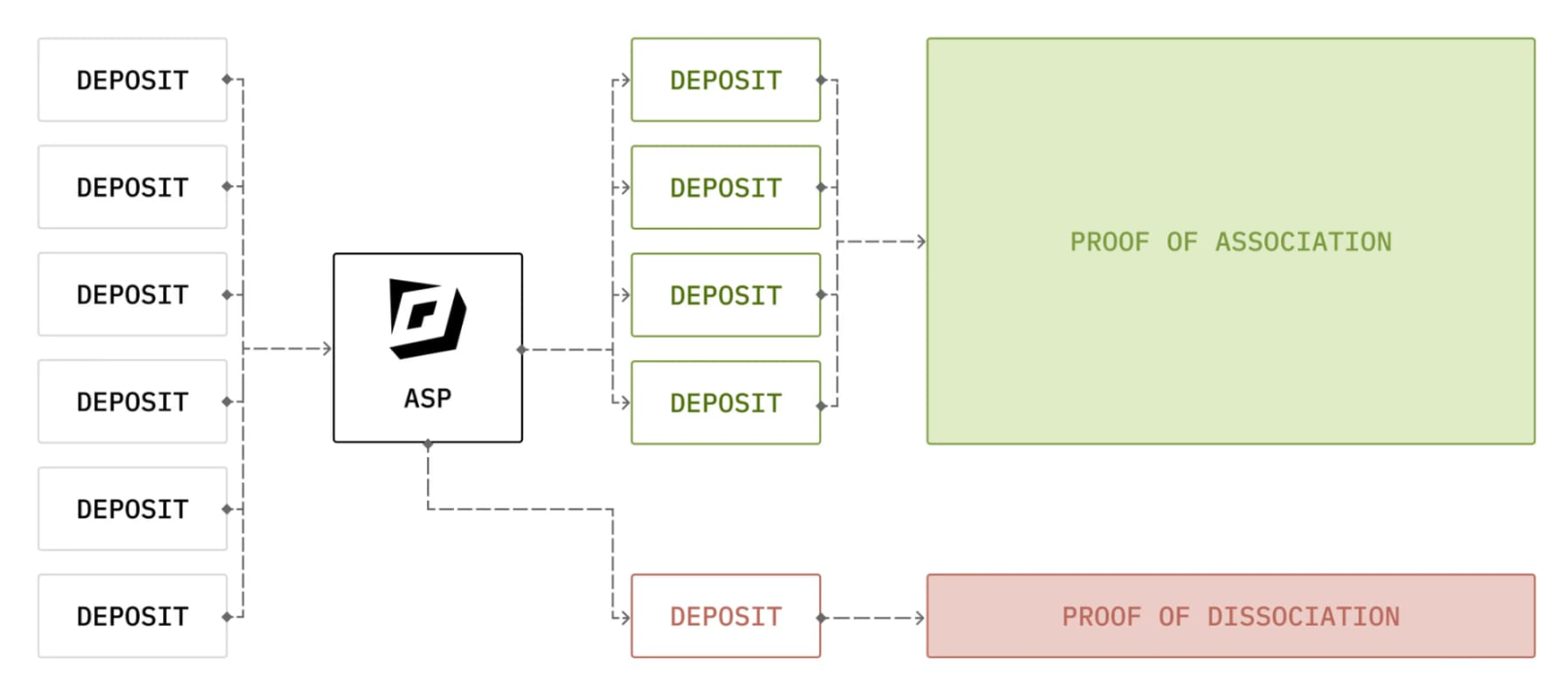
Privacy Pools allow users to encrypt transactions through mixing protocols while still proving that their funds come from legitimate sources. The specific operational process is as follows:
- Connect Wallet and Create Dedicated Wallet: Users connect to the Privacy Pools system through a compatible wallet to create a dedicated 0xbow wallet (this wallet is only used for the privacy pool).
- Deposit: Deposit ETH into the privacy pool. The initial version supports a maximum deposit limit of 1 ETH and a minimum of 0.1 ETH. After depositing funds, 0xbow ASP will review the source of the funds; if these funds do not originate from illegal activities, they will be accepted into the associated set. Once the transaction is confirmed, the deposited funds become part of the anonymous set. Deposits will appear in the Privacy Pools smart contract.
- Withdrawal: Specify the fund receiving address. The dApp will automatically generate a zero-knowledge proof in the user’s browser. After confirmation, the withdrawal transaction is completed, and the funds are transferred to the specified address.
It is worth mentioning that due to the continuous updates of the ASP rules, initially approved deposits may be disqualified. This means that even if users pass the initial screening, they may still be prohibited from withdrawing.
Summary
The launch of Privacy Pools provides users with tools that balance privacy and compliance, which is expected to encourage more institutions and enterprises to adopt blockchain technology.
By isolating illegal funds, Privacy Pools help alleviate regulatory pressure on the industry, clearing obstacles for industry development to some extent. In addition, other privacy protocols can integrate the ASP mechanism to enhance their compliance and promote the standardization of privacy technology. Of course, ordinary users can also participate in on-chain activities in a safer and more compliant manner, redefining the “norm” of blockchain privacy.
However, the road to success for Privacy Pools still faces many challenges, including the credibility of ASP, the centralized review boundaries of ASP, regulatory adaptability across different jurisdictions, and the attitudes of regulatory agencies.
Reference source:
Disclaimer: The information on this page may come from third parties and does not represent the views or opinions of Gate. The content displayed on this page is for reference only and does not constitute any financial, investment, or legal advice. Gate does not guarantee the accuracy or completeness of the information and shall not be liable for any losses arising from the use of this information. Virtual asset investments carry high risks and are subject to significant price volatility. You may lose all of your invested principal. Please fully understand the relevant risks and make prudent decisions based on your own financial situation and risk tolerance. For details, please refer to
Disclaimer.


