As a protocol built for on-chain computing and distributed task execution, Golem is widely used in AI computation, CGI rendering, scientific computing, and other high-performance computing scenarios.
As artificial intelligence, on-chain applications, and Web3 infrastructure continue to develop, demand for computing resources has begun to rise rapidly. Traditional cloud computing can provide stable compute services, but its resource scheduling, pricing structure, and platform control are highly centralized. Against this backdrop, decentralized compute networks have gradually become an important direction for blockchain infrastructure. The distributed computing model represented by Golem attempts to lower the barrier to accessing computing power through an open market mechanism while improving the efficiency of global resource utilization.
From the perspective of digital assets and the blockchain ecosystem, Golem is not only a “shared computing power platform,” but also an economic network built around decentralized computing. The GLM token serves payment, settlement, and incentive functions, while node collaboration, task distribution, and on-chain payment mechanisms together form the underlying logic of the network. This model allows computing resources to be traded and allocated much like digital assets, helping push Web3 infrastructure in a more open direction.
Basic Concept of Golem (GLM): What Is a Decentralized Compute Network?
The core concept of Golem is a “decentralized compute network.” In simple terms, it connects large amounts of idle CPU, GPU, and server resources around the world to create an open computing market. When users need to complete complex computational tasks, they can rent computing power directly from other nodes in the network instead of relying on a single cloud service provider.
In the traditional internet, computing resources are usually controlled by large cloud platforms. For example, businesses rent servers through centralized data centers. In the Golem network, however, any individual or organization can become a compute provider, connect their own devices to the network, and offer resources.
This model is similar to applying the “sharing economy” to computing. Just as ride-sharing platforms connect idle vehicles with passengers, Golem connects idle computing resources with users who need computing power.
Golem is positioned close to Infrastructure-as-a-Service (IaaS), while also having some characteristics of Platform-as-a-Service (PaaS). On one hand, it provides underlying computing resources. On the other, it also supports developers in building and deploying distributed applications, while expanding the software ecosystem through an application registry mechanism.
Around Golem’s underlying structure, related concepts such as “decentralized compute markets,” “on-chain compute networks,” and “Web3 infrastructure” have also emerged. Together, these ideas form an important part of the decentralized computing sector.
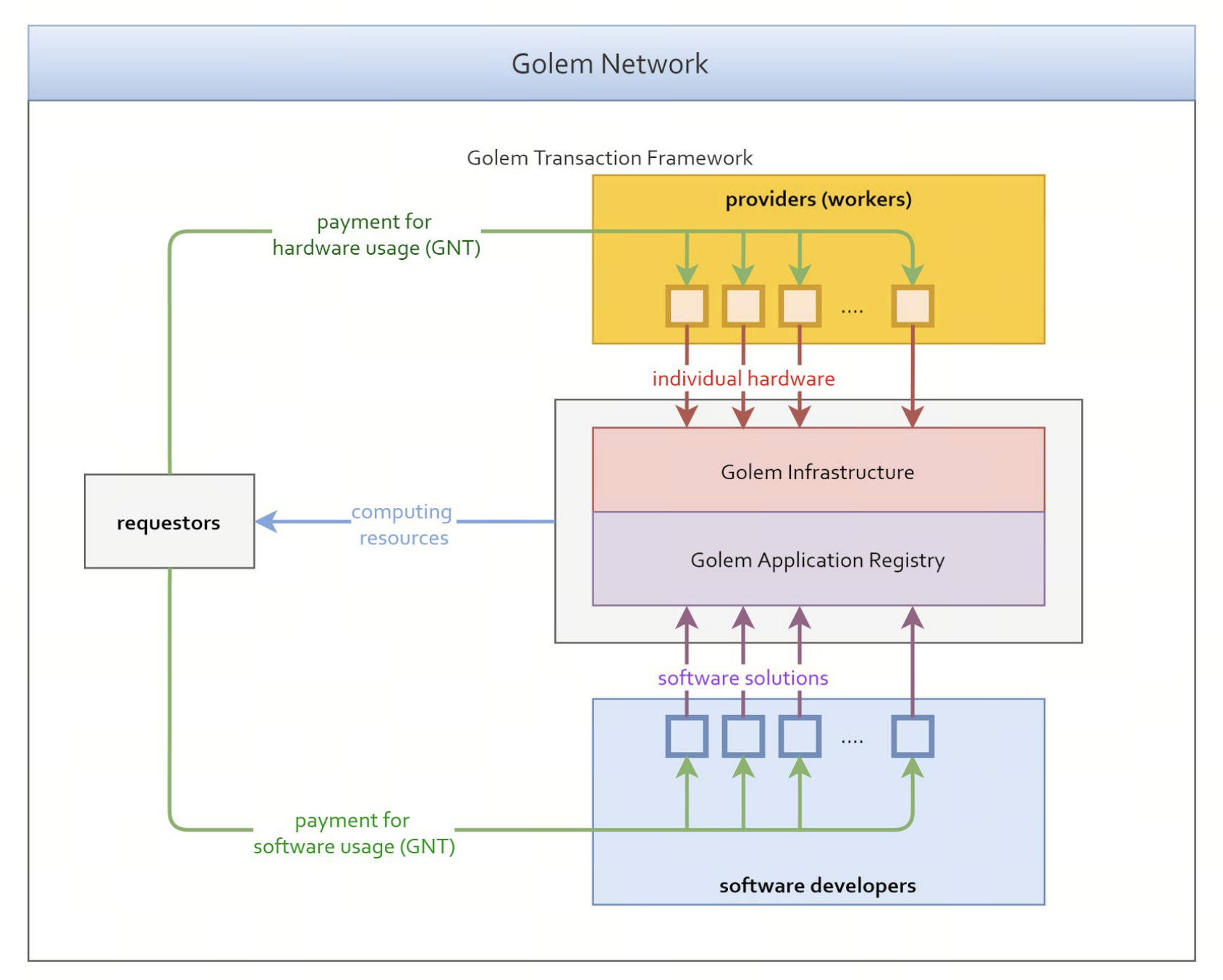
Source: golem.network
Golem’s Background: Why Blockchain Needs Distributed Computing Resources
Blockchain networks themselves are not well suited for directly executing high-performance computing tasks. Ethereum, for example, was designed primarily for security and decentralization, not for efficient complex computation. As a result, many tasks involving AI inference, 3D rendering, or scientific simulation usually cannot be completed directly on-chain.
At the same time, the internet is full of idle computing resources. Personal computers, enterprise servers, and even professional GPU devices are not fully utilized during many periods of time. Traditional cloud platforms can aggregate this demand, but the market has long been dominated by a small number of major technology companies.
This structure creates several problems:
-
Computing power prices are determined by platforms
-
Users need to rely on a single service provider
-
Resource allocation efficiency is limited
-
Developers lack an open market environment
The emergence of Golem is essentially an attempt to reorganize the global computing resource market. Its goal is not to build another centralized server platform, but to create a more open mechanism for compute collaboration through a peer-to-peer network.
As demand for AI model training, machine learning, and off-chain data processing continues to grow, the importance of distributed computing is also increasing. This is especially true in the Web3 ecosystem, where many applications need low-cost, open computing resources. Decentralized compute networks help fill this gap.
Therefore, what Golem represents is not merely a project, but a new way of organizing computing resources.
The Role of GLM in the Golem Network and Its Token Mechanism
GLM is the native token of the Golem network. Its core role is to serve as the medium of payment and settlement within the network.
During Golem’s operation, users who request computational tasks, known as Requestors, need to pay the nodes that provide computing power. GLM is the main asset used in this payment process. Once nodes complete a task, they receive the corresponding GLM reward.
Unlike traditional cloud platforms, which rely on fiat payments, Golem uses an Ethereum-based on-chain payment system. This means:
-
Payments do not require a centralized intermediary
-
Nodes can settle directly with one another
-
The network incentive mechanism can run automatically
Beyond its basic payment function, GLM also plays an important role in maintaining the network’s economic cycle. Provider nodes are motivated to offer resources because they can earn GLM rewards, while Requestors obtain computing power by paying GLM.
This model forms a typical two-sided market structure:
| Role |
Action |
What They Receive |
| Requestor |
Submits computing tasks |
Receives computing resources |
| Provider |
Provides idle computing power |
Receives GLM rewards |
| Developer |
Deploys applications and tools |
Receives ecosystem benefits |
Looking at the overall network structure, GLM is closer to a “resource settlement asset” than a purely governance-oriented token.
This also means that GLM’s value logic is directly linked to actual demand for computing power in the network. As more applications are deployed on the Golem network, the size of the compute market may expand further, and the token becomes the medium of value exchange within that market.
How Golem’s Decentralized Compute Market Works
Golem’s core mechanism is task distribution and distributed execution.
When a user needs to complete a complex computational task, the system first divides the task into multiple subtasks that can be executed independently. These subtasks are then assigned to different nodes for execution.
The overall process usually includes the following steps:
-
The user submits a computing request
-
The network divides the task
-
Provider nodes accept the task
-
Nodes perform the computation
-
Results are returned and verified
-
GLM is used for settlement and payment
For example, a CGI rendering task may involve thousands of image frames. In the traditional model, these tasks are usually handled by a single server cluster. In Golem, different frames can be assigned to different nodes and processed at the same time.
The main advantages of this model are:
-
It can improve resource utilization
-
It supports global parallel computing
-
It reduces dependence on centralized servers
At the same time, Golem also supports asynchronous task execution. This means nodes in the network do not need to stay continuously online and synchronized. Instead, they can complete computations independently based on task status.
This mechanism is clearly different from the “full-node synchronized computation” found in traditional blockchain networks, making it better suited for high-performance computing scenarios.
This structure also involves concepts such as “task verification mechanisms,” “decentralized task scheduling,” and “node reputation systems.” Together, these mechanisms determine how efficiently the network operates.
Participants in the Golem Network: Requestors, Providers, and Developers
The Golem network is mainly made up of three core types of participants:
Requestor
A Requestor is a user or application developer who needs computing resources. They submit tasks to the network and pay GLM to obtain computing support.
These tasks may include:
-
AI model inference
-
Image rendering
-
Scientific simulation
-
Data analysis
The usual goal of a Requestor is to obtain computing power in a more open and lower-cost way.
Provider
A Provider is a node that supplies idle computing power to the network.
Any user with computing equipment can take on this role, including:
Providers compete in the market based on their device performance, online status, and resource configuration, earning GLM rewards by completing tasks.
Developers
Developers are responsible for building software tools and the application ecosystem.
Golem supports developers in publishing applications to the network and expanding the broader ecosystem through an application registry mechanism. This means Golem is not only a computing power platform, but also an open network that supports the operation of distributed software.
Together, these three roles form Golem’s ecosystem loop:
Golem Use Cases: AI, Rendering, Scientific Computing, and Off-Chain Task Processing
One of the most common application areas for Golem is high-performance computing.
Because its network is well suited to parallel processing, many “divisible tasks” can run on Golem.
AI and Machine Learning
AI model training and inference usually require large amounts of GPU resources, and a decentralized compute market can give developers a more open source of resources.
Especially as demand for GPUs grows rapidly, distributed compute networks are gradually becoming an important part of Web3 AI infrastructure.
CGI and 3D Rendering
CGI rendering was one of the earliest use cases Golem focused on.
In the animation, film, and gaming industries, large-scale rendering tasks often require GPU resources for long periods of time. Golem can divide these tasks and assign them to multiple nodes, improving overall efficiency.
Scientific Computing
Research simulations, data analysis, mathematical modeling, and similar tasks are also well suited to distributed execution.
Because these tasks are often highly parallelizable, they can make full use of decentralized compute networks.
Off-Chain Computing and Web3 Applications
Some Web3 applications need to perform complex off-chain computation, such as:
These needs are making distributed computing networks such as Golem an increasingly important part of Web3 infrastructure.
Golem is often compared with traditional cloud platforms such as AWS and Google Cloud, but the two differ significantly in their underlying structure.
Traditional cloud platforms rely on centralized data centers, while Golem uses a peer-to-peer node network.
| Comparison Dimension |
Golem |
Traditional Cloud Platforms |
| Network structure |
Decentralized node network |
Centralized data centers |
| Resource source |
Idle devices worldwide |
Enterprise servers |
| Scheduling method |
Market-based matching |
Unified platform scheduling |
| Payment method |
GLM on-chain payments |
Fiat payments |
| Control model |
Open network |
Platform control |
From the perspective of DePIN (Decentralized Physical Infrastructure Network), Golem is a typical decentralized infrastructure project. However, compared with some DePIN projects that focus specifically on GPU networks or AI-dedicated networks, Golem places greater emphasis on general-purpose computing rather than being limited to a single scenario.
This difference means:
-
Golem leans more toward an open computing market
-
AI-specific networks focus more on GPU optimization
-
Storage-based DePIN projects focus on data storage resources
Different projects, in practice, correspond to different types of infrastructure markets.
Golem (GLM): Advantages, Limitations, and Common Misconceptions
Golem’s core strengths lie in its openness and its efficient use of resources.
By connecting idle devices around the world, Golem can theoretically lower the barrier to accessing computing power and improve the utilization rate of computing resources. At the same time, its decentralized structure reduces reliance on any single platform.
However, this model also has limitations. First, node stability may affect task execution efficiency. Because Provider nodes come from different users around the world, their network quality and online status are not fully consistent. Second, complex real-time tasks are not always suitable for distributed execution. Some applications that require extremely low latency are better suited to centralized server environments.
In addition, many users mistakenly think of Golem as a “blockchain version of a cloud server.” In reality, Golem is closer to an open computing market than a direct replacement for traditional cloud platforms.
Another common misconception is that “decentralized computing power is always cheaper than traditional cloud platforms.” In fact, pricing is affected by task type, network supply and demand, and the structure of node resources. Therefore, Golem and traditional cloud platforms are not simply substitutes for one another. They are better understood as two different ways of organizing resources.
Conclusion
Golem (GLM) is an open compute network built around decentralized computing resources. Its goal is to reshape the global computing market through peer-to-peer collaboration. Unlike traditional cloud platforms, which rely on centralized servers, Golem connects idle device resources into a tradable distributed computing network and uses the GLM token to support on-chain payments and node incentives.
As demand for AI, Web3, and high-performance computing continues to grow, decentralized compute networks are gradually becoming an important direction for blockchain infrastructure. The open computing model represented by Golem not only expands the off-chain capabilities of the blockchain ecosystem, but also supports the development of DePIN and distributed resource markets.
FAQ
What Is Golem (GLM)?
Golem is a decentralized compute network that connects idle computing resources around the world to form an open computing market. GLM is the native payment token used in the network.
What Role Does GLM Play in the Golem Network?
GLM is mainly used to pay for computing resources and serves as the reward asset for Provider nodes.
How Is Golem Different from Traditional Cloud Computing?
Traditional cloud platforms rely on centralized servers, while Golem uses a decentralized node network to distribute and execute computational tasks.
What Kinds of Tasks Are Suitable for the Golem Network?
AI inference, CGI rendering, scientific computing, and other divisible high-performance computing tasks are generally better suited to distributed execution.
Is Golem a DePIN Project?
Yes. Golem is part of the Decentralized Physical Infrastructure Network (DePIN) sector, with a core focus on the distributed computing resource market.
Not completely. Golem is better suited to open parallel computing, while traditional cloud platforms still have advantages in stability and enterprise-grade real-time services.







