As generative AI and blockchain continue to converge, the onchain economy is moving from “manual user operations” toward “automated execution by intelligent agents.” In this context, Pieverse is used to reduce the complexity of Web3 adoption and provide AI Agent with auditable payment and settlement capabilities, allowing them to participate in more complex economic activities.
Definition and Development Background of Pieverse
AI Agents are gradually evolving from simple tools into participants with autonomous execution capabilities. In a Web3 environment, these agents can not only execute transactions, but also automatically manage assets and carry out strategies based on instructions.
The emergence of Pieverse is closely tied to this trend. Its core positioning is to provide standardized payment capabilities and interaction interfaces for AI Agents, so onchain activity no longer has to depend on traditional wallet operations. Built around this logic, the role of AI Agents in Web3 is expanding from assistive tools into part of the broader economic system.
Pieverse’s Core Mechanism and Operating Logic
Pieverse operates through the coordination of several key modules, including the x402b payment protocol, execution logic, and data recording mechanisms.
Within this structure, the payment layer uses a gasless model to lower the cost of user interaction, so transactions no longer require users to pay gas directly. The execution layer is handled by AI Agents, which trigger onchain operations based on input instructions. The data layer records transaction information with timestamps, making each action verifiable.
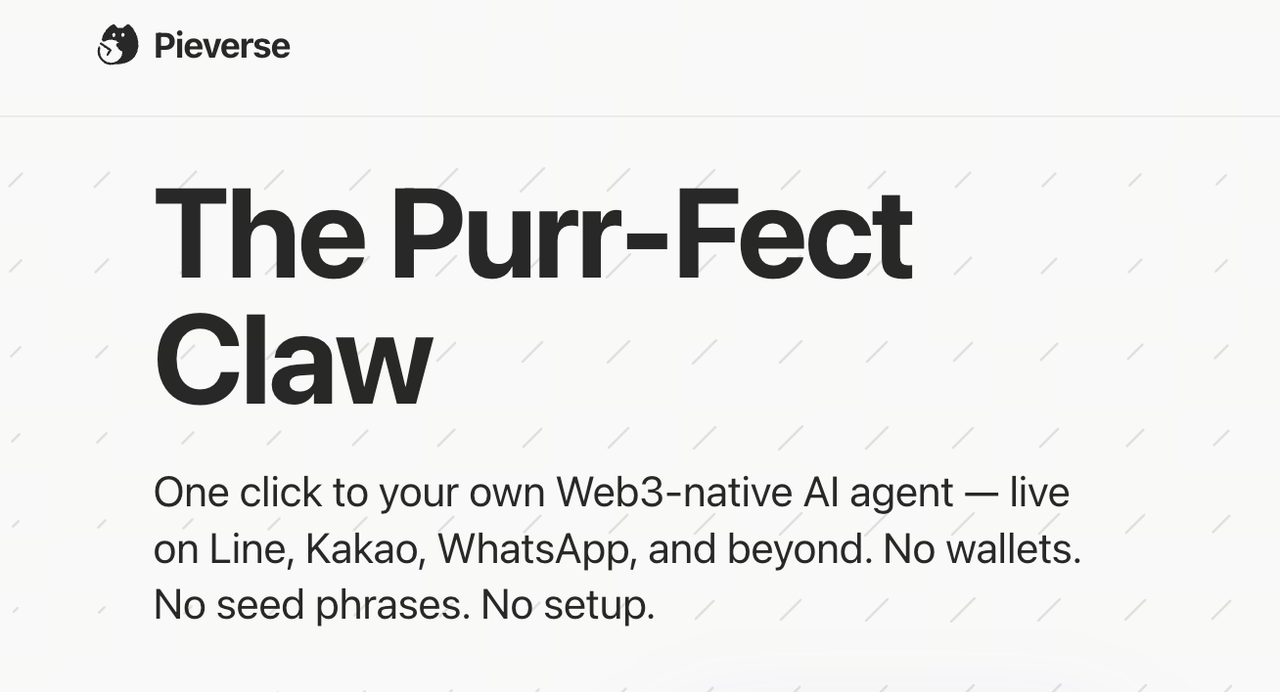
Purr-Fect Claw: A Walletless Gateway to Web3 Interaction
Purr-Fect Claw offers a chat based approach to Web3 interaction, allowing users to call onchain functions directly within common communication tools.
This model reduces the complexity of traditional wallet management, including private key storage and signing processes. Users can trigger transactions through natural language input, while the system handles the subsequent execution.
Pieverse’s Agent Economy Model
Within the Pieverse system, AI Agents do more than serve as execution tools. They can also participate in the flow of value.
This model is often described as the Agentic Economy, an economic system led by agents. In this system, Agents can make payments, manage assets, and even interact with other Agents.
Pieverse Use Cases
Pieverse is designed for a range of scenarios that combine onchain and offchain activity.
In automated trading, Agents can execute buy and sell operations based on preset rules. In enterprise environments, the system can be used to generate auditable payment records. In social scenarios, users can complete onchain interactions directly through a chat interface.
Pieverse’s Advantages and Limitations
Pieverse has clear advantages in lowering the barrier to entry. Its walletless design enables more users to participate in Web3 interactions. At the same time, its auditable structure supports compliance oriented use cases.
However, this model also introduces new challenges, including execution risks from AI Agents, permission control issues, and potential security vulnerabilities.
How Pieverse Differs from Traditional Web3 Payment Systems
Traditional Web3 interactions usually rely on wallets for signing and transaction confirmation, requiring users to manually complete multiple steps.
By contrast, Pieverse uses AI Agents to execute transactions automatically, abstracting the operating process into instruction input. This difference is not only reflected in the interaction model, but also affects the user experience and risk structure.
A comparison of Web3 wallets and the Agent model makes the practical differences between the two easier to understand.
Conclusion
Pieverse represents a shift in Web3 interaction from a “user driven” model to an “Agent driven” model. Through walletless interaction, automated execution, and auditable records, the system provides infrastructure support for AI Agents participating in the onchain economy.
As AI and blockchain continue to converge, models like this may take on a more important role in the future digital economy.
FAQ
Does Pieverse require a traditional crypto wallet?
Pieverse is designed to let users complete interactions in most cases without directly using a traditional wallet, although the underlying system still relies on onchain accounts.
What is the core role of Purr-Fect Claw?
Its main role is to provide a chat based gateway that allows users to call onchain functions through natural language.
How do AI Agents execute transactions in Pieverse?
AI Agents trigger transactions based on user input or preset rules, and the system completes the payment and recording process.
Does Pieverse support enterprise level applications?
Its auditable and timestamped recording mechanisms make it suitable for scenarios that require compliance and financial transparency.
What is the main change compared with traditional Web3 payments?
The main change is that interaction shifts from manual operation to automated execution, while also lowering the barrier to entry for users.