Users often search for SLOP because Slonks isn’t just a standard NFT collection—it fuses AI image discrepancies, NFT status changes, and tokenomics. SLOP’s value can’t be understood simply as a Meme Token or conventional governance token; it must be viewed within the context of the Slonks Void system.
This topic generally covers three aspects: how slop values convert into SLOP, how the Void enables NFTs to become recoverable, and how SLOP’s burn mechanism shapes the supply structure of Slonks.
What Is the SLOP Token
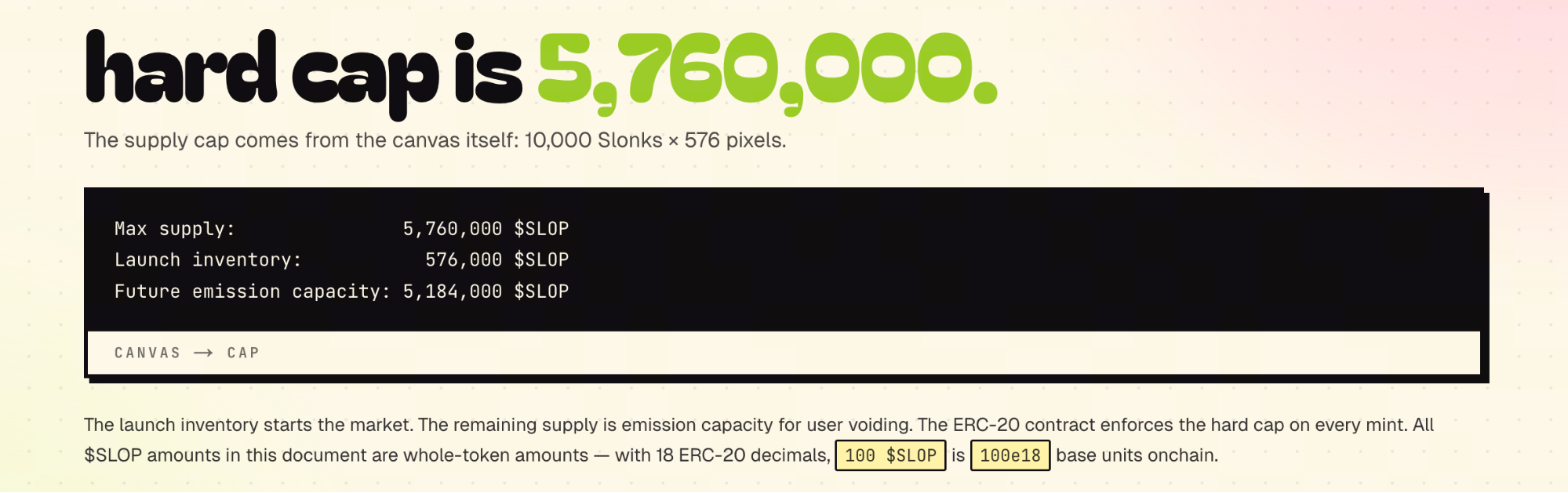
SLOP is designed to turn the image discrepancy value of a Slonks NFT into a tradable asset. According to the official mechanism, SLOP is the ERC-20 version of slop, where slop refers to the number of pixel differences between a Slonks model-generated image and the original CryptoPunk image.
Structurally, SLOP isn’t a typical token issued independently from NFTs. Instead, it’s an on-chain resource generated based on Slonks NFT status. Each Slonk image has 576 pixels, so a single NFT’s slop value theoretically ranges from 0 to 576. When a Slonk is placed into the Void and claimed, its current slop value determines how much SLOP is minted.
SLOP’s supply logic stands apart from traditional Meme Tokens. There are no team reserves, VC allocations, or fixed community airdrops; instead, token issuance is directly tied to NFT activity.
| SLOP Tokenomics |
Data |
| Maximum Supply |
5,760,000 SLOP |
| Initial Circulating Supply |
576,000 SLOP |
| Subsequent Release Method |
Users void NFTs |
| Burn Mechanism |
Revival Burn |
| Does Merge Directly Mint Tokens |
No |
| Theoretical Max Output per NFT |
576 SLOP |
This means SLOP acts more as an on-chain resource driven by NFT image discrepancies, not a conventional pre-mined token.
How the Void Mechanism Generates SLOP
The core of the Void is to transition Slonks NFTs from an active state to a contract state, converting the NFT’s slop value into SLOP. The Void isn’t just a burn address—it’s a contract pool that holds voided NFTs, which can later re-enter circulation through the Revival mechanism.
First, users lock an active Slonk into the game contract. The system records the user as the SLOP claim recipient, and the NFT cannot be transferred or otherwise changed while locked.
Anyone can then submit a model output proof to verify the Slonk’s current image state and slop value. The contract mints the corresponding amount of SLOP based on the verified slop and sends it to the recorded recipient.
Finally, the Slonk enters the Void, joining the NFT inventory eligible for Revival.
| Process Stage |
User Action |
System Action |
Result |
| Lock Slonk |
User submits NFT |
Contract records recipient |
NFT enters claim-pending state |
| Submit Proof |
Any address submits proof |
Model output verified |
Current slop confirmed |
| Claim SLOP |
User waits or triggers claim |
Mint corresponding SLOP |
slop becomes token |
| Enter Void |
NFT no longer active |
Contract stores Slonk |
Becomes Revival inventory |
This flow demonstrates that the Void is a comprehensive on-chain process of “lock, verify, mint, and pool,” not simply burning NFTs.
Why slop Value Determines SLOP Amount
SLOP is the tokenized form of slop, so the slop value directly determines how much SLOP is minted. Each Slonk’s slop is calculated as the pixel difference between its AI-generated image and the original CryptoPunk, serving as both an image variance metric and a token release parameter.
The system reads the Slonk’s sourceId, current active embedding, model-generated pixels, and original CryptoPunk pixels, calculating the number of differing pixels.
Since a Slonk image has 576 pixels, the maximum SLOP that can be generated per Void is 576.
| Current slop Value |
SLOP Generated |
| 15 |
15 SLOP |
| 128 |
128 SLOP |
| 400 |
400 SLOP |
| 576 |
576 SLOP |
This design ensures SLOP supply is algorithmically tied to NFT image states—not manual allocation. The higher the slop, the greater the difference from the original image, and the more SLOP is minted.
This mechanism fuses NFT visual variance, on-chain proof, and token issuance. SLOP is not merely an ecosystem reward—it’s a liquid representation of Slonks model output.
How SLOP Restores Void-State NFTs
SLOP’s main use case is Revival—burning SLOP to recover a Slonk from the Void. This gives SLOP both an acquisition path and a clear utility.
First, the user initiates a Revival request and burns SLOP at the current Revival cost. The system logs the request and, after a delay, uses on-chain randomness to select a Slonk from the eligible Void pool.
The chosen Slonk receives a new active embedding and re-enters circulation with a new image state. The NFT’s tokenId and sourceId remain unchanged, but its merge level and image state are updated.
Revival is the primary SLOP burn sink. After burning SLOP, users don’t select a specific NFT—they participate in an on-chain draw to restore a Slonk from the Void.
This mechanism gives SLOP real-world utility: it brings NFTs back from the Void to active status and reduces SLOP supply through burning.
How SLOP Differs from Standard Meme Tokens
SLOP’s core difference from Meme Tokens is that it isn’t built around narrative marketing or fixed issuance. Instead, it creates a supply-demand cycle through the Slonks NFT Void, slop calculation, and Revival.
Meme Tokens typically focus on community hype, liquidity pools, and trading, with the token itself rarely tied to any NFT state or on-chain computation.
SLOP, however, is issued based on a Slonk’s slop value after voiding and consumed via Revival burns.
| Comparison |
SLOP |
Standard Meme Token |
| Issuance Source |
Slonks Void Mechanism |
Project preset supply |
| Asset Relationship |
Bound to NFT state |
Usually independent |
| Calculation Basis |
slop pixel difference |
Typically no on-chain basis |
| Use Case |
Revival to restore NFT |
Primarily trading, community use |
| Supply Dynamics |
Affected by void and burn |
Defined by tokenomics |
This shows SLOP is a functional resource within the Slonks NFT ecosystem—not just a hype-driven Meme Token.
How Slonks Builds a Cyclical Mechanism with SLOP
The Slonks ecosystem cycle revolves around NFTs, Void, SLOP, and Revival. NFTs can enter the Void to generate SLOP, and can return from the Void by burning SLOP.
After acquiring a Slonk, users can send it to the Void and receive SLOP equivalent to its slop value. Others can burn SLOP to initiate a Revival and recover a Slonk from the Void.
The revived Slonk keeps its identity but gets a new image state and re-enters active circulation.
Note: Merge changes the NFT image and increases slop, but doesn’t directly generate SLOP. Its main function is to boost future Void returns.
In summary:
- Merge increases slop
- Void releases SLOP
- Revival burns SLOP
These three mechanisms form the Slonks on-chain cycle.
How the SLOP Mechanism Impacts NFT Scarcity
SLOP’s mechanism affects Slonks NFT scarcity through both Void and Revival. Void reduces the number of active NFTs, while Revival brings some Void-state NFTs back into circulation—making supply dynamic, not static.
When more users void their Slonks, the number of active NFTs drops and SLOP circulation rises. Tradable Slonks decrease, but the Revival pool grows.
Conversely, when more users burn SLOP for Revival, NFTs return from the Void, SLOP supply shrinks, and active Slonks increase.
This makes Slonks scarcity dynamic—not just determined by initial supply, but by how users move assets between NFTs and SLOP.
SLOP’s impact goes beyond tokens—it reshapes NFT supply structure, restoration pace, and user strategies.
Summary
The SLOP token’s role must be understood within the Slonks Void and Revival mechanisms. It’s not a standard Meme Token, but the ERC-20 representation of slop, providing liquidity for NFT image discrepancies.
In practice, users lock their Slonk into the Void, the system verifies the model output and calculates slop, then mints the corresponding SLOP. SLOP can then be burned in the Revival process to bring some Void-state NFTs back to active circulation.
Meanwhile, Merge changes NFT image state and increases future Void yields, but doesn’t directly generate SLOP.
This structure creates a cyclical relationship among Slonks NFTs, slop values, and SLOP tokens, shifting NFT scarcity from fixed supply to a dynamic, user-driven mechanism.
FAQ
What is the SLOP token
SLOP is the ERC-20 version of the slop value in the Slonks ecosystem. It’s generated through the Void mechanism and tied to Slonks NFT image discrepancies, on-chain state, and the Revival process.
What is SLOP’s maximum supply
According to the official white paper, SLOP’s theoretical max supply is 5,760,000, based on 10,000 Slonk NFTs and 576 pixels per NFT.
How does the Void generate SLOP
The Void locks a Slonk NFT and calculates its current slop using model output proof. After claiming, the contract mints SLOP equal to the slop value.
Does Merge directly generate SLOP
No. Merge changes the NFT image state and increases slop, affecting the amount of SLOP that can be minted in future Voids.
How does SLOP restore NFTs
Users can burn SLOP to initiate a Revival request. The system randomly selects a Slonk from the Void pool and restores it to active circulation with a new image state.
What’s the difference between SLOP and Meme Tokens
SLOP issuance and consumption are tied to the Slonks NFT mechanism, while Meme Tokens typically rely on community hype and trading. SLOP functions as a resource within the NFT ecosystem.