Recently, Wintermute posted on X stating that the macro environment remains favorable, including rate cuts, the end of quantitative tightening, and stocks approaching highs. However, as capital flows have gradually decreased following the FOMC meeting, cryptocurrency performance continues to lag. Global liquidity is expanding, but capital has not flowed into the crypto market. ETF inflows have stalled, DAT trading activity has dried up, and only stablecoins are still growing. The market structure appears healthy—leverage has been suppressed, and positions are relatively clear. Nonetheless, a rebound in ETF or DAT inflows will be a key signal for liquidity recovery and potential catch-up.
Macro Update
Last week, the market experienced inevitable volatility following the Fed’s rate cut, the release of the FOMC minutes, and earnings reports from several US tech giants. As expected, the Fed cut rates by 25 basis points, marking the official end of quantitative tightening, and the Mag7 earnings reports were solid. However, Powell retracted almost certain expectations of another rate cut in December, causing market fluctuations. Before the meeting, market expectations for price volatility were as high as 95%, but now they’ve fallen to around 68%, prompting traders to readjust strategies and risk sentiment to rebound quickly.
This sell-off was less panic-driven and more about position adjustments. Some investors were overly bullish before the meeting, falling into a “first in, last out” scenario, as the market had already fully priced in the 25 basis point move. Stocks stabilized quickly after the meeting, but cryptocurrencies did not experience a similar rebound.
As of this writing, BTC and ETH prices have been oscillating, hovering around $107,000 and $3,700 respectively, while other cryptocurrencies remain volatile, mainly driven by short-term market sentiment. Compared to other asset classes, cryptocurrencies have performed the worst.
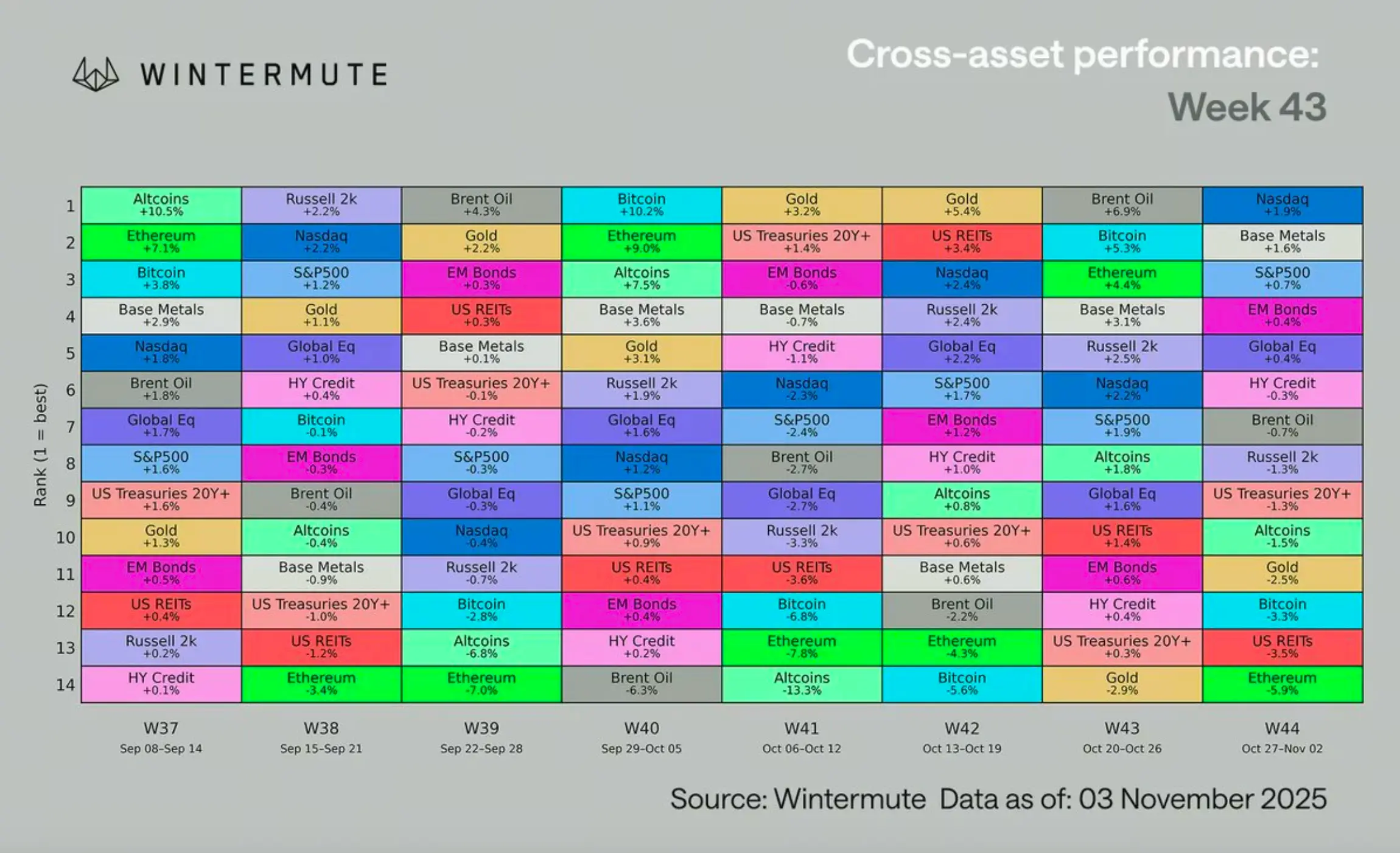
On the index front, major indices declined sharply last week, with the GMCI-30 index dropping 12%. The declines were widespread:
- Gaming sector down 21%
- Secondary markets down 19%
- Meme coin sector down 18%
- Small and mid-cap stocks down approximately 15-16%
Only the AI sector (-3%) and DePIN sector (-4%) showed relative resilience, thanks to TAO and some proxy stocks rallying earlier last week. Overall, this decline appears driven by capital flows rather than fundamentals, aligning with the liquidity contraction trend following the Fed meeting.

So, why has cryptocurrency lagged behind the rally in global risk assets?
In short, the issue is liquidity—not a lack of liquidity, but where the liquidity is flowing.
Global liquidity is clearly expanding. Central banks are weakening relatively strong assets rather than weak ones. We’ve seen this pattern only a few times before, and it typically leads to a strong risk appetite afterward. The problem is that new liquidity hasn’t been flowing into the crypto market as it did in the past.
Stablecoin supply continues to grow (up 50% year-to-date, adding $100 billion), but since summer, ETF inflows have stalled, with Bitcoin ETF assets under management hovering around $150 billion. The once-hot DAT trading channels have also gone quiet, with trading volumes on secondary markets like Nasdaq declining significantly.
Of the three main engines that drove capital inflows earlier this year, only stablecoins remain active. ETF inflows have stabilized, DAT activity has dried up, and although overall liquidity remains ample, the share of funds flowing into cryptocurrencies has shrunk noticeably. In other words, capital hasn’t stopped flowing; it has just shifted elsewhere.
The initial excitement has faded, ETF allocations are normalizing, and retail investors are turning to stocks, AI, and prediction markets for growth.
Our Perspective
The overall market environment remains strong, as evidenced by stock market performance. Liquidity has yet to benefit the crypto market.
The market is still digesting liquidation shocks, but the structure looks solid—leverage has been released, volatility is under control, and macroeconomic conditions are supportive. Bitcoin remains the market anchor, with steady ETF inflows and tight exchange supply; Ethereum and some L1/L2 tokens are also beginning to show early signs of relative strength.
The four-year cycle theory no longer applies, even as more people on the CT forum associate it with negative price performance. The mechanisms that once drove market movements, such as miner supply and halving cycles, are no longer relevant in mature markets. Today, liquidity is the key driver of market performance.
Macro conditions remain robust, with ongoing de-risking and the end of QT. Stocks are near highs, but crypto performance lags because liquidity hasn’t flowed into the crypto sector. Of the main capital inflow engines last year—ETFs, stablecoins, and DAT—only stablecoins are in good shape now. Monitoring ETF inflows and DAT activity is crucial, as these are likely among the first signals of liquidity returning to the crypto space.
Disclaimer: The information on this page may come from third parties and does not represent the views or opinions of Gate. The content displayed on this page is for reference only and does not constitute any financial, investment, or legal advice. Gate does not guarantee the accuracy or completeness of the information and shall not be liable for any losses arising from the use of this information. Virtual asset investments carry high risks and are subject to significant price volatility. You may lose all of your invested principal. Please fully understand the relevant risks and make prudent decisions based on your own financial situation and risk tolerance. For details, please refer to
Disclaimer.


