After a long and unbearable downturn, Pi Network has once again made headlines. The community is buzzing about Pi Network’s integration with the ISO 20022 standard, a message upgrade used by global banks that could position it alongside Stellar and XRP. Recent system updates include additional reviews for initial KYC cases, resulting in over 3.36 million Pi users passing KYC verification.
ISO 20022 Integration Targets the Global Banking System
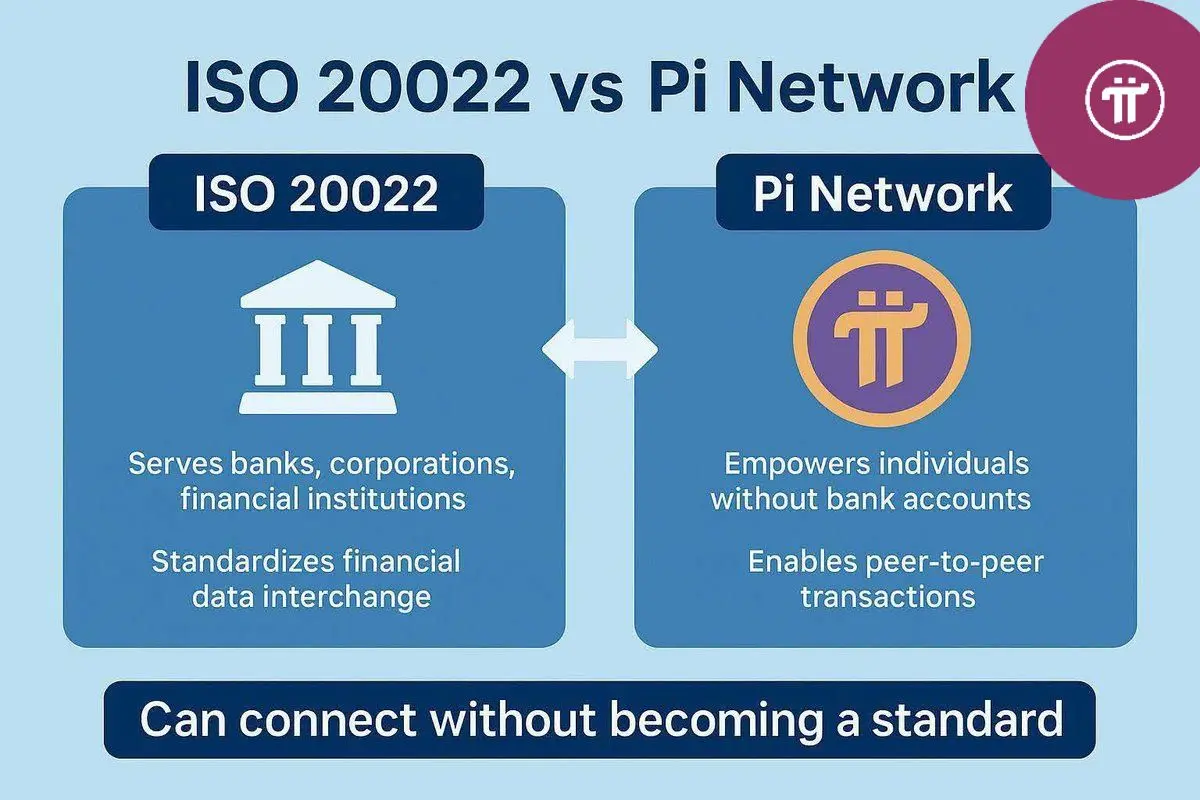
(Source: Facebook)
Pi Network has adopted the ISO 20022 standard, a message upgrade used by banks worldwide. This move could see Pi competing directly with Stellar and XRP, both of which are involved in regulated cross-border payments. ISO 20022 is a global electronic financial messaging standard that provides a universal language for businesses and banks to exchange and communicate data efficiently.
This structured language enhances the security, automation, and accuracy of transactions like asset exchanges and payments. It also allows for more detailed information within each message, such as invoice numbers, simplifying processes like payment reconciliation. Not only does this position Pi Network to compete with established crypto projects like Stellar and Ripple, but it also boosts its credibility, especially amid ongoing criticism.
Adopting ISO 20022 is strategically significant for Pi Network. Currently used by over 9,000 financial institutions across more than 70 countries—including SWIFT, the Federal Reserve, and the European Central Bank—this standard ensures Pi’s transaction messaging format will be fully compatible with traditional banking systems. This paves the way for smoother future integrations with banks and payment providers.
There are rumors that Pi Network aims to complete full integration by November 22, 2025. If achieved, Pi would be among the few cryptocurrencies fully compliant with ISO 20022 standards. This compliance could attract institutional investors and corporate clients wary of regulatory issues surrounding crypto.
Three Strategic Values of ISO 20022 Integration
Bank System Compatibility: Message format compatibility enables direct integration of Pi payments
Cross-Border Payment Competitiveness: Competing alongside XRP and Stellar in international remittances
Increased Institutional Trust: Meeting global standards reduces compliance risks and attracts enterprise clients
With stronger partnerships and clearer development goals, Pi Network is making significant progress, potentially stabilizing its long-term value. This marks a key transition from a community experiment to a professional financial infrastructure.
3.36 Million Users Pass KYC, 4.76 Million Waiting
An exciting update: recent system enhancements include extra reviews for initial KYC cases, allowing over 3.36 million Pi users to pass verification, in addition to the original early adopters and active participants. Moreover, 4.76 million users are eligible but still waiting to complete KYC. These figures represent a major milestone in Pi’s identity verification efforts.
Pi Network has been dedicated to strengthening network integrity and user authentication. To this end, it introduced a new automated system process designed to clear backlogs of KYC applications, enabling millions of pioneers to complete full verification and eventually migrate to the mainnet. This large-scale process analyzes vast datasets from KYC submissions and biometric checks, utilizing advanced AI models for complex validation.
The system verifies whether each applicant is a real person and whether they have passed all necessary secondary checks, ultimately completing the KYC process. These measures help prevent fraudulent accounts, uphold Pi’s “one person, one account” policy, and maintain network integrity.
Passing KYC for 3.36 million users is a significant milestone, meaning they can now transfer their Pi to the mainnet and trade freely once the Open Mainnet launches. For users who have waited years, this is one of the most tangible signs of progress. The 4.76 million eligible but pending users also indicate a large queue of users awaiting verification.
Pi team emphasizes that biometric verification is crucial for final KYC approval and user migration to the mainnet. They encourage active engagement within the app, which can trigger automated processes to speed up migration and verification. This demonstrates Pi’s use of AI-driven automation to handle large-scale KYC, with user cooperation accelerating the process.
DeFi Testnet Opens New Chapter in Financial Ecosystem
What truly brought Pi Network back into the spotlight is the launch of its DeFi (Decentralized Finance) testnet. This testnet integrates AMM (Automated Market Makers) and DEX (Decentralized Exchanges) into the Pi Wallet, allowing early users to simulate liquidity provision and asset swaps without using real Pi tokens, focusing instead on feedback and education.
In simple terms, a testnet is a blockchain environment for testing new features, applications, and smart contracts without risking real assets. Pi Network’s recent upgrade introduces AMM and DEX functionalities within the Pi Wallet, marking a significant step in ecosystem expansion.
This allows pioneers to experiment safely with DeFi tools, create liquidity pools, and perform asset swaps. Users can provide feedback and gain experience before the features go live on the mainnet. The launch of the testnet is a crucial move toward making Pi a practical, Web3-ready platform with a community-driven financial ecosystem.
This step not only aligns Pi with other leading blockchain ecosystems but also signals a shift from theoretical planning to practical application. Successful DEX platforms like Uniswap and PancakeSwap handle hundreds of billions of dollars in trading volume, offering users autonomy and transparency beyond traditional exchanges. Pi’s DeFi testnet demonstrates its serious commitment to this direction.
Pi Network’s Long Road Ahead, Clear Direction
It’s clear that Pi Network still has a lot of work to do. The launch of its DeFi testnet shows readiness for broader adoption, increased maturity, and liquidity. It indicates that the network is preparing for a comprehensive Web3 experience, where Pi users become not just consumers but active participants in the financial ecosystem.
The integration of ISO 20022 is particularly exciting, promising more transparent, secure, and faster financial transactions. Rumors suggest Pi plans to complete full integration by November 22, 2025. If true, Pi will transition from a community project to a globally compliant financial infrastructure within less than a year.
Until then, we’ll have to wait and see what surprises Pi Network has in store. For Pi holders, these three major updates offer compelling reasons for optimism: ISO 20022 integration addresses compliance, 3.36 million KYC clearances show migration is accelerating, and the DeFi testnet lays the groundwork for future financial applications.
Disclaimer: The information on this page may come from third parties and does not represent the views or opinions of Gate. The content displayed on this page is for reference only and does not constitute any financial, investment, or legal advice. Gate does not guarantee the accuracy or completeness of the information and shall not be liable for any losses arising from the use of this information. Virtual asset investments carry high risks and are subject to significant price volatility. You may lose all of your invested principal. Please fully understand the relevant risks and make prudent decisions based on your own financial situation and risk tolerance. For details, please refer to
Disclaimer.


