Trading activity in Ether futures has surpassed that of Bitcoin on the Chicago-based CME Group, marking a notable shift in the digital asset derivatives market and fueling speculation that Ether may be entering a long-anticipated “super-cycle” — a sustained, multi-year period of accelerated growth driven by rising adoption.
In a recent CME video, Priyanka Jain, the exchange’s director of equity and crypto products, said Ether (ETH) options are currently exhibiting higher volatility than Bitcoin (BTC) options. Rather than deterring participation, she said, the increased volatility has attracted traders and helped drive growth in Ether futures activity.
“This heightened volatility has served as a powerful magnet for traders, directly accelerating participation in CME Group’s Ether futures,” Jain said. “Is this Ether’s long-awaited super-cycle, or merely a catch-up trade driven by short-term volatility?”
The rotation was especially pronounced in July, when the so-called flippening saw open interest in Ether futures overtake that of Bitcoin futures on the exchange for the first time.
While Bitcoin and Micro Bitcoin futures still account for the largest share of activity when measured by US dollar value, Jain said the broader trend is clear: Market participation in Ether-linked products is expanding rapidly.
 Source: CME GroupRelated: ETH sells off alongside Bitcoin, but Ether adoption pace still supports rally to $10K
Ether price sees renewed volatility
Ether, Bitcoin and the broader cryptocurrency market came under renewed selling pressure on Monday, extending a volatile period that has capped a difficult month for the sector. The move appeared to follow a coordinated wave of de-risking at the end of November.
Commenting on the sell-off, market analyst CTO Larsson said traders cut exposure immediately after the monthly close.
“People reduced exposure at exactly 00:00 UTC, because the monthly candle closed bad,” he said.
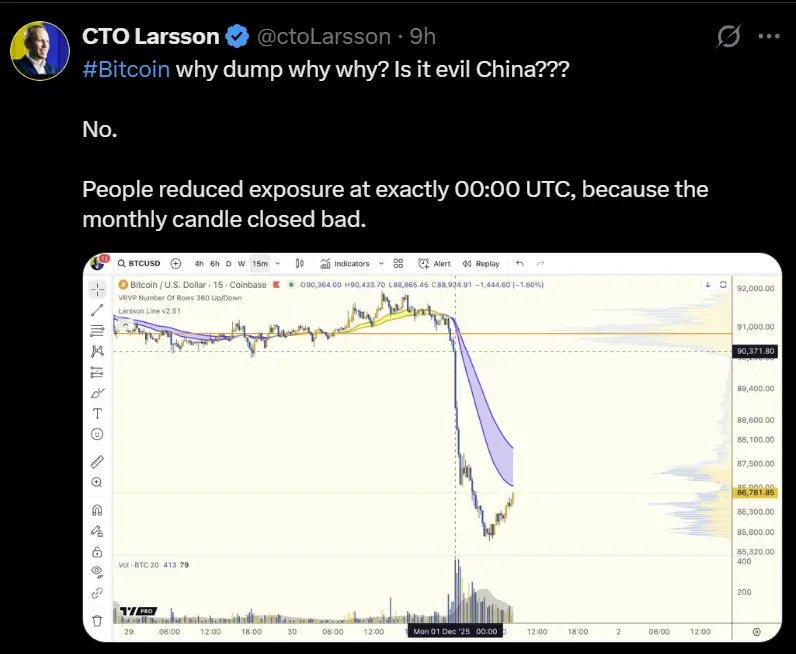 Source: CTO LarssonMeanwhile, Ether treasury companies — corporations that made holding ETH on their balance sheets a core business strategy — have seen the value of their holdings decline sharply. Companies such as SharpLink and Bit Digital are now underwater on their ETH positions, according to data from CoinGecko.
Magazine: How Ethereum treasury companies could spark ‘DeFi Summer 2.0’
- #Ethereum
- #CME
- #Futures
- #Ethereum Options
Add reaction
![]()
Disclaimer: The information on this page may come from third parties and does not represent the views or opinions of Gate. The content displayed on this page is for reference only and does not constitute any financial, investment, or legal advice. Gate does not guarantee the accuracy or completeness of the information and shall not be liable for any losses arising from the use of this information. Virtual asset investments carry high risks and are subject to significant price volatility. You may lose all of your invested principal. Please fully understand the relevant risks and make prudent decisions based on your own financial situation and risk tolerance. For details, please refer to
Disclaimer.
Related Articles
BitMine position update: holds over 4.8 million ETH and 198 BTC, with total assets of $11.4 billion
BitMine released a holdings update on April 6. The total value of its crypto assets and moonshots reached $11.4 billion. It holds ETH, BTC, and multiple equity positions, and has been approved to upgrade from NYSE American to the NYSE main board. The stock will begin trading in the new market on April 9.
GateNews17m ago
Strive increases its holdings by 113 BTC, bringing total holdings to 13,791 BTC and ranking ninth
Bitcoin treasury company Strive recently increased its holdings by 113 BTC, bringing its total holdings to 13,791 BTC, ranking ninth. CEO Matt Cole hinted that it will surpass a certain CEX that holds 15,389 BTC.
GateNews28m ago
BTQ Technologies releases quantum bitcoin mining research: actual costs are extremely high, and the real risk lies in a signature vulnerability
BTQ Technologies publishes a research paper assessing the physical costs of quantum computing in Bitcoin mining, emphasizing that Bitcoin’s main risk comes from vulnerabilities in cryptographic signatures rather than quantum mining. The study proposes an open-source resource estimation model that covers key computational steps.
GateNews42m ago


