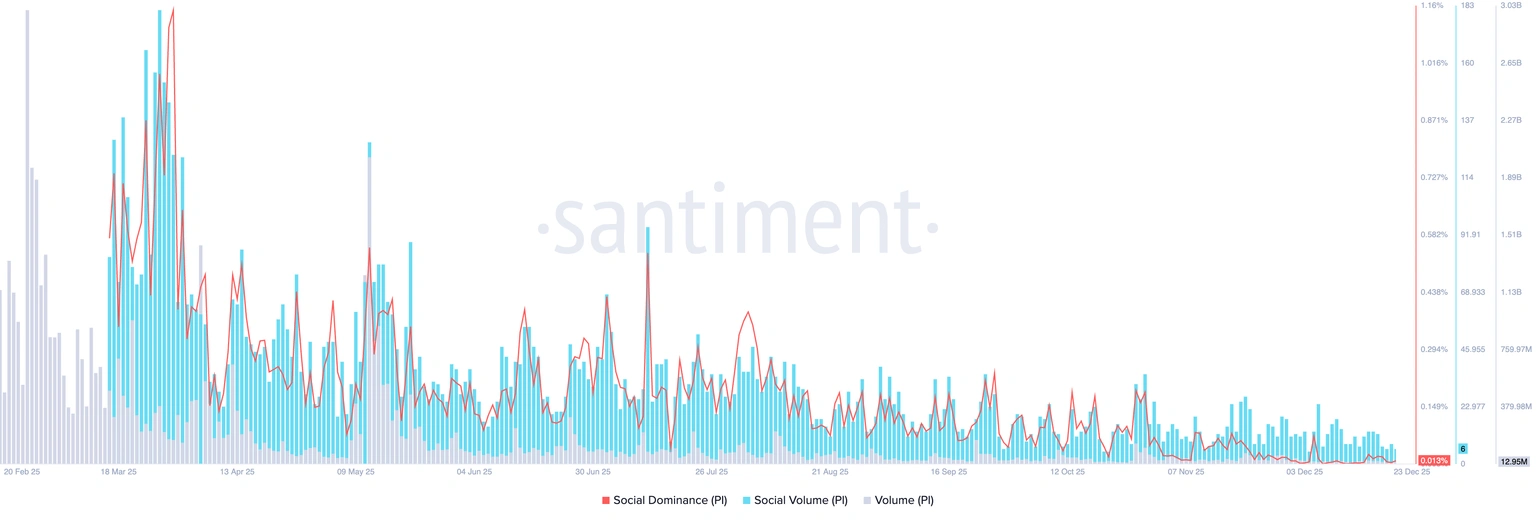
Pi Network (PI) rises slightly by nearly 1%, rebounding from the $0.20 level after four consecutive days of decline, but this rally remains weak. Santiment data shows that Pi’s social media share and trading volume have decreased to 0.013% and 6 respectively. Daily trading volume has shrunk to below 12 million PI, and the Pi token breaking through the 50-day EMA of $0.2239 becomes a key factor for initiating a Christmas rally.
Pi Token Trading Volume Crashed 99% Revealing a Deadly Crisis
(Source: Santiment)
Whether Pi Token can usher in a Christmas rally is primarily hindered by a catastrophic collapse in trading volume. From a daily trading volume of 2 billion PI on May 12, it has plummeted to the current 12 million PI, a decrease of 99.4%. Such a scale of volume contraction is extremely rare in the crypto market and usually indicates that market participants are withdrawing en masse.
Trading volume is a critical indicator of market health. When trading volume continues to shrink, it suggests that both buyers and sellers are losing interest, and liquidity depletion can amplify price fluctuations in any direction. For a community-driven project like Pi Network, a collapse in trading volume is not only a technical issue but also reflects a complete loss of community confidence.
Santiment data further confirms this trend. Pi Network’s social media attention is declining; as of Wednesday, social media share has dropped from its peak of 0.017% on December 6 to 0.013%, a decline of 23.5%. Social volume has fallen from 24 to 6, a plunge of 75%. This sharp decrease in community engagement indicates that even the most loyal Pi supporters are beginning to lose patience.
In the crypto market, social media attention often serves as a leading indicator of price movements. When discussion enthusiasm wanes, it usually signals that prices are about to face greater pressure. Currently, Pi Network is caught in this negative cycle: falling prices lead to community disappointment, which further weakens buying interest, causing prices to remain under pressure. Once this vicious cycle forms, it is difficult to reverse in the short term.
Why Hackathon and E-commerce Events Fail
Pi Token’s potential to see a Christmas rally was initially hoped to be driven by two recent catalysts: the Pi Hackathon and community e-commerce holiday activities. However, these events, which should have boosted market sentiment, failed to produce the expected effects and instead highlighted deeper issues facing Pi Network.
The Pi Hackathon aims to attract developers to build applications based on Pi Network, enriching the ecosystem. In theory, more applications mean more use cases, which could increase demand for the token. But in reality, the developer community’s interest in Pi Network is far less than their interest in mature platforms like Ethereum and Solana. This may stem from several factors: inadequate technical documentation, unfriendliness of development tools, or most fundamentally—lack of confidence in the platform’s long-term prospects.
Three Main Reasons for the Failure of Pi Network Activities
Doubtful Authenticity of User Base: Pi Network claims to have tens of millions of users, but actual active users may be far fewer, leading to lower-than-expected participation in activities.
Lack of Killer Applications in Ecosystem: Without truly engaging use cases, e-commerce activities become mere formalities.
Limited Token Liquidity: A large portion of PI remains locked, unable to be freely traded, which restricts market vitality.
Community e-commerce holiday activities further expose Pi Network’s awkward situation. Although the project encourages merchants to accept PI payments, actual adoption remains very low. The reason is simple: why would merchants accept a cryptocurrency with unstable prices, poor liquidity, and difficulty converting to fiat currency? In a context where fiat and mainstream stablecoins already provide convenient payment solutions, the value proposition of PI is unclear.
These activity failures send a dangerous signal: even with efforts from the project team, market interest in Pi Network remains low. This “push not working” state is a common feature of many failed projects, making the possibility of a Christmas rally for Pi even more unlikely under these circumstances.
Technical Analysis: The Last Defense at $0.20
(Source: Trading View)
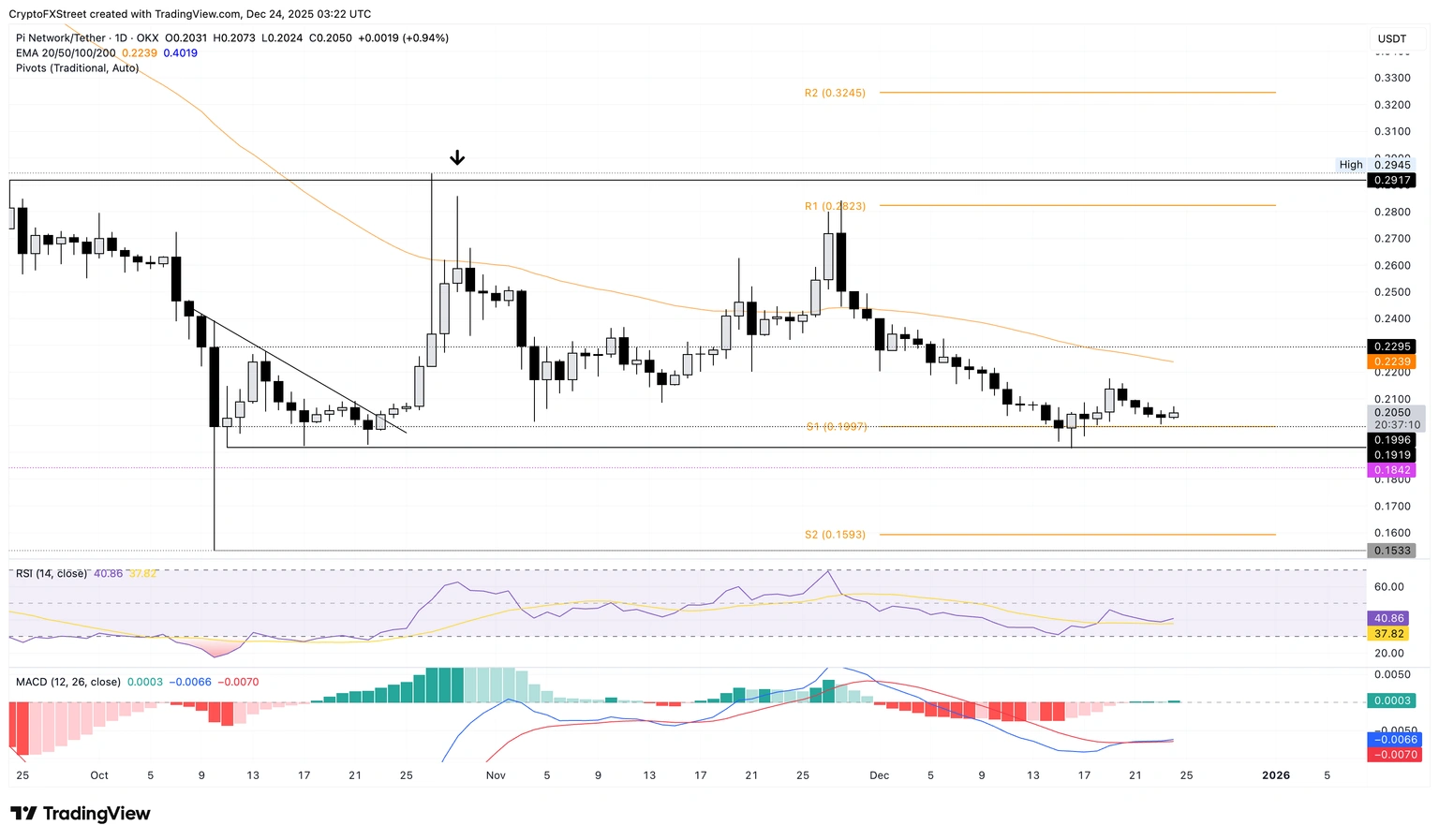
From a technical perspective, whether Pi can rally for Christmas depends on whether the critical psychological support at $0.20 can hold. On Wednesday’s close, PI struggled to stay above $0.20, rising by 1%, reflecting demand at this price level. This level is also close to the S1 pivot point at $0.1997, forming a double support structure.
However, technical indicators show insufficient rebound momentum. The Relative Strength Index (RSI) is at 40, slightly rebounding but still in a weak zone. An RSI below 50 generally indicates that the bears are in control; only a break above 50 can confirm a trend reversal. The Moving Average Convergence Divergence (MACD) crossed above the signal line on Sunday and is currently stable above it, which is the only positive signal.
Even if PI successfully rebounds from $0.20, there are many resistances ahead. The 50-day EMA at $0.2239 is the first major hurdle. After breaking through this, it must also face the R1 pivot at $0.2823. Considering current trading volume levels, it will be difficult for PI to gather enough buying momentum to clear these resistances.
More concerning is the downside risk. If PI fails to close higher on the day, it may break below $0.20, continuing its decline. In this case, the October 11 low of $0.1919 and the S2 pivot at $0.1593 could become the next support levels. Falling below $0.1919 would open the door to $0.15 or even lower. At that point, whether Pi can rally for Christmas will turn into the question: “Can Pi hold $0.10?”
Combining fundamental and technical analysis, the outlook for a Christmas rally for Pi leans pessimistic. Unless there is an unexpected major positive development (such as listing on mainstream exchanges or launching killer applications), PI is more likely to continue under pressure before Christmas.
Disclaimer: The information on this page may come from third parties and does not represent the views or opinions of Gate. The content displayed on this page is for reference only and does not constitute any financial, investment, or legal advice. Gate does not guarantee the accuracy or completeness of the information and shall not be liable for any losses arising from the use of this information. Virtual asset investments carry high risks and are subject to significant price volatility. You may lose all of your invested principal. Please fully understand the relevant risks and make prudent decisions based on your own financial situation and risk tolerance. For details, please refer to
Disclaimer.
Related Articles
Pi Network Agreement 23 Targets the Institutional Market, Smart Contracts, and RWA Tokenization to Launch in Early May
Pi Network officially went live with Protocol 23 on May 18, bringing smart contracts, real-world asset tokenization, and the AI App Studio, enabling Pi to transform from a payment token into a programmable blockchain infrastructure. The protocol covers four major functions, similar to Ethereum, and is expected to attract institutional investors. The upgraded node milestones signal market confidence and may affect Pi’s price performance.
MarketWhisper10h ago
Pi Network 18 million users complete KYC, and 26.5 million PI are issued to verifiers
Pi Network distributes 26.5 million PI tokens to more than 1 million community members who have completed KYC verification, to accelerate user identity verification and strengthen the decentralized model. 18 million already-verified users have laid the groundwork for the ecosystem’s development, but the key lies in how to convert these users into active participants. With the protocol upgrade, Pi Network is moving toward the open network phase, and smart contract support signals richer application scenarios.
MarketWhisper04-14 05:07
Pi Network price hits a new 7-week low as a wave of 60 million token unlocks comes in
Pi Network's native token PI fell to $0.165 in April, hitting a 7-week low and leaving market sentiment weak. The unlock peak will release more than 60 million PI, adding downward pressure. Despite the core team recently publishing technical updates, it failed to improve market confidence and instead drew community criticism due to KYC access issues and the ongoing slide in price. Increased future supply could further drive prices lower.
MarketWhisper04-14 02:50
Pi Network Distributes 26.5M PI to 1M KYC Validators
Pi Network has taken another step forward in building its ecosystem. The project recently distributed 26.5 million PI tokens to more than 1 million KYC validators.
These rewards were given to users who helped verify identities on the network. This process is important. Because it ensures that
Coinfomania04-13 13:30
Pi Network PIRC baseline protection mechanism sparks controversy, implying a “quasi-stablecoin” logic
Pi Network member Daniel F raised a logical contradiction in the PIRC token design, noting that if it has a 23.8% floor protection, it would need to behave like a stablecoin, which conflicts with its high volatility on CEX. This floor is based on Pi’s price calculations; if Pi itself fluctuates significantly, it will be unable to effectively protect holders. Daniel emphasized the importance of transparency, but the project team did not respond to it, leading the community to continue speculating about the reasons for its silence.
MarketWhisper04-13 02:23


