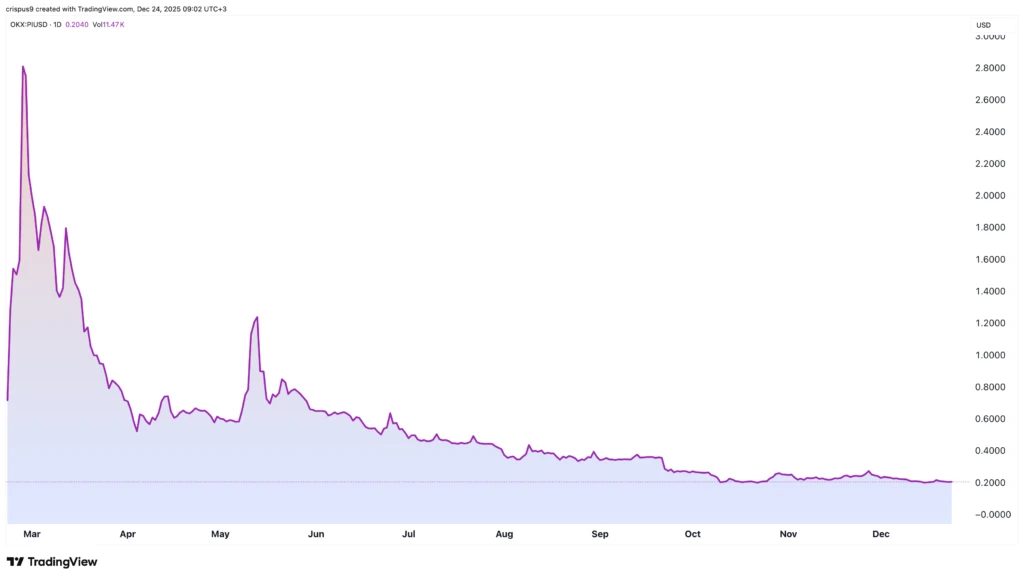
Pi Network was the dark horse of the 2019 crypto projects, promising that anyone could mine and get rich using just a mobile phone, attracting over 60 million users. But after the mainnet launched in February 2025, the token price plummeted from a historical high of $3 to $0.2040, and its market cap evaporated from nearly $20 billion to $1.7 billion. Miners found themselves stuck in the KYC process, unable to withdraw tokens, turning five years of mining efforts into nothing but despair.
From 60 Million Users to the Fall of a Ghost Chain
(Source: Google Play Store)
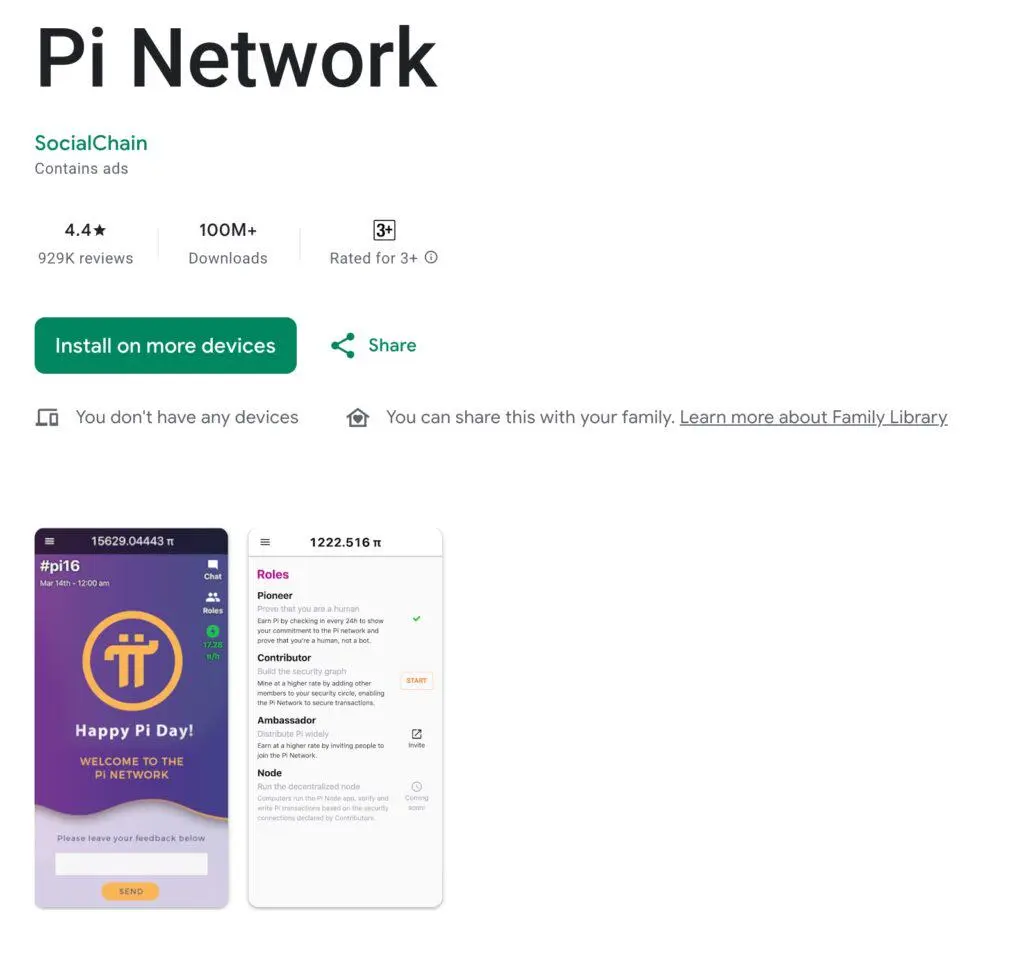
Pi Network was launched in 2019 by Dr. Nicolas Kokkalis and Dr. Chengdiao Fan of Stanford University, with an extremely attractive vision: unlike Bitcoin which requires specialized mining hardware, anyone could mine Pi coins using a smartphone, with transaction costs far lower than other cryptocurrencies. This “everyone can mine and get rich” narrative spread rapidly worldwide, with Android downloads surpassing 100 million.
The project transitioned to a closed mainnet in December 2021, claiming the mainnet was ready but only operating on an internal network. This closed period lasted over three years, during which Pi Network continued to attract new users to join the mining army. Many opened the app daily to click the mining button, dreaming of wealth once Pi was listed on exchanges.
In February 2025, the mainnet finally opened, and tokens were listed on exchanges like Gate. However, the dream was instantly shattered. First, only users who completed the strict KYC process could transfer tokens from the closed mainnet to the mainnet. This KYC process was extremely cumbersome and lacked transparency; many users were rejected for various reasons, and tens of millions’ mining results were locked inside the system, unable to be cashed out.
Even more devastating, those lucky enough to pass KYC found the token value far below expectations. After briefly reaching $3 early on, the price started to crash, now down to $0.2040. Five years of persistence did not bring wealth but only despair and total loss.
Three Fatal Flaws Causing $20 Billion Market Cap to Vanish
(Source: Trading View)
The collapse of Pi Network was not accidental but the inevitable result of structural flaws. The first critical issue was the lack of listing on mainstream exchanges. Unlike many emerging crypto projects, Pi Network did not gain support from top-tier exchanges. A major CEX CEO even publicly called it a scam, which completely destroyed its chances of entering the mainstream market.
Without mainstream exchanges, liquidity was extremely scarce. Even users holding Pi coins found it difficult to find buyers when they wanted to sell, causing prices to plummet. Worse, the absence of backing from major exchanges made Pi Network appear untrustworthy to institutional investors and professional traders, further accelerating the price collapse.
Fatal Flaws of Pi Network
Ghost Chain Dilemma: Despite claiming to have an application ecosystem, in reality, it lacks real users and valuable DApps. Network activity is extremely low, earning it the industry’s label as a “Ghost Chain.”
Extreme Dilution Effect: Hundreds of thousands of new tokens are unlocked weekly, with over 1.2 billion expected to be released in the next 12 months. Continuous supply pressure crushes the price.
Centralized Dictatorship: The Pi Foundation controls billions of tokens without voting mechanisms. The community has no say in decisions, and there is a lack of transparency. This “cryptocurrency shell with centralized dictatorship core” destroys trust in Pi Network.
Ghost Chain is Pi Network’s most deadly label. Although the team claims there are applications running on the network, investigations show these DApps have almost no real users and many are deemed useless. A blockchain without practical use cases, how can its tokens have value? When investors realize Pi Network is just a shell, a sell-off becomes inevitable.
The dilution effect is a chronic poison continuously destroying the price. Unlike cryptocurrencies like Bitcoin with a fixed supply cap, Pi Network releases millions of new coins weekly, with over 1.2 billion more to be unlocked. This means that even with new capital inflows, the increasing supply will dilute the value. Early miners’ hard-earned coins are diluted by the endless release of new coins, making the economic model fundamentally unsustainable for maintaining token value.
The centralized governance structure also fundamentally contradicts the original spirit of cryptocurrencies. The Pi Foundation, a little-known entity, controls billions of tokens without constraints. The community cannot vote on project directions, cannot oversee token releases, and even basic transparency is lacking. This “cryptocurrency shell + centralized dictatorship core” combination causes Pi Network to lose trust within the crypto community.
Can Desperate Self-Help Succeed?
Fairly speaking, Pi Network’s sharp decline coincided with overall weakness in the crypto market, including major coins like Bitcoin and Ethereum experiencing corrections. To reverse the downward trend, the team is making some changes. They are developing testnets for token generators, automated market makers (AMMs), and decentralized exchanges (DEX), hoping their DEX platform can attract users like successful platforms such as Aave and Raydium.
Additionally, Pi Network has invested in two projects: CiDi Games and OpenMind. The former will introduce gaming features, and the latter aims to make it an AI platform. The team also registered a token in Europe under MICA, which could give it a chance to list on mainstream exchanges in that region. If these initiatives succeed, they could theoretically improve Pi Network’s fundamentals.
However, whether these self-help measures can turn the tide remains a huge question mark. Developing DEX and AMM takes time, and it’s unclear if Pi Network has enough users and liquidity to support these functions. The integration of gaming and AI is even more distant, and the market has already lost patience with Pi Network.
Disclaimer: The information on this page may come from third parties and does not represent the views or opinions of Gate. The content displayed on this page is for reference only and does not constitute any financial, investment, or legal advice. Gate does not guarantee the accuracy or completeness of the information and shall not be liable for any losses arising from the use of this information. Virtual asset investments carry high risks and are subject to significant price volatility. You may lose all of your invested principal. Please fully understand the relevant risks and make prudent decisions based on your own financial situation and risk tolerance. For details, please refer to
Disclaimer.
Related Articles
Pi Network fake 2FA scams surge, with 119,000 migrated users targeted
Recently, there has been a surge in phishing attack cases targeting Pi Network. Scammers send fake 2FA links aimed at users who have already completed the second mainnet migration, attempting to steal their 24-word seed phrase. These phishing pages resemble the official interface and exploit users’ trust in official operations to carry out the scam. Experts recommend that if a user has leaked their seed phrase, they should immediately transfer their assets and stop using the old wallet to protect their assets.
MarketWhisper49m ago
Pi Network mainnet gets faster again! 109,000 users complete a second migration, and ecosystem rollout enters a critical phase
In 2026, the Pi Network mainnet rollout initiative has made progress, with more than 119,000 users completing a second migration, signaling a transition toward an “application-driven” model. Second migration allows users to transfer additional Pi balances into their mainnet accounts, but it requires KYC verification. The project team is proceeding carefully, has begun expanding real-world application scenarios, and despite disagreements within the community, the system as a whole is developing steadily; going forward, the key will be migration efficiency and the successful rollout of ecosystem applications.
GateNews49m ago
Pi Network Surpasses 119K Second Mainnet Migrations
The Pi Network has achieved a milestone with over 119,000 users completing their second migrations, allowing for transferring additional Pi balances and referral bonuses. While progression continues, priority remains on first migrations, ensuring users are not left behind. New tools are enhancing the ecosystem, contributing to real utility within the network despite some user frustrations.
Coinfomania1h ago
Pi Network mainnet migration triggers CEX deposits, bulls defend the 0.1736 USDT support line to the death
After Pi Network’s second mainnet migration, about 119,000 users completed KYC verification, resulting in more than 1.12 million PI tokens flowing into centralized exchanges and creating short-term selling pressure. Technical analysis shows that $0.1736 is a key support level, and the Protocol 21 upgrade on April 6 will affect token stability and application expansion.
MarketWhisper4h ago
The PI bulls remain steadfast at the critical support level that marks the decisive point between the second phase of the migration wave
Pi Network saw a 2% rise on Tuesday, maintaining key support amid US-Iran tensions. The second mainnet migration led to increased PI deposits on exchanges, highlighting ecosystem challenges. Technical indicators show potential recovery, but resistance remains at $0.1872.
TapChiBitcoin4h ago
Pi Network Audit Scores 96 Out Of 100, Highlighting Coixa Wallet As Low Risk
_Pi Network’s Coixa Wallet scores 96/100 in a 260-page audit, classifying it as low risk._
_Protocol V21.2 is ready; Windows Node users update automatically, Linux CLI users run update-protocol._
_Coixa Wallet securely connects ecosystem features while keeping private keys and
LiveBTCNews11h ago


