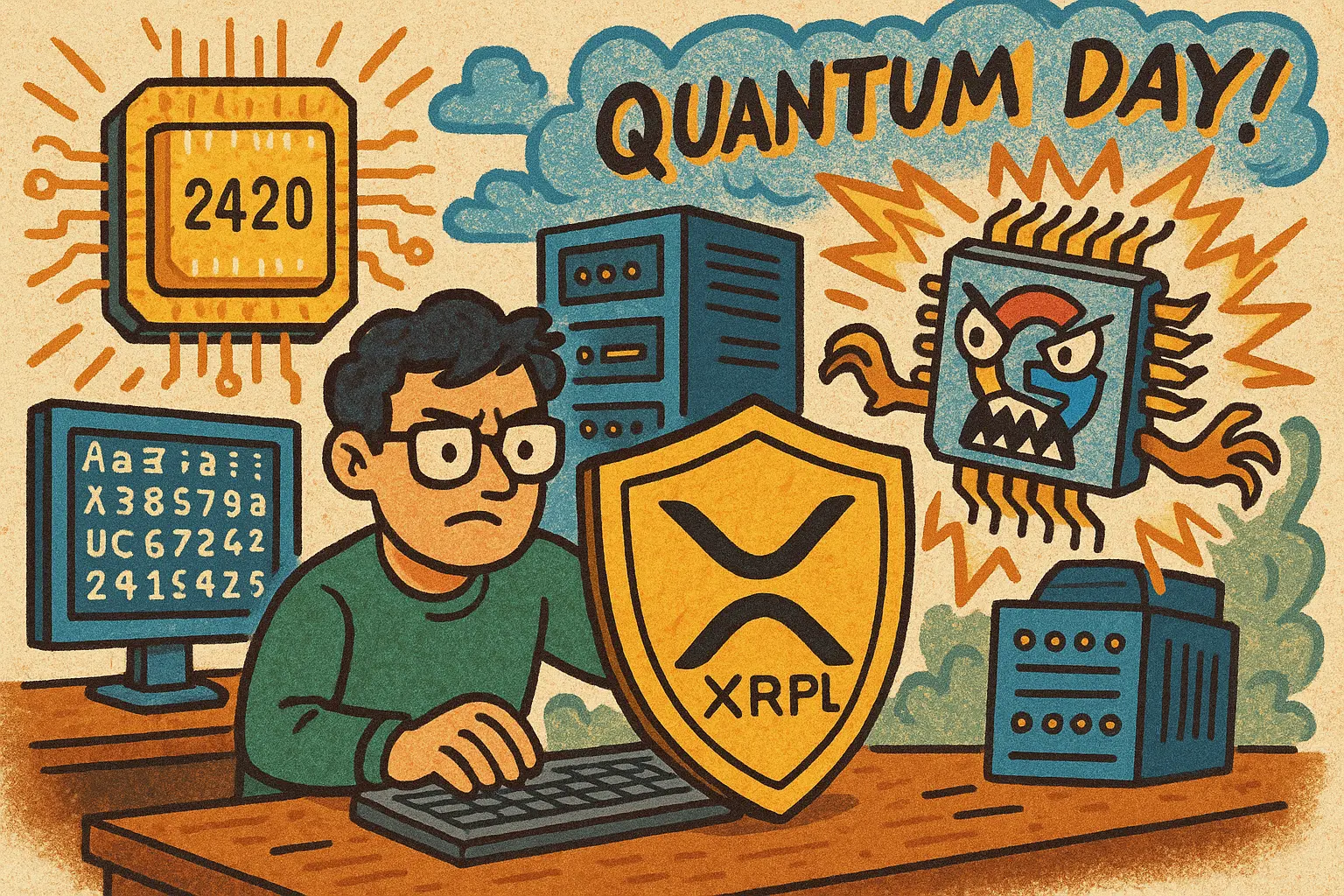
XRPL Labs Chief Engineer Denis Angell announced the integration of post-quantum cryptography and smart contracts into AlphaNet. The network is now running the NIST standardized CRYSTALS-Dilithium algorithm, with signatures increasing from traditional 64 bytes to 2,420 bytes, directly defending against the “Quantum Day” threat. Experts predict that running Shor’s algorithm on quantum computers will break elliptic curve encryption.
The Reality and Timeline of Quantum Threats
Most blockchain networks, including Bitcoin and Ethereum, use elliptic curve cryptography (ECC) to protect user funds. This mathematical approach is effective because current computers find it nearly impossible to reverse-engineer private keys from public keys. However, this security model relies on the limitations of classical physics. Quantum computers operate differently; they utilize qubits to perform calculations simultaneously in multiple states.
Security agencies define the moment when sufficiently powerful quantum computers can crack existing encryption systems as “Quantum Day” (Q-Day). Experts predict that a sufficiently powerful quantum computer running Shor’s algorithm will eventually solve elliptic curve cryptography problems within seconds. Google’s recent release of the Willow chip, with only 105 qubits, demonstrates breakthroughs in error correction, indicating that quantum computing is accelerating. Industry estimates suggest that quantum computers capable of cracking Bitcoin or Ethereum may emerge between 2030 and 2035.
There are no secret messages to decrypt on the blockchain. The real threat is that Shor’s algorithm can forge signatures once public keys have been leaked. Once a user has made a transaction, their public key is exposed on the blockchain. After Q-Day, attackers could collect these public keys, use quantum computers to compute the corresponding private keys, and then forge signatures to steal funds. For addresses that have never been used, the public key remains undisclosed and is relatively safe. However, for frequently transacted accounts, the risk is extremely high.
The AlphaNet update on XRPL directly addresses this vulnerability. Angell confirmed that the network is now running on the CRYSTALS-Dilithium platform. The National Institute of Standards and Technology (NIST) recently standardized this algorithm (now called ML-DSA) as a primary barrier against quantum attacks. By weaving Dilithium into the testnet structure, XRPL Labs effectively shields the ledger from future hardware breakthroughs. This proactive deployment makes XRPL the first mainstream blockchain to implement quantum resistance on a testnet.
The Technological Revolution and Cost of Dilithium Signatures
Angell stated that this integration touches every critical aspect of the XRPL architecture. He described a comprehensive reform introducing three major modules: quantum accounts, quantum transactions, and quantum consensus. Quantum accounts change how users establish identities. In traditional networks, the relationship between private and public keys is based on elliptic curves. In the upgraded AlphaNet, this relationship is built on lattice-based mathematics. Users generate a Dilithium key pair, creating a mathematical maze that confounds both classical and quantum solvers.
The Three-Layer Architecture of Quantum Security Upgrade
Quantum Accounts: Built on lattice mathematics to generate key pairs, replacing elliptic curves, making reverse calculation impossible
Quantum Transactions: Every fund transfer must use Dilithium signatures, ensuring that no machine can forge authorization
Quantum Consensus: Validators must communicate using a new language to prevent attackers from impersonating and hijacking votes to rewrite the ledger
However, this shift toward quantum resistance introduces unique operational costs. Dilithium signatures require significantly more storage space than standard ECDSA signatures. An ECDSA signature occupies 64 bytes, while a Dilithium signature needs about 2,420 bytes, an increase of approximately 38 times. This growth impacts network performance. Validators must propagate larger data blocks, consuming more bandwidth and increasing latency. The ledger’s rapid growth also raises storage costs for node operators.
The AlphaNet pilot aims to gather data on these trade-offs. Network engineers will determine whether the blockchain can maintain its transaction throughput amid increased data loads. If the ledger inflates, it will raise the entry barrier for independent validators and could lead to centralization of network topology. This is the residual trade-off that quantum security must confront: balancing security with performance and decentralization.
Smart Contracts to Compete with Ethereum
Beyond security, this update also addresses a longstanding programmability flaw in XRPL. The introduction of smart contracts fills this critical competitive gap. While the network can efficiently handle payments, it has lacked the capacity to support applications that attract developers and liquidity, drawing activity toward Ethereum and Solana. These ecosystems have grown because they allow markets, lending protocols, and automated trading to operate directly on-chain. As a result, they have become the two main DeFi platforms, locking in over $100 billion in value.
XRPL previously lacked this capability, limiting activity to transfers. The native smart contracts on AlphaNet change this situation. They introduce smart contract tools that enable developers to build directly on the base chain without sidechains or external frameworks. These contracts leverage existing XRPL features such as automated market makers, decentralized exchanges, and custodial systems, providing space for developers to create DeFi services beyond simple payments. This opens new avenues for XRPL development and lowers the entry barrier for teams already familiar with existing smart contract languages.
Disclaimer: The information on this page may come from third parties and does not represent the views or opinions of Gate. The content displayed on this page is for reference only and does not constitute any financial, investment, or legal advice. Gate does not guarantee the accuracy or completeness of the information and shall not be liable for any losses arising from the use of this information. Virtual asset investments carry high risks and are subject to significant price volatility. You may lose all of your invested principal. Please fully understand the relevant risks and make prudent decisions based on your own financial situation and risk tolerance. For details, please refer to
Disclaimer.
Related Articles
Ethereum Network Activity Claims New ATH Indicating Bullish Divergence
The Ethereum network has reached a new all-time high in activity, signaling its growing utility beyond speculation. Factors like L2 scaling and DeFi are driving this surge, suggesting strong long-term growth potential for Ethereum ($ETH).
BlockChainReporter1h ago
BlackRock withdrew 2,700 BTC and 30,000 ETH from a certain CEX.
Gate News, April 10, according to Onchain Lens monitoring, BlackRock withdrew 2,700 BTC (worth $196.87 million) and 30,000 ETH (worth $67.42 million) from a certain CEX.
GateNews4h ago
Ethereum Breaks Upward as Bullish Momentum Returns — What Next for ETH?
ETH rises above $2,200 as buyers regain control and defend key support.
Derivatives and ETF inflows show growing demand and renewed market confidence.
Critical support near $2,000 will determine if bullish momentum can continue.
Ethereum has finally shown signs
CryptoNewsLand5h ago
Tom Lee: The market is showing signs of forming a bottom; Ethereum, BMNR, and Bitcoin are recommended.
Gate News message, April 10, renowned market analyst Tom Lee posted that there are increasing signs the market bottom has already formed, even though the overall market still generally remains skeptical. Tom Lee suggested that for investors who are still skeptical, they could consider buying assets that performed ahead during the U.S.-Iran war. He pointed out that Ethereum and BMNR are among his top picks, and Bitcoin is also included among the recommendations. Tom Lee believes that crypto assets have already proven themselves to be a store of value during wartime.
GateNews5h ago
Grayscale transferred 1,327 ETH and about 406 BTC to a certain CEX, for a total value of over $3.8 million
Gate News update: On April 10, according to Arkham monitoring, about 1 hour ago, Grayscale transferred 1,327 ETH and approximately 406.187 BTC to a certain CEX, totaling more than $3.8 million in value.
GateNews5h ago


