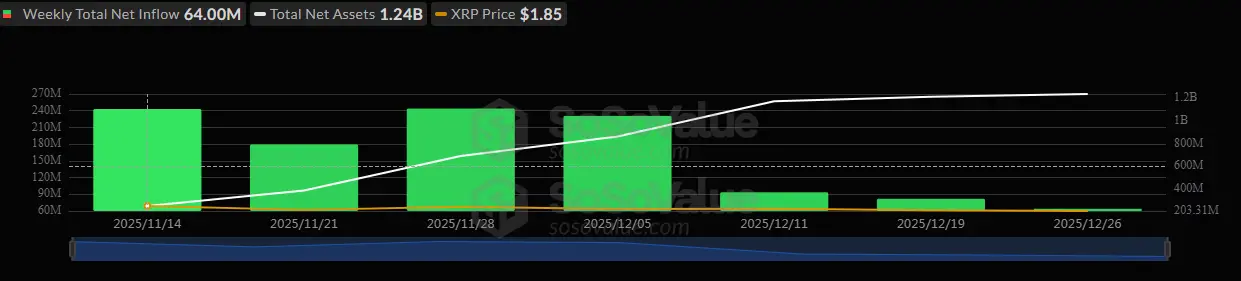
Although XRP price is below $2, its fundamentals and technicals are diverging. The US XRP spot ETF has seen seven consecutive weeks of inflows, with a net inflow of $64 million that week, while BTC spot ETF experienced a net outflow of $589 million during the same period. Progress in the Market Structure Bill, increased practicality, and ongoing institutional demand are laying the foundation for XRP to break free from BTC’s influence.
ETF Capital Flows Reveal XRP and BTC Decoupling Signals
(Source: SoSoValue)
On December 28, XRP declined by 0.47% under the influence of BTC, but the capital flow trends in the XRP and BTC spot ETF markets indicate they are decoupling. As of the week ending December 26, the US XRP spot ETF market had a net inflow of $64 million for the seventh consecutive week, showing growing confidence among institutional investors in XRP. In contrast, the US BTC spot ETF experienced a net outflow of $589 million, reflecting institutional capital withdrawal from Bitcoin.
This divergence in capital flows is significant. Historically, XRP’s price has been highly dependent on BTC movements, with a strong correlation. However, when ETF capital flows move in opposite directions, it suggests that institutional investors are starting to allocate based on XRP’s own fundamentals rather than simply following BTC risk appetite. Although this decoupling has not yet fully reflected in the price, the seven-week inflow trend indicates institutions are positioning for the future.
Notably, despite strong demand for XRP spot ETFs, XRP still fell 3.04% during the week ending December 28, while BTC only declined 0.92%. This contradiction indicates XRP is still in a phase where “supply and demand balance has not yet transmitted to price.” The inflows into XRP spot ETFs have not yet caused significant price movements through supply and demand changes, but once a critical threshold is reached, price reactions could be very sharp.
Crypto attorney Bill Morgan commented: “My critique of supply shock theories is as strong as my previous critique of the absurd Ripple custodial sell-off theory. Neither theory provides any meaningful explanation for XRP’s price movements. The real explanatory factor is BTC’s price trend. That is the main driver.” However, ongoing ETF capital inflows are challenging the effectiveness of the BTC-dominant narrative.
Market Structure Bill and Grayscale Institutional Demand Expectations
The key catalyst for XRP decoupling from BTC is the progress of crypto-friendly legislation. The progress of the Market Structure Bill directly impacts XRP’s price. On July 17, 2025, when the US House of Representatives passed the bill and sent it to the Senate, XRP’s price surged by 14.69 in a single day, reaching a historic high of $3.66. However, due to a US government shutdown, Senate review was delayed, and XRP plummeted 48.5% from the high to around $1.86.
The significance of the Market Structure Bill for XRP lies in further solidifying its legitimacy as a non-security asset and granting it practical utility. These key factors, combined with investor protection regulations, will open the door to a broader investor base. Once the Senate passes the bill, XRP could quickly recover and challenge its all-time high.
Grayscale research director Zach Pandl predicts bipartisan support for crypto regulation could push up cryptocurrency prices. Pandl expects significant but selective institutional demand growth in 2026, with XRP’s key features making it attractive to institutional investors. Pandl stated: “It will be a very rigorous screening process. Investors are likely to focus first on mainstream tokens, considering market cap, liquidity, and use cases. So, they will definitely start with the largest market cap assets.”
As a top ten market cap cryptocurrency with clear cross-border payment applications, XRP fully meets Pandl’s institutional screening criteria. This institutional demand expectation provides a theoretical basis for the continued inflow into XRP spot ETFs.
Three Major Risks Could Undermine Bullish Outlook
Central Bank Policy Turning Hawkish: If the Bank of Japan announces maintaining interest rates at a hawkish neutral level of 1.5% to 2.5%, and US economic indicators reduce the March rate cut expectations, risk asset demand will weaken.
MSCI Removing Digital Asset Reserve Companies: If MSCI removes Digital Asset Reserve Companies (DAT) from its indices, market interest in XRP as a treasury reserve asset could diminish.
Legislative Delays or ETF Outflows: If the Market Structure Bill faces skepticism or XRP spot ETF experiences capital outflows, the bullish narrative will be directly impacted, potentially pushing the price down to $1.75 support.
Technical and Fundamental Divergence Play

(Source: Trading View)
On December 28, XRP closed at $1.8637, breaking below the 50-day and 200-day exponential moving averages (EMA), indicating a bearish technical outlook. The 50-day EMA is at $2.0668, and the 200-day EMA is at $2.3725, both acting as resistance levels above the current price. From a purely technical perspective, XRP is in a weak structure.
However, the fact that fundamentals are strengthening is overshadowing the negative technical signals. Seven weeks of ETF inflows, legislative progress expectations, and rising institutional demand are outweighing technical indicators. Historical experience shows that when fundamentals and technicals diverge, prices tend to follow fundamentals in the end.
Key technical levels include: $1.75 as short-term support; if broken, it tests $1.50. On the upside, the $2 psychological level is the first target; a successful break above it would challenge the 50-day EMA at $2.0668. Continued breakout above the 50-day EMA would confirm a short-term bullish reversal, with potential tests of the 200-day EMA at $2.3725 and the resistance at $2.5.
On the daily chart, XRP has recently formed a bullish structure with an ascending trendline. Breaking above $2 will activate the upper trendline and the $2.5 resistance. Sustained breakout of the upper trendline would signal a trend reversal, confirming medium-term (4-8 weeks) target of $2.5 and long-term (8-12 weeks) target of $3.0. Conversely, if the price faces resistance at $2 and falls below the lower trendline, the bullish structure will be invalidated.
Short, Medium, and Long-term Price Paths and Catalysts
Based on current market dynamics, XRP’s price trajectory can be divided into three timeframes. Short-term (1-4 weeks) outlook is cautiously bullish with a target of $2, contingent on continued ETF inflows and no unexpected deterioration in US economic data. Medium-term (4-8 weeks) outlook remains bullish with a target of $2.5, requiring progress in the Market Structure Bill in the Senate or a March rate cut signal from the Fed.
Long-term (8-12 weeks) outlook is also bullish, targeting $3, requiring Senate approval of the Bill, actual rate cuts by the Fed, and accelerated ETF inflows. If all conditions are met, XRP could challenge the $3.66 all-time high within 6-12 months.
Key catalysts include: Bank of Japan and Fed rate decisions, US economic indicators, news related to the Market Structure Bill, and weekly capital flow data for XRP spot ETFs. Investors should closely monitor these variables, as they will determine whether XRP can reverse the 16% decline in the second half of 2025 and reopen bullish prospects.


