US-based spot Bitcoin ETF funds recorded a total net outflow of approximately $1.29 billion USD over 12 trading sessions, from December 15 to December 31.
This quiet holiday period has become one of the clearest tests of the “stickiness” of the spot Bitcoin ETF group, amid subdued trading activity and portfolio adjustments ahead of the New Year.
Notably, the capital flow was unevenly distributed. According to data from Farside, the entire period saw only about $812 million USD in inflows, concentrated on the two rare positive sessions on December 17 and December 30. Conversely, the remaining sessions experienced total outflows of around $2.10 billion USD.
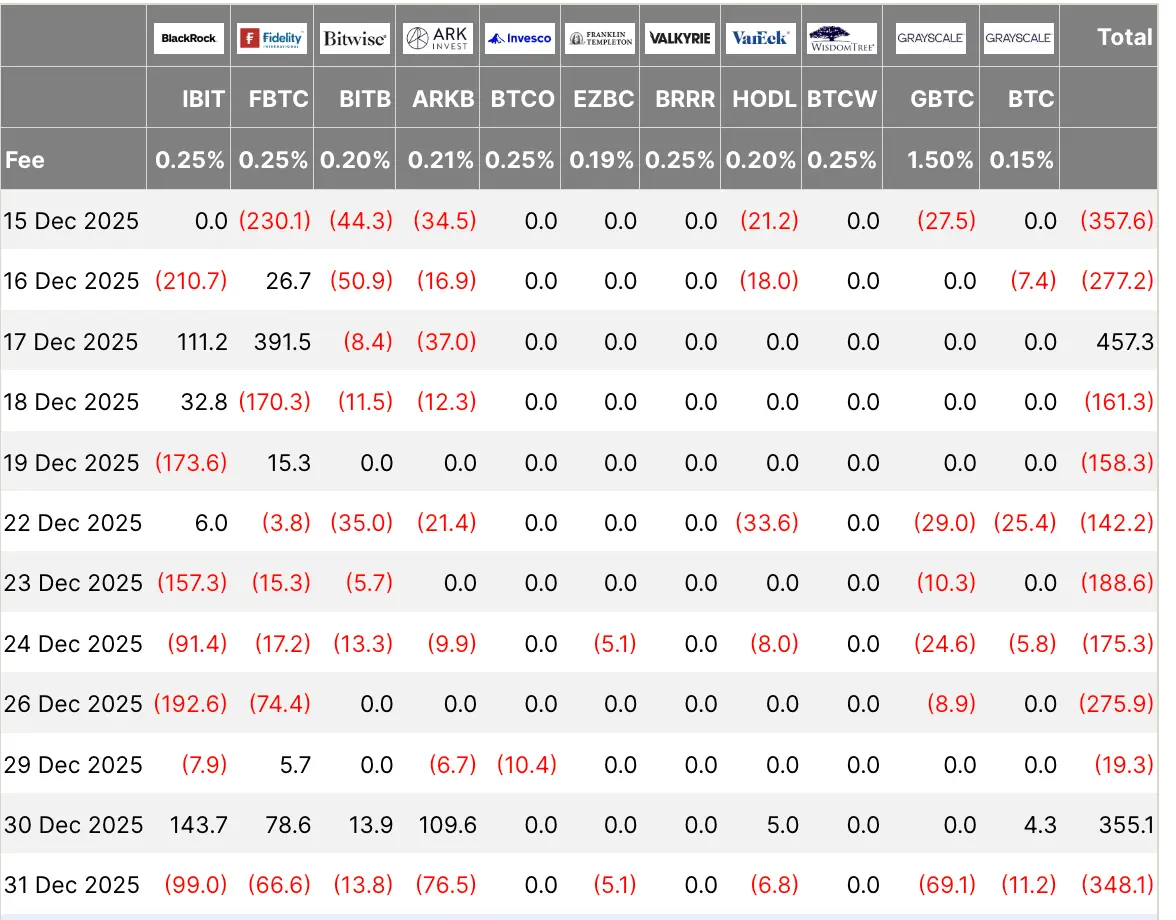 Bitcoin capital flow (Source: Farside) This pattern is quite familiar to those who observe risk asset markets at year-end, when investors typically reduce their positions before the holidays. The current difference is that the buying and selling pressure has been “compressed” into a few trading sessions, with daily fluctuation ranges potentially reaching hundreds of millions of USD.
This is especially significant given that large capital allocators increasingly view the Bitcoin spot ETF as the primary channel for entry and exit, shaping market dynamics outside traditional crypto cycle frameworks.
Standard Chartered believes that, in the current context, ETF flows may even play a more important role than the halving cycle. As such, the question of “who is buying and who is withdrawing” has become a macro variable on a daily basis, rather than just a niche market detail.
During the holiday period, the most notable signal is that outflows did not only come from familiar scenarios like GBTC. IBIT — a fund often considered a core allocation product — accounted for nearly half of the total net outflows in the observed sample.
This creates a very different nuance compared to periods when pressure mainly stems from GBTC redemption waves, especially considering the fee disparities among ETF products.
The distribution of net outflows from 12/15 to 12/31 is as follows:
- IBIT: -$639 million USD, about 49.5%
- GBTC: -$169 million USD, about 13.1%
- BITB: -$169 million USD, about 13.1%
- ARKB: -$106 million USD, about 8.2%
- Other funds (combined): -$208 million USD, about 16.1%
- Total: -$1.291 billion USD
On a daily basis, the flow during the holiday period did not follow a straight decline. December 17 saw a strong inflow of about $457 million USD, while December 30 continued with an additional roughly $355 million USD. However, these two days were not enough to offset the significant outflows on other days, notably December 15 (around -$358 million USD) and December 31 (around -$348 million USD).
In other words, the market has two opportunities to regenerate upward momentum driven by ETF demand, but most of the remaining time still faces selling pressure.
Price movements reflect this “suppressed” state. Bitcoin is currently trading around $89,000 USD, trapped within a narrow range as outflows from ETFs weaken upward momentum.
If the $1.29 billion USD outflow is converted into Bitcoin at roughly $89,000 USD, it equates to about 14,500 BTC under selling pressure. This is a quick estimate but enough to explain why the market feels heavy despite the absence of panic.
Beyond capital flows, the story is also influenced by familiar seasonal factors. Year-end often involves “portfolio rebalancing” activities that do not reflect long-term views, such as adjusting positions after a strong quarter, risk management during low liquidity periods, or closing basis trades when the advantage is no longer attractive.
The reason the market is closely watched now is that ETF capital flows tend to concentrate during predictable timeframes. When liquidity is thin, this can amplify price impacts.
Kaiko has pointed out that ETFs have changed the structure of the spot market and intraday trading patterns. This indicates that the scale of capital flows is only part of the story; timing is the other crucial factor.
On the macro level, December does not signal a clear transition into 2026. The US Federal Reserve continues to emphasize a data-dependent stance, focusing on “the timing and magnitude” of policy adjustments. AP reports that this decision also features rare dissenting opinions, keeping interest rate volatility a closely monitored topic.
Meanwhile, the US dollar is heading toward its steepest decline in years — a factor often seen as supportive for Bitcoin. However, this environment is still insufficient to outweigh ETF outflows during the holiday period.
The outlook for the next quarter may start with viewing December as a test: whether the spot Bitcoin ETF is functioning as a structural allocation or merely as a two-way trading valve.
If recent pressure mainly stems from year-end activities, January could see capital flow back as institutions reopen and rebalance portfolios. Conversely, if the causes are related to interest-sensitive positions and yield compression, capital movements are likely to remain volatile, and Bitcoin will continue to trade as a macro risk asset, reacting strongly to daily data.
Standard Chartered also notes that institutional buying is arriving later than expected. This is especially important in early 2026, when the pace of decision-making by investment committees and risk limits may overshadow long-term bullish arguments.
The market also recognizes that even products considered “core” can be used tactically.
Currently, the clearest picture and simplest fact remain: US-based spot Bitcoin ETFs ended the period from 12/15 to 12/31 with a total net outflow of approximately $1.29 billion USD.
Vương Tiễn
Disclaimer: The information on this page may come from third parties and does not represent the views or opinions of Gate. The content displayed on this page is for reference only and does not constitute any financial, investment, or legal advice. Gate does not guarantee the accuracy or completeness of the information and shall not be liable for any losses arising from the use of this information. Virtual asset investments carry high risks and are subject to significant price volatility. You may lose all of your invested principal. Please fully understand the relevant risks and make prudent decisions based on your own financial situation and risk tolerance. For details, please refer to
Disclaimer.


