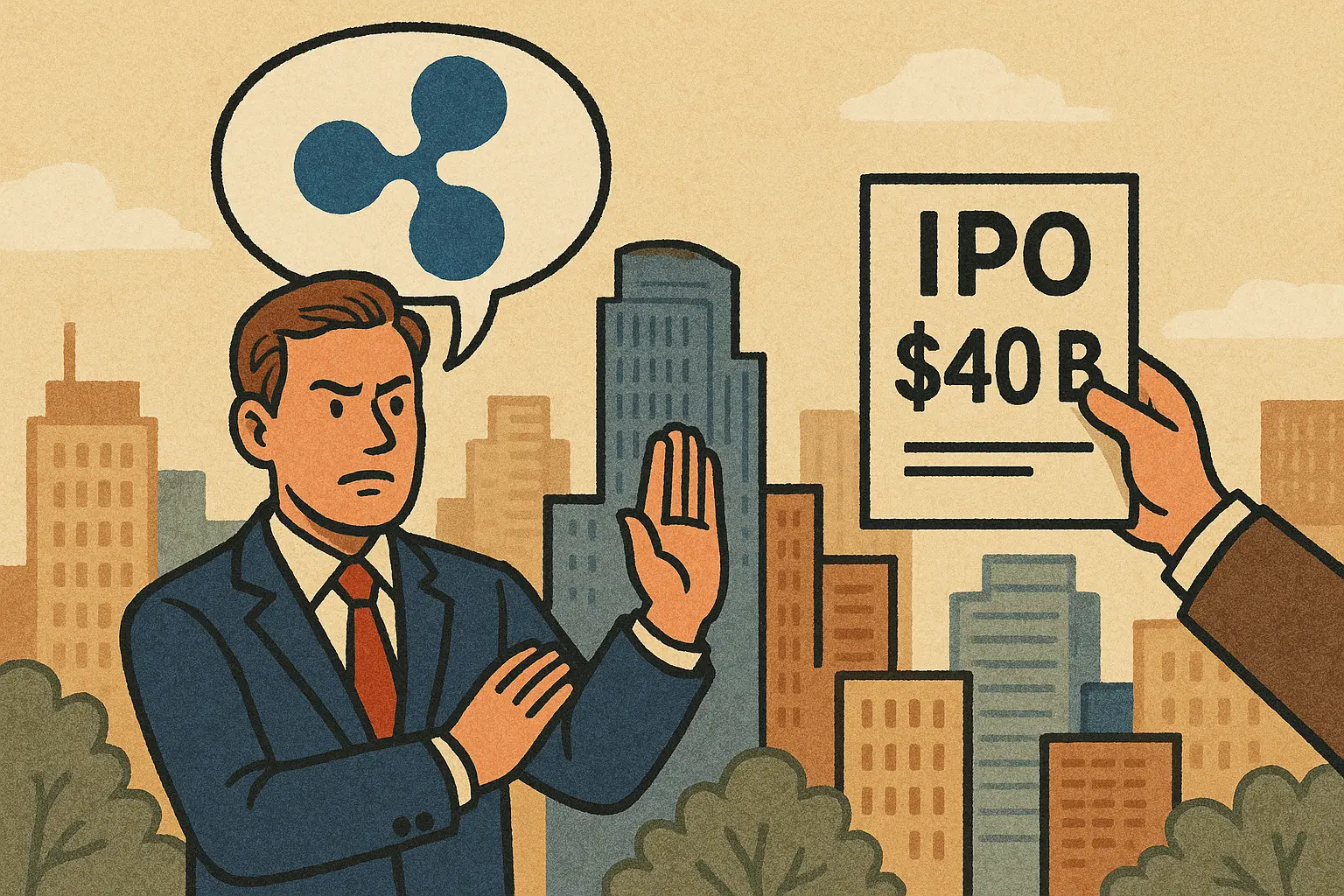
Ripple President Monica Long said in an exclusive Bloomberg interview on Tuesday that there are no plans for an IPO, stating “maintaining privatization.” Last November, the company raised $500 million in funding, valuing it at $40 billion. Long emphasized that financial health does not require going public. In December, Ripple obtained an OCC bank charter, with XRP trading at $2.15, making it the fourth largest by market cap.
The Private Logic Behind the $40 Billion Valuation
On Tuesday, during an interview with Bloomberg, Ripple President Long responded to rumors about the company’s plans to go public after reaching a $40 billion valuation in November of last year. Long stated that after the $500 million funding round led by Citadel Securities and Fortress Investment Group, the company is focused on growth, and this funding also contributed to the increase in Ripple’s valuation.
“Currently, we still plan to remain private,” Long explained further based on comments after the November funding. “Typically, an IPO is a strategy to gain liquidity from investors and the public markets. Our current financial situation is very healthy, and we can continue to fund and invest in the company’s development without going public.”
This logic is not uncommon among tech companies, but it is relatively rare in the crypto industry. Most crypto firms consider an IPO once their valuation reaches billions of dollars, such as Coinbase going public in 2021 and Circle planning an IPO in May 2025. Ripple’s refusal reflects caution regarding regulatory pressures from public markets and the transparency requirements of quarterly financial reports.
The biggest advantage of privatization is flexibility. Public companies must release quarterly financial reports and face scrutiny from shareholders and analysts, with poor performance potentially causing stock volatility. Private companies can focus on long-term strategies without the pressure of short-term profits. For Ripple, building cross-border payment infrastructure takes years, and an early IPO could be hampered by quarterly performance pressures.
Is a $40 billion valuation reasonable? The largest compliant US crypto exchange has a market cap of about $70 billion, and Circle’s valuation is around $5 billion. Ripple falls between the two, with both its B2B business via RippleNet and the financial attributes of XRP tokens. The $40 billion valuation reflects investor recognition of its dual value.
Four Reasons Why Ripple Rejects IPO
Financial Self-Sufficiency: $500 million funding provides ample capital, no need for public market financing
Avoid Regulatory Pressure: Going public requires compliance with strict SEC regulations; privatization maintains flexibility
Long-term Strategic Freedom: No quarterly report pressures, focus on building cross-border payment infrastructure
XRP Complexity: XRP’s regulatory status remains controversial; going public could trigger new regulatory challenges
OCC Bank Charter Is the True Milestone
In December, the US Office of the Comptroller of the Currency (OCC) conditionally approved the national trust bank charters for Circle and Ripple. BitGo, Fidelity Digital Assets, and Paxos also received conditional approval to convert their existing state-chartered trust companies into federally chartered national trust banks. This license is far more significant than an IPO.
A national trust bank charter allows Ripple to provide financial services at the federal level, not limited to a single state. This cross-state operation capability is crucial for cross-border payments, as RippleNet needs to connect hundreds of financial institutions worldwide. The federal license also enhances Ripple’s compliance profile in the eyes of traditional financial institutions, making large banks more willing to cooperate with federally regulated entities.
Ripple’s application states that its articles of incorporation “will not make it the issuer of its USD-pegged stablecoin Ripple USD (RLUSD).” This design separates stablecoin issuance from trust banking activities, reducing regulatory complexity. Other companies will offer various digital asset custody services. Among these applicants, BitGo has announced plans to go public, and Circle completed an IPO in May.
Unlike Circle’s choice to go public, Ripple’s decision to continue privatization after obtaining a bank license indicates its strategic focus on business compliance rather than capital market fundraising. The business value unlocked by the bank license may far surpass the branding benefits of an IPO.
Strategic Freedom After SEC Lawsuit Ends
Long made these remarks as he looked toward 2026, just a few months after the US Securities and Exchange Commission announced it would gradually cease enforcement actions against Ripple, sparking speculation about an IPO. Long repeatedly denied reports that Ripple is seeking to go public. This firm denial indicates that IPO is not a priority in Ripple’s strategic planning.
The end of the SEC lawsuit clears the biggest regulatory hurdle for Ripple. In 2020, the SEC sued Ripple for illegal securities sales; the lawsuit lasted several years and severely impacted Ripple’s US expansion. In 2023, a judge ruled that XRP’s programmatic sales do not constitute securities offerings, and in 2025, the SEC withdrew its appeal, marking a victory for Ripple.
This victory has significant strategic implications. Once XRP is clearly classified as a non-security, Ripple’s US operations face minimal regulatory obstacles. An IPO might have been seen as a way to legitimize and gain mainstream acceptance, but with regulatory issues resolved, the need for an IPO diminishes greatly. Ripple can continue operating privately, avoiding the restrictions of public markets.
As of writing, XRP’s price is $2.15, down about 6% in the past 24 hours. By market cap, it is the fourth-largest cryptocurrency. The relationship between XRP’s price and Ripple’s IPO status is subtle; if Ripple goes public, it could temporarily boost XRP’s price, but long-term, it might expose weaknesses due to increased transparency requirements. Maintaining privatization preserves mystery and imagination.
Overall, Ripple’s rejection of an IPO is based on considerations of financial independence, strategic flexibility, and regulatory risk. The $40 billion valuation combined with the OCC bank license has positioned Ripple with a market standing comparable to a public company, without the additional burdens of the public markets.
Disclaimer: The information on this page may come from third parties and does not represent the views or opinions of Gate. The content displayed on this page is for reference only and does not constitute any financial, investment, or legal advice. Gate does not guarantee the accuracy or completeness of the information and shall not be liable for any losses arising from the use of this information. Virtual asset investments carry high risks and are subject to significant price volatility. You may lose all of your invested principal. Please fully understand the relevant risks and make prudent decisions based on your own financial situation and risk tolerance. For details, please refer to
Disclaimer.
Related Articles
Rakuten Pay Integrates XRP for 44 Million Japanese Users, Enables Payments at 5M+ Merchants
Rakuten Pay has integrated XRP, enabling 44 million users to spend the cryptocurrency at over 5 million merchants in Japan. This integration highlights a shift from trading cryptocurrencies to everyday payments, supported by Japan's favorable regulations and fintech infrastructure.
GateNews2h ago
MoonPay Hints at Potential Ripple Collaboration With XRP-Themed Post
MoonPay's recent social media post featuring an XRP theme has sparked speculation about a potential partnership with Ripple. As both companies focus on enhancing cryptocurrency infrastructure, the implications of this possible collaboration, along with Ripple's initiatives in institutional finance, highlight a shift towards practical applications in the crypto space.
GateNews3h ago
Gate’s “Crazy Wednesday” is live with a hot launch. Complete tasks to win XRP and Glenfiddich whisky. For USDT savings, earn up to 100% APY. For BTC/ETH/SOL staking, earn up to 16% mining APY.
Gate News message, according to Gate’s official announcement on April 15, 2026
Gate launches a “Crazy Wednesday” campaign, running from April 15, 2026 at 14:00 to April 19, 2026 at 16:00 (UTC+8). Users complete multiple tasks to unlock mystery boxes, with a chance to win XRP tokens and Glenfiddich whisky. The mystery box tasks include multiple categories such as flash swaps, spot, and futures trading, as well as top-ups, invitations, and VIP upgrades, and each tier corresponds to a different number of mystery box openings.
Campaign Two launches a USDT wealth-management product, with a 14-day fixed-term annualized yield of 6%. New users can also participate in a 3-day product offering 100% annualized yield. In addition, Yu’e Bao also offers multi-currency wealth-management options such as USAT, USDD, 0G, and APT, with annualized returns of up to 300%. Campaign Three introduces a boosted rewards policy for staking users, offering up to a 16% annualized return for staking BTC, ETH, and SOL; for SOL staking, staking 0–1 coins can yield up to 16% annualized.
GateAnnouncement7h ago
XRP Today News: CLARITY Act Pushes Through in May, Standard Chartered Bank Turns Bullish on $8
Ripple CEO Garlinghouse confirmed at the summit that the CLARITY Act’s goal for passage is by the end of May, and said that the controversy surrounding stablecoin yield rates is nearing resolution. If the bill passes, XRP is expected to rise to $5–$10; otherwise, it could fall back to $1.2. The bill’s passage would create a regulatory framework for the digital asset market, clarify XRP’s classification as a commodity, and reduce compliance barriers for institutional investors.
MarketWhisper8h ago
Rakuten Wallet Integrates XRP for Payments Across 5M+ Merchants in Japan
Rakuten Wallet has launched XRP as a payment method, allowing users to buy XRP with Rakuten Points and spend it at millions of merchants in Japan. This integration expands XRP's reach to a vast, non-crypto user base within Rakuten's extensive ecosystem.
GateNews10h ago


