The XRP ETFs recently recorded the largest daily capital inflow for any crypto ETF, beating Bitcoin, Ethereum, and Solana.
According to data from market resource Sosovalue, XRP ETFs witnessed a little above $17 million worth of capital inflows on Jan. 15, marking their sixth consecutive intraday inflow since the $40.8 million outflow recorded on Jan. 7. Further, the latest stat means that XRP ETFs have now seen 42 days of capital inflows out of 42 trading days since their launch.
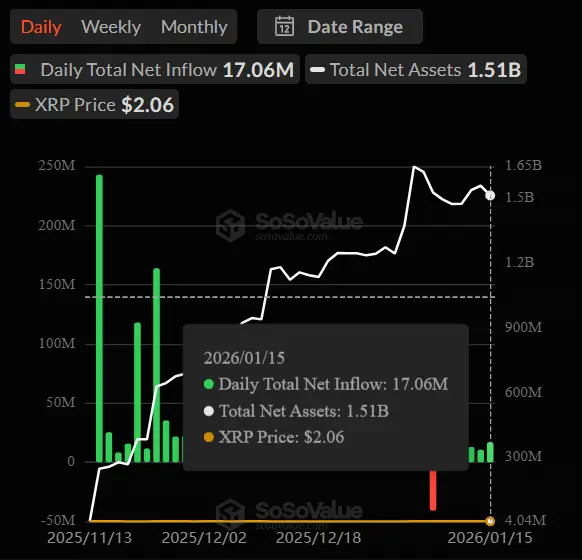 XRP ETFs Daily Inflow | SosovalueWhile the $17.06 million may appear modest compared to larger inflows such as $46 million witnessed earlier this year, it represents the biggest inflow on Jan. 15 for any crypto ETF in the market, as Bitcoin (BTC) recorded outflows, while Ethereum (ETH) and Solana (SOL) witnessed smaller inflow figures.
Key Data Points
- XRP ETFs recorded $17.06 million in capital inflows on Jan. 15, extending their inflow streak to six days.
- The ongoing streak began on Jan. 8 after these products saw their first outflow worth $40.8 million the previous day.
- The latest $17.06 million figure represents the largest across all crypto ETFs in the market.
- While Bitcoin saw outflows on the same day, Ethereum recorded $15.21 million in inflows, and Solana’s inflows stood at $8.94 million.
XRP ETFs Lead During Market Struggles
The recent performance demonstrates XRP’s ability to secure impressive capital inflows at a time when the broader crypto market grapples with price struggles. For context, the XRP ETFs’ $17 million inflow came as the global crypto market cap lost $47 billion yesterday, down 1.46% in what was its largest intraday decline in a week.
However, Bitcoin ETFs have often reacted more adversely to bearish market conditions, as investors typically pull out funds from the products when the broader crypto market underperforms. Yesterday, BTC ETFs saw outflows valued at $215.61 million, breaking what would have been four days of consistent capital influx.
Meanwhile, the $15.21 million figure from Ethereum ETFs represented a decline of 91% from the previous intraday inflow of $175 million. Solana’s $8.94 million also marked a 62% drop from its Jan. 14 record of $23.57 million. Only XRP ETFs witnessed an increase from the previous day, with the $17.06 million representing a 60% increase in daily inflows.
Historical Performance
This trend was prevalent during Q4 2025, when XRP ETFs saw consistent inflows and outperformed the broader ETF market, while crypto prices struggled. For context, the global crypto market lost $917 billion in Q4 2025, but XRP ETFs saw $1.165 worth of inflows. Meanwhile, BTC ETFs lost $4.5 billion, while ETH ETFs shed $2 billion within the same period.
At the time, some critics argued that the positive performance was due to the products’ early success syndrome. However, today, the XRP ETFs have sustained this pattern. With the latest figure, the products have now recorded $1.27 billion in cumulative total net inflow.
Disclaimer: The information on this page may come from third parties and does not represent the views or opinions of Gate. The content displayed on this page is for reference only and does not constitute any financial, investment, or legal advice. Gate does not guarantee the accuracy or completeness of the information and shall not be liable for any losses arising from the use of this information. Virtual asset investments carry high risks and are subject to significant price volatility. You may lose all of your invested principal. Please fully understand the relevant risks and make prudent decisions based on your own financial situation and risk tolerance. For details, please refer to
Disclaimer.
Related Articles
BTC short-term decline of 0.54%: Large volume of on-chain transfers and leveraged liquidations resonating to intensify selling pressure
On 2026-03-17 from 03:30 to 03:45 (UTC), BTC experienced a sharp decline with K-line data showing a yield of -0.54%, price range between 74350.0—74829.0 USDT, and amplitude reaching 0.64%. During this period, market attention increased and volatility intensified, with the short-term downward movement triggering widespread tracking.
The main driver of this volatility was multiple large transfers exceeding 500 BTC each appearing on-chain, primarily flowing into a major exchange, causing the exchange's hot wallet balance to increase by approximately 3,200 BTC. This triggered concentrated selling pressure, prompting
GateNews5m ago
South Korea Police Agency Sets First-Ever Dark Coin Management Guidelines, Virtual Assets Compressed by Approximately 54.5 Billion Korean Won Over Past 5 Years
Korea's National Police Agency completes draft virtual asset management directive, first time including dark coin management and clarifying software wallet solutions. Over the past 5 years, virtual assets worth approximately 54.5 billion won have been seized, with police planning to select private custodian institutions. Experts recommend establishing a government-led custody system.
GateNews27m ago
BTC falls below 75000 USDT, intraday decline of 0.16%
Gate News reports that on March 17, Bitcoin fell below the 75,000 USDT level, currently trading at 74,994.01 USDT, with an intraday decline of 0.16%.
GateNews31m ago
Liquid Capital Founder Yi Lihua: Going All-In on Rebound, BTC Rebound to $85,000-$90,000 is a Reasonable Range
Liquid Capital founder Yi Lihua stated that he is preparing a new fund and adopting a full-position strategy to capitalize on rebounds, believing that BTC rebounding to $85,000 and $90,000 is reasonable. He shared his experience of over a decade in the crypto industry, emphasizing the importance of maintaining a positive mindset and conducting oneself with integrity.
GateNews50m ago
Slippage: The Most Underestimated Profit Killer in Trading
Author: CryptoPunk
Many crypto traders have experienced the same disappointment: strategies that appear stable and profitable in backtests quickly see their returns shrink when actually deployed, sometimes turning from profit into loss. The issue is often not "misjudging the direction," but underestimating trading costs, especially slippage.
In crypto markets where bull and bear phases switch more rapidly, volatility is more intense, and order books are more fragmented, slippage is not a trivial decimal point—it is the real threshold that determines whether a strategy can survive. A deviation of just 2 or 3 basis points can, in high-turnover strategies, completely wipe out the theoretical alpha.
Based on long-term backtests of BTC/USDT and ETH/USDT, this article aims to answer a very practical question: to what extent does slippage erode strategy returns, and which strategies are most likely to be killed by slippage?
1. Introduction: Why Slippage
PANews54m ago


