
Bitcoin falls below $92,000, with $860 million in liquidations across the network. CryptoQuant points out that Bitcoin is still being suppressed by key daily moving averages, although institutions and shark addresses are increasing their holdings against the trend, but spot demand remains weak?
Bitcoin drops below 92K, with $860 million in liquidations across the network
Bitcoin ($BTC) showed weakness during today’s (1/19) Asian morning session, once falling below $92,000, with a low of $91,910, a roughly 3% intraday decline, indicating that the upward momentum driven by derivatives markets has weakened.
Data from CoinGlass shows that, in the past 24 hours, the cryptocurrency perpetual contract market experienced $860 million in liquidations, mostly from long positions (buy orders), with a total liquidation amount of $783 million.
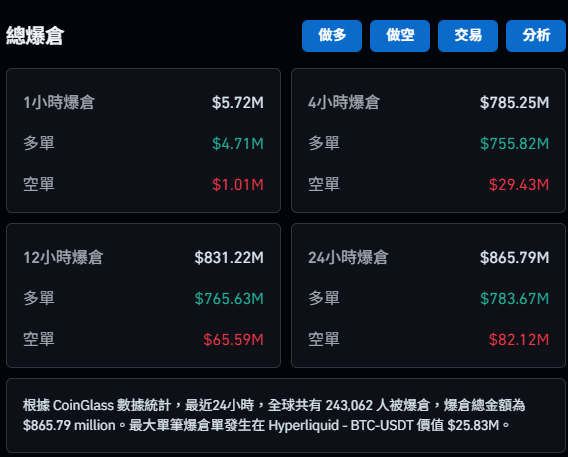
Image source: CoinGlass
CryptoQuant: Bitcoin is being suppressed by the 365-day moving average
In response to recent market volatility, blockchain analytics firm CryptoQuant, in its latest weekly report, characterized the recent upward trend since November last year as a potential “bear market rebound,” and it is still uncertain whether the trend has truly reversed, meaning a new bullish wave could be on the horizon.
CryptoQuant points out that Bitcoin is still being suppressed by the 365-day moving average (around $101,000). Historically, this moving average often serves as an important dividing line between bullish and bearish markets.
Glassnode also notes that the recent push toward $96,000 was mainly driven by derivatives capital flows and short covering, rather than steady spot accumulation.
Glassnode further states that, due to relatively thin futures liquidity, if forced buying pressure diminishes, prices could be susceptible to leverage and liquidity changes, leading to sharp pullbacks.
Bitcoin Shark Accumulation and ETF Funds Resuming Inflows
Despite short-term correction pressures, on-chain data and institutional capital flows reveal potential bullish signals.
According to Glassnode data, the shark and fish addresses holding between 10 and 1,000 Bitcoins have increased their holdings by about 110,000 Bitcoins in the past 30 days, marking the largest monthly increase since the FTX incident in 2022.
Meanwhile, retail investors holding less than 1 Bitcoin have accumulated over 13,000 Bitcoins recently, indicating that investors of various scales are seeking to reaccumulate spot during the market correction.
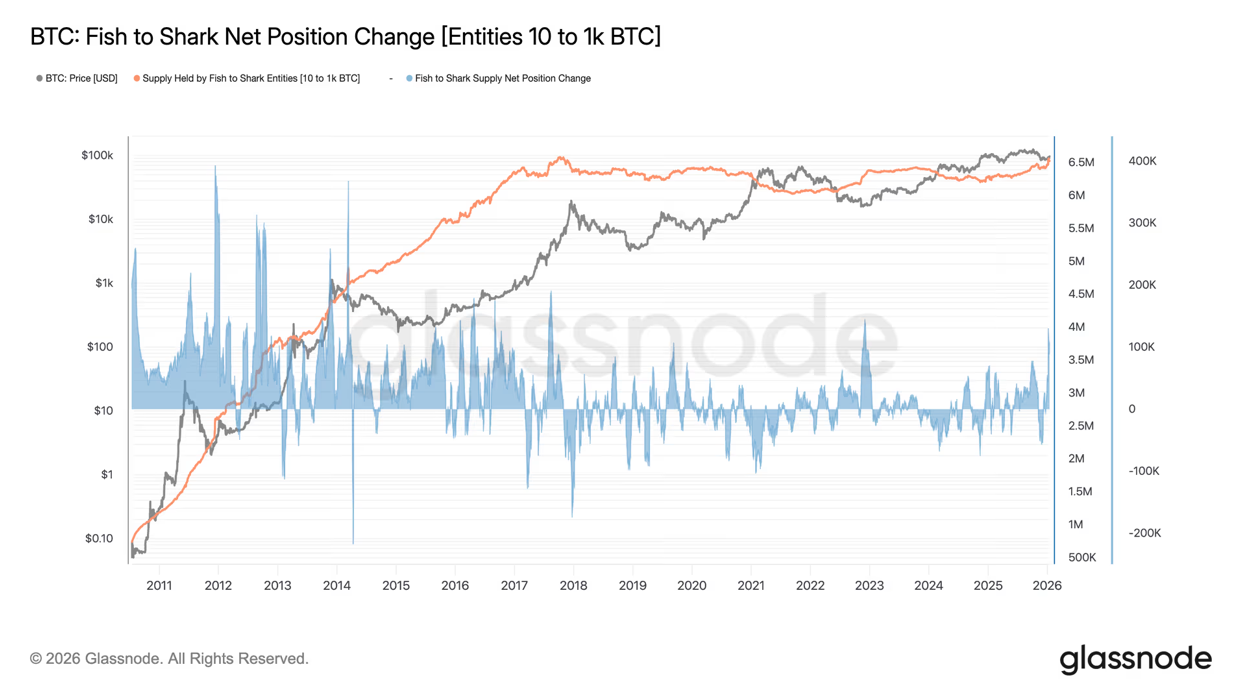
Image source: Glassnode
On the other hand, the US Bitcoin spot ETF has seen approximately $1.2 billion in net inflows since January, reversing December’s net outflows.
CF Benchmarks analyst Mark Pilipczuk analyzed that, as the spot-futures price gap narrows significantly, the profit potential from traditional “basis arbitrage” trading has been largely squeezed out, and ETF inflows are not for arbitrage but reflect institutional investors betting on long-term price appreciation.
Crypto exchange Bitfinex analyst added that this type of capital belongs to more sticky, long-term allocations, indicating that institutions are starting to view Bitcoin as part of their diversified assets in a low-volatility environment, willing to make long-term positions at this price level.
However, although marginal demand appears to be improving, CryptoQuant believes overall spot demand is still shrinking, and the inflow scale of US Bitcoin spot ETFs remains moderate, with no substantial change in market structure.
Further reading:
MicroStrategy prepares reserves to fight the bear market! CryptoQuant pessimistically predicts: Bitcoin may drop to $55,000 this year
This content is compiled by Crypto Agent from various sources, reviewed and edited by “Crypto City.” It is still in training, so there may be logical biases or informational errors. The content is for reference only and should not be considered investment advice.
Disclaimer: The information on this page may come from third parties and does not represent the views or opinions of Gate. The content displayed on this page is for reference only and does not constitute any financial, investment, or legal advice. Gate does not guarantee the accuracy or completeness of the information and shall not be liable for any losses arising from the use of this information. Virtual asset investments carry high risks and are subject to significant price volatility. You may lose all of your invested principal. Please fully understand the relevant risks and make prudent decisions based on your own financial situation and risk tolerance. For details, please refer to
Disclaimer.


