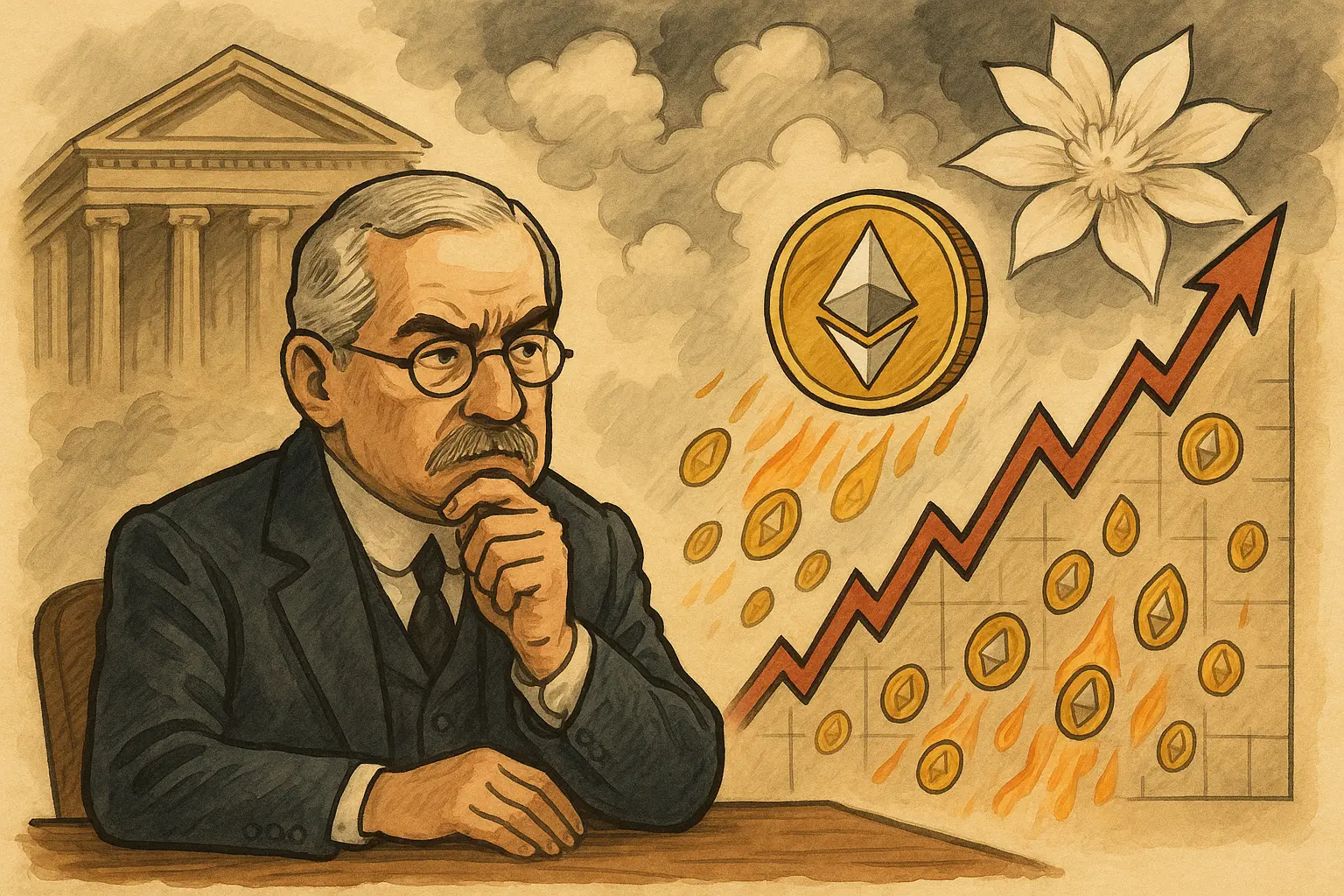
JPMorgan questions whether the surge in activity after the Ethereum Fusaka upgrade can be sustained, noting that multiple past upgrades failed to produce lasting increases. On December 3, Fusaka increased the block capacity from 15 to 21 blobs, reducing fees and driving a spike in activity. However, with Base accounting for nearly 70% of Layer 2 revenue, Solana capturing market share, and reduced speculation still present, the decrease in transaction fee burns puts downward pressure on ETH price.
JPMorgan’s Core Argument Questioning the Effectiveness of Ethereum’s Upgrade
JPMorgan analysts are questioning whether the recent surge in network activity following the Ethereum Fusaka upgrade can continue, indicating that the factors hindering sustained usage still exist. The Fusaka upgrade went live on December 3, expanding the maximum data capacity per block from 15 to 21 blobs and immediately lowering transaction fees. After the fee reduction, active addresses and transaction volume surged.
“However, it remains unclear whether this recent increase in network activity can be sustained,” the JPMorgan analyst team (led by Managing Director Nicolas Panigirtzoglou) stated in a report on Wednesday. “Historically, multiple Ethereum upgrades have failed to produce lasting increases in network activity for various reasons.”
This argument is based on observations of past Ethereum upgrades. Over the years, Ethereum has undergone several major upgrades, including the London upgrade (introducing EIP-1559), Shanghai (unlocking staked withdrawals), and Pectra. These upgrades often caused short-term spikes in activity upon launch, but such growth was rarely sustained. JPMorgan analysts believe that the structural factors behind this pattern have not changed, casting doubt on the long-term impact of Fusaka.
From a technical perspective, Fusaka’s increase in blob capacity reduces Layer 2 data posting costs, indirectly lowering end-user transaction fees. However, JPMorgan analysts note that fee reduction is just one factor influencing network activity, not the only or decisive one. Without addressing other structural issues, simply lowering fees cannot guarantee long-term growth in activity.
Layer 2 Continues to Divert Mainnet Activity
Analysts believe the primary reason is the ongoing migration of transaction activity from Ethereum mainnet to Layer 2 networks like Base, Arbitrum, and Optimism. They cite data from CryptoRank indicating that just Base alone now accounts for approximately 60% to 70% of all Layer 2 revenue on Ethereum.
This data reveals a paradox within the Ethereum ecosystem. On one hand, the prosperity of Layer 2s demonstrates Ethereum’s success as a settlement layer, since these Layer 2s ultimately rely on the Ethereum mainnet for security. On the other hand, the success of Layer 2s means a large volume of transactions and fee revenue are being diverted, directly weakening the mainnet’s economic activity.
Base, launched by Coinbase, contributing 60-70% of Layer 2 revenue, is particularly striking. This means Coinbase alone dominates the entire Ethereum Layer 2 ecosystem. This concentration reflects Coinbase’s brand influence and user base advantage but also exposes the Ethereum mainnet’s weakness in attracting direct users.
The continued diversion of Layer 2 activity has profound effects on Ethereum’s token economics. Ethereum’s EIP-1559 mechanism burns a portion of transaction fees, reducing ETH supply. However, as large amounts of activity move to Layer 2, mainnet transaction volume and fees decline, leading to less fee burning, which challenges ETH’s deflationary narrative.
Solana and Other Competitors Capture Market Share
Competition from other blockchains remains a persistent challenge. Analysts say networks like Solana have gained “significant” market share by offering faster, cheaper transactions, drawing users and developers away from Ethereum. They add that this competitive pressure shifts on-chain activity to rival ecosystems.
Solana experienced notable recovery and growth in 2024-2025, with its performance advantage (theoretically 65,000 transactions per second, practically a few thousand) and extremely low fees (usually below $0.001) making it ideal for high-frequency trading, NFT minting, and meme coin speculation. These use cases were once Ethereum’s strengths, but high gas fees have driven many projects and users to Solana.
Besides Solana, other Layer 1 chains like BNB Chain, Avalanche, and Polygon (as sidechains) also hold their niches. This multi-chain landscape means Ethereum is no longer the sole smart contract platform, giving developers and users more alternatives. This environment poses a long-term challenge to Ethereum’s market dominance.
JPMorgan analysts emphasize that this competitive pressure exists not only at the user level but also among developer communities. Many new projects consider performance, cost, ecosystem support, and user base when choosing deployment platforms. If Ethereum cannot maintain a clear advantage in these areas, it risks losing top-tier projects.
Reduced Speculation and Capital Dispersion
Analysts also highlight that the speculative activity that previously drove Ethereum usage has diminished. During the 2021-2022 bull cycle, demand related to ICOs, NFTs, and meme coins boosted transaction volume. They note that most of this speculative activity has now waned or shifted to other blockchains, reducing key activity sources that once supported Ethereum’s network metrics.
Furthermore, capital that once primarily flowed into Ethereum is now more dispersed across various application-specific blockchains. For example, Uniswap migrated to its own Layer 2, Unichain, and dYdX transitioned to a standalone chain. Analysts say, “Both have successfully attracted liquidity to their respective networks, generating protocol revenue.”
Uniswap’s launch of Unichain and dYdX’s move to a standalone chain represent a new trend: successful DeFi protocols no longer settle for being just applications on Ethereum but seek to build their own infrastructure. This trend causes Ethereum to lose some of its most valuable applications and users, further weakening mainnet activity.
Decreased Fee Burning Impacts ETH Price
Overall, these factors influence Ethereum’s fee dynamics and token economics. Analysts point out that reduced mainnet activity decreases fee burns, leading to an increase in ETH circulating supply over time and downward pressure on price. They also note that between the Pectra and Fusaka upgrades, Ethereum’s total value locked (TVL) measured in ETH declined, which is a negative signal.
The analysts conclude: “In summary, while Fusaka significantly increased network activity—such as transaction volume and active addresses—we remain skeptical about the sustainability of this growth. Historical data shows that Ethereum’s upgrades have not historically resulted in lasting increases in network activity, and the reasons behind this remain.”
At the Ethereum core developer conference on Thursday, several researchers expressed doubts about whether the community can deliver two additional hard forks by 2026 to match the pace of last year’s Pectra and Fusaka upgrades. JPMorgan’s analysts are less bullish on ETH than Bitcoin, recently reaffirming a $170,000 target price for Bitcoin within the next 6 to 12 months.
Related Articles
Grayscale transferred 5,322 ETH and 155.649 BTC to a certain CEX, with a total value of over $22 million
Gate News update, April 9. Arkham monitoring shows that about an hour ago, Grayscale transferred a total of 5,322 ETH (worth $11.6 million) and 155.649 BTC (worth $11.07 million) to a certain CEX Prime address.
GateNews34m ago
“Maji big brother” Huang Licheng closes out an HYPE long position; the Ethereum long position is increased to 12,300 ETH.
Gate News message, on April 9, Hyperbot data shows that the HYPE long position newly opened by Big Brother A-ma JI — Huang Licheng — has been fully closed out within the past 20 minutes. Currently, he is still continuously adding to his 25x leveraged Ethereum long position; he holds 12,300 ETH, with a position value of $26.61M, and a liquidation price of $2,081.
GateNews48m ago
Etherscan contract tab redesign, adds an IDE-style code browser
Etherscan announced a redesign of the contract tabs page, adding an IDE-style code browser with features like file tree navigation, multiple-file tabbed browsing, and cross-file search. It also updated the design of the read/write contract interface; users can switch to full screen and edit contract code directly in Blockscan and Ethereum Remix.
GateNews1h ago
Japan-compliant stablecoin JPYC: 6-month trading volume reaches $137 million, with Polygon accounting for 66%
Gate News message: As of April 9, Japan-compliant stablecoin JPYC has reached a total trading volume of $137 million since the end of October last year. Of this, Polygon leads with $90.4 million, accounting for 66%, Avalanche has a trading volume of $26.4 million, and Ethereum has $19.7 million. In addition, Polygon’s founder confirmed that Japanese physical retail stores have supported offline payments for JPYC on the Polygon network.
GateNews1h ago
A whale opens 20x leverage BTC and ETH short positions, with a position value of about $80 million
Gate News said that on April 9, according to Lookonchain monitoring, a whale address opened 20x leveraged BTC and ETH short positions about 30 minutes ago. Among them, the Bitcoin short position holds 562.58 BTC, and the Ethereum short position holds 18,350 ETH; the total value of the two positions is about $80 million.
GateNews2h ago
BlackRock ETHA fund transferred nearly 20k ETH to a certain CEX Prime address
Gate News, April 9, Arkham monitoring data shows that about 50 minutes ago, BlackRock, via its Ethereum exchange-traded fund ETHA, transferred a total of 19,935 ETH worth $43.65 million to a CEX Prime address.
GateNews3h ago


