Original Author: Mankun Brand Department
“In Guangdong, especially in Shenzhen, some seemingly ordinary part-time jobs are mass-producing criminal suspects.” This is a recent warning posted by Lawyer Deng Xiaoyu, Partner at Mankun (Shenzhen) Law Firm on the Xiaohongshu platform. In the post, he pointed out that these types of part-time jobs under the guise of “cash for crypto” or “offline currency exchange errands” have formed a highly procedural “hunting mechanism,” often targeting young people with high education levels and insufficient risk awareness.
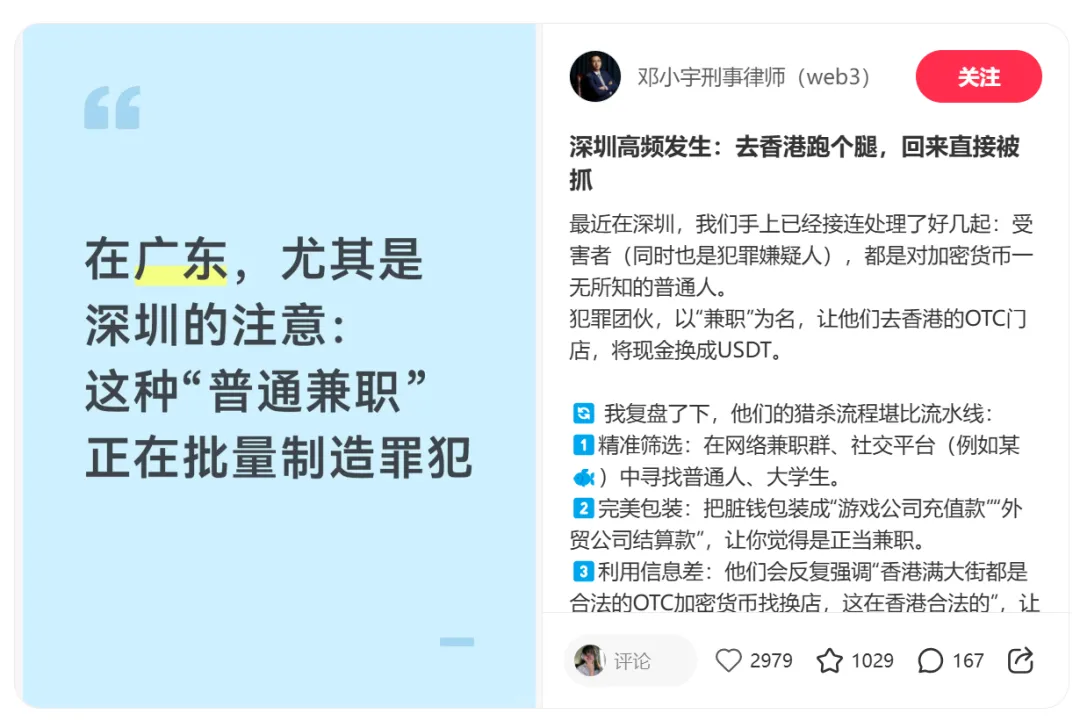
In these tasks, part-timers usually only need to follow instructions, convert funds into Hong Kong dollars, then go to designated OTC crypto exchange shops to complete the transaction. It seems like a simple “errand,” but unknowingly, they are completing a crucial step in money laundering—“human border crossing.”** Once the funds are deemed illegal gains, participants may be directly exposed to criminal risks.
Lawyer Deng Xiaoyu believes that in recent years, this kind of “low threshold, high return” part-time model has been systematically used by criminals for money laundering activities. Many participants, unaware of the nature of their actions, have already crossed legal boundaries.
Based on this judgment, Lawyer Deng Xiaoyu (Partner at Mankun Law Firm, specializing in criminal crypto assets) and Huang Wenjing (Compliance Advisor at Mankun Law Firm) recently gave an interview to Shenzhen News Network, analyzing real cases to systematically dissect related criminal patterns, social harms, and legal risks, aiming to reveal the hidden and complex money laundering network and help more people see the legal truth behind it.
“Just helping to exchange coins,” why is it suspected of money laundering?
Shenzhen News Network Reporter:
Lawyer Deng Xiaoyu, in your recent cases, how do criminal groups usually recruit young people under the guise of “part-time jobs”?
Deng Xiaoyu:
We recently handled a typical case: a mainland university student received a “errand part-time” offer on a second-hand goods trading platform. The other party asked him to go to Hong Kong, use a local crypto exchange shop (OTC store) to buy a certain amount of Tether (USDT), and transfer it to a specified blockchain address.
The specific process was: the part-timer first used his own bank card to receive RMB, then exchanged it for Hong Kong dollars at a fiat exchange point in mainland China, then went to a designated Hong Kong OTC shop to buy USDT, which was directly transferred by the shop to a specified wallet.
After purchasing USDT worth several ten-thousand RMB through this method, the student’s bank card and WeChat Pay account were frozen by mainland law enforcement, and he was told that the funds he received came from transfers by victims of an upstream scam.
Subsequently, we collaborated with a professional blockchain technical team to analyze and confirmed that this was a typical “card back to U” money laundering method, linked to organized crime networks in Southeast Asia.
Since then, we have received multiple similar inquiries. Some participants have been investigated for charges such as fraud, concealing or disguising criminal proceeds, and aiding cybercrime; others, though not detained, have had their bank and payment accounts frozen for a long time, severely affecting their daily life, studies, and work.
Shenzhen News Network Reporter:
Consultant Huang Wenjing, why do black industry criminal groups frequently choose Hong Kong crypto OTC shops as operation nodes? Is this mode harder to trace?
Huang Wenjing:
From a practical perspective, there are three main reasons why Hong Kong OTC shops are easily exploited by criminals.
First, regulatory boundaries are relatively vague, and anti-money laundering requirements are inconsistent.
Currently, Hong Kong has a mature licensing and regulatory system for centralized virtual asset trading platforms, but crypto OTC shops still operate in a somewhat ambiguous regulatory space, with diverse entities and inconsistent compliance standards. Some shops have obvious shortcomings in verifying fund sources, transaction monitoring, and anomaly analysis, leaving operational space for black industry.
Second, cash transactions are inherently high-risk scenarios.
OTC shops mainly deal in cash, which lacks the account linkage and structured data that bank transfers have. Investigations often rely more on physical surveillance, witness testimony, and physical evidence, making source tracing more difficult.
Third, frequent financial activities provide greater cover-up opportunities.
In Hong Kong’s 2024 VAOTC consultation background, it was mentioned that in some scam cases, OTC shops were used for the first round of laundering involved funds. As an international financial center with active multi-currency circulation and cross-border transactions, criminals find it easier to package transaction backgrounds and obscure the true source of funds.
Dual Loss to Individuals and Society: Criminal Risks Hidden Behind “Legitimate Narratives”
Shenzhen News Network Reporter:
Lawyer Deng Xiaoyu, in your cases, many so-called “part-timers” are highly educated young people. Why are they so easily trapped? What legal consequences might they face if involved? And what long-term impacts could this have?
Deng Xiaoyu:
In my view, the reason this kind of part-time job can deceive highly educated groups is that the other side constructs a seemingly complete, reasonable, and legal narrative.
When part-timers raise doubts, such as “Why must I go to Hong Kong in person,” the other party usually explains that: virtual asset trading is restricted in mainland China but legal and open in Hong Kong; since the client is abroad, it’s too costly to go in person, so nearby part-timers handle it, which is more “cost-effective.” Under this self-consistent explanation, many students do not perceive obvious abnormalities in rational judgment, thus lowering their guard and trusting.
However, criminal risks often have a delayed characteristic. Many part-timers only realize their bank or payment accounts are frozen, or they receive calls from public security agencies, or are intercepted at customs when traveling abroad months later. These sudden changes often cause inexperienced students to panic, impacting their mental health and normal studies and life.
Shenzhen News Network Reporter:
The general public may not understand how such part-time jobs involved in money laundering facilitate black and gray industries, and what impact they have on financial regulation and anti-money laundering systems?
Huang Wenjing:
Taking recent national efforts against telecom network scams as an example, “scamming money” is only the first step; the real key is how to quickly transfer and obscure the funds’ destination to make recovery difficult.
If the involved funds stay only in criminal accounts, it’s not hard for victims to report and freeze them. But through the methods involved in these cases, funds are rapidly split and circulate across “multiple assets, multiple chains, multiple nodes” in cross-financial systems, creating a vicious cycle of “faster scams, faster transfers, harder to recover.” This kind of part-time work essentially provides key fund channels for black-gray industries, directly promoting upstream crime scale and industrialization.
On a macro level, money laundering transactions tend to be fragmented, dispersed, and high-frequency, greatly increasing regulatory and financial institution compliance costs. If such non-genuine, abnormal economic activities account for a rising proportion in a region’s financial system, it can distort financial data and pose hidden risks to overall financial security.
Once this risk attracts international attention, the region may be labeled as a “high-risk jurisdiction.” For example, some countries and regions, due to weak anti-money laundering regulation, are listed on FATF’s gray list, and their citizens face difficulties opening accounts and conducting cross-border transactions, causing long-term, profound negative impacts on reputation and economy.
Qualitative and Consequences: How Money Laundering is Defined and Its Penalty Boundaries
Shenzhen News Network Reporter:
Lawyer Deng Xiaoyu, why do you post warnings on social media to alert the public about these money laundering traps? From a criminal law and judicial interpretation perspective, how are such behaviors usually characterized? How to distinguish “individual incidental transactions” from “organized exchange activities”?
Deng Xiaoyu:
I post on social media mainly because of my legal duties as a member of the Shenzhen Bar Association’s Common Crime Defense Committee, and also to protect young people in society as much as possible.
In the cases I’ve handled, many part-timers’ original intentions were to use their labor to support their livelihood and reduce family burdens. But it’s precisely this kind of innocent psychology that criminals exploit, leading them into specific links of money laundering.
From judicial practice, the behavior of such part-timers is more often evaluated as part of money laundering crimes. For individuals following instructions to transfer funds or move money, generally they are not directly charged with “illegal business operation,” but the focus is on whether they have objectively participated in the transfer, concealment, or disguise of illegal proceeds.
Regarding “individual incidental transactions” versus “organized exchange activities,” the key is not whether they are paid, but whether they have continuity, organization, and commercial attributes. Ordinary part-timers who do not recruit clients or form stable transaction patterns usually do not meet the elements of illegal business, but this does not mean they are free from criminal risk.
Shenzhen News Network Reporter:
Consultant Huang Wenjing, if the involved amount reaches “especially serious circumstances,” what penalties might the relevant personnel face? How do individual and corporate criminal liabilities differ?
Huang Wenjing:
Taking money laundering as an example, according to the Criminal Law of China and the “Several Issues on Applying Law in Money Laundering Criminal Cases” interpretation, once classified as “especially serious,” the sentence usually falls into the second tier, i.e., five to ten years imprisonment and fines.
It’s important to emphasize that in judicial practice, the amount involved is only one threshold for guilt and sentencing. Whether the circumstances are “especially serious” also depends on factors like repeated offenses, causing significant losses, refusal to cooperate in recovery, etc. It cannot be simply concluded based on amount alone.
Moreover, money laundering crimes are subject to “dual penalties.” If the act is committed in the name of a unit, the unit will be fined; individual responsible persons and direct responsible personnel will still bear personal criminal liability according to the standards of money laundering crime. If the circumstances are severe enough for heavier punishment, they may face five to ten years imprisonment and fines.
Risk Reminder: How to Avoid Becoming a “Money Laundering Hand”
Shenzhen News Network Reporter:
How can the public identify risks of money laundering in part-time jobs? Once encountering suspicious transactions, what self-protection measures should they take?
Huang Wenjing:
Actually, recognizing these risks boils down to one key judgment:
Any part-time job that involves helping handle money transactions, account operations, or crypto asset exchanges essentially turns you into a fund channel—99% are scams or money laundering.
Common “danger signals” include:
- Asking you to provide or open new bank cards or corporate accounts;
- Lending you WeChat or Alipay collection codes to collect and immediately transfer funds;
- Asking for offline cash withdrawal, or to exchange cash for virtual currency at a shop and transfer to a specified address;
- Repeatedly emphasizing “Hong Kong cash trading virtual currency is legal,” “physical shops are open, impossible to be illegal,” or “just running errands.”
The common point of these scripts is to deliberately divert attention. The real risk does not lie in whether a specific operation is formally legal, but in its purpose to conceal the true source and flow of funds.
If the funds come from telecom scams, gambling, or other upstream crimes, your account and identity may be regarded as part of the criminal chain, risking account freezing, investigation, or even criminal liability if the situation is severe.
Shenzhen News Network Reporter:
Lawyer Deng Xiaoyu, what targeted advice do you have for young people? Should they be wary of seemingly legitimate “exchange rate arbitrage” or similar temptations?
Deng Xiaoyu:
I want to especially remind young people:
Any part-time job that treats you as a “fund channel,” no matter how “legal and compliant” it appears, should be rejected immediately.
Many think money laundering is far from them, but in reality, it’s often disguised as “errand running,” “cross-border settlement,” “spread or exchange rate arbitrage,” or “buying coins and arbitrage,” sounding professional or even reasonable. In essence, it’s about using your real-name identity to pass someone else’s illicit funds through your account.
In the cases we’ve seen, the real focus of the other side is not the “labor” of the part-timer, but their real-name account and the transaction traces created by their operations to disguise criminal proceeds. Once upstream funds are traced, the “part-timer” can instantly become an “involved person,” with the most direct consequences being account freezing, restricted life, and, in severe cases, legal responsibilities.
Mankun Law Firm Reminder: Beware of These High-Risk Signals
Based on interviews and practical experience, we especially highlight:
- Part-time jobs involving agency collection, cash handover, account operations, or crypto asset exchanges should be highly cautious;
- Compensation that is disproportionate to the work involved is often a red flag;
- Evasion of fund source questions is a key risk indicator;
- If in doubt, consult a professional lawyer as early as possible to potentially avoid serious consequences.
We will continue to participate in public discussions from a professional perspective, and hope that through real cases and legal analysis, the public can better understand legal boundaries and stay away from potential criminal risks.


