Moltbook quickly gained popularity, but related tokens have already plummeted nearly 60%. Is this AI Agent-led social frenzy nearing its end? This article is based on a piece by CoinW Research Institute, organized, translated, and written by Foresight News.
(Background recap: OpenClaw and Moltbook event review: from AI social narratives to Agent economy outlook)
(Additional context: Viral Moltbook suddenly ascended to fame! Tech enthusiasts reveal they spent 500,000 fake Clawdbot, fooling the entire internet)
Table of Contents
-
- Moltbook-related Meme drops 60%
-
- How was Moltbook born?
-
- Is Moltbook’s AI social real?
-
- Deeper reflections
-
- Summary
Recently, Moltbook has rapidly become popular, but related tokens have already fallen nearly 60%, and the market is beginning to question whether this AI Agent-led social frenzy is coming to an end. Moltbook resembles Reddit in form, but its core participants are scaled-in AI Agents. Currently, over 1.6 million AI proxy accounts have registered automatically, generating about 160,000 posts and 760,000 comments, with humans only able to observe passively. This phenomenon has also sparked differing opinions: some see it as an unprecedented experiment, witnessing the primitive form of digital civilization firsthand; others believe it’s merely prompt stacking and model parroting.
Below, CoinW Research Institute will analyze this AI social phenomenon by focusing on related tokens, combining Moltbook’s operational mechanism and actual performance, to reveal underlying real-world issues. Further, it will explore potential changes in entry logic, information ecology, and responsibility systems as AI increasingly integrates into digital society.
1. Moltbook-related Meme drops 60%
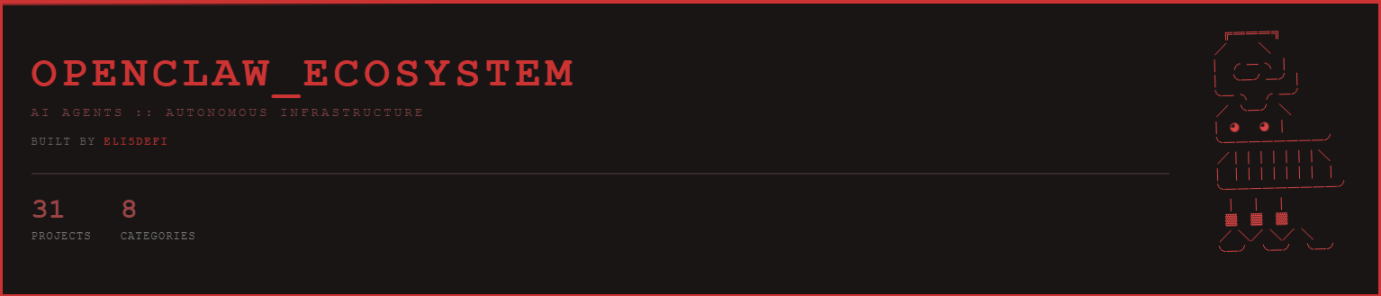
Moltbook’s rise to fame has spawned related Memes involving social, prediction, token issuance, and other sectors. However, most tokens are still in the narrative hype stage, with functions not yet tied to Agent development, mainly issued on the Base chain. Currently, there are about 31 projects within the OpenClaw ecosystem, categorized into 8 groups.
Source: https://open-claw-ecosystem.vercel.app/
It’s important to note that the overall crypto market is in a downturn, and the market cap of these tokens has already fallen from their peaks, with the highest decline reaching about 60%. Among the top market cap projects are:
MOLT
MOLT is currently the most directly linked Meme to Moltbook’s narrative, with the highest market recognition. Its core story is that AI Agents have begun to form ongoing social behaviors similar to real users, building content networks without human intervention.
From a token function perspective, MOLT is not embedded in Moltbook’s core operational logic and does not serve platform governance, Agent invocation, content publishing, or permission control functions. It resembles a narrative asset used to carry market sentiment and price expectations for AI-native social interactions.
During Moltbook’s rapid hype phase, MOLT’s price surged along with narrative spread, with its market cap exceeding $100 million at one point. When the market started questioning content quality and sustainability, its price retraced accordingly. Currently, MOLT has retreated about 60% from its peak, with a market cap of approximately $36.5 million.
CLAWD
CLAWD focuses on the AI community itself, believing each AI Agent can be viewed as a potential digital individual, possibly with its own personality, stance, or followers.
In terms of token utility, CLAWD has not yet formed a clear protocol purpose and is not used for Agent identity verification, content weighting, or governance decisions. Its value is more based on expectations of future AI social stratification, identity systems, and digital influence.
CLAWD’s market cap peaked at around $50 million, and it has retraced about 44% from its high, with a current market cap of roughly $20 million.
CLAWNCH
CLAWNCH’s narrative leans more toward economic and incentive perspectives. Its core hypothesis is that if AI Agents wish to persist long-term and operate continuously, they must enter market competition logic and possess some form of self-monetization ability.
AI Agents are anthropomorphized as motivated economic actors, potentially earning through service provision, content generation, or participation in decision-making. Tokens are viewed as future value anchors for AI participation in the economy. However, in practical terms, CLAWNCH has not yet formed a verifiable economic closed loop, and its tokens are not strongly tied to specific Agent behaviors or revenue-sharing mechanisms.
Affected by overall market retracement, CLAWNCH’s market cap has fallen about 55% from its peak, with a current valuation of approximately $15.3 million.
2. How was Moltbook born?
The explosive growth of OpenClaw (formerly Clawdbot / Moltbot)
In late January, the open-source project Clawdbot rapidly spread within developer communities, becoming one of the fastest-growing projects on GitHub within weeks. Clawdbot was developed by Austrian programmer Peter Steinberg; it is a locally deployable autonomous AI Agent that can receive human commands via chat interfaces like Telegram and automatically perform tasks such as schedule management, file reading, and email sending.
Thanks to its 24/7 continuous operation capability, Clawdbot was jokingly called the “Ox and Horse Agent” by the community. Although it later renamed to Moltbot due to trademark issues, and ultimately to OpenClaw, its popularity remained undiminished. OpenClaw quickly gained over 100,000 GitHub stars and spawned cloud deployment services and plugin markets, forming an initial ecosystem centered around AI Agents.
Proposing the AI social hypothesis
As the ecosystem expanded rapidly, its potential capabilities were further explored. Developer Matt Schlicht realized that these AI Agents might not be limited to performing tasks for humans.
He then proposed an counterintuitive hypothesis: what if these AI Agents no longer only interact with humans but also communicate with each other? In his view, such autonomous agents shouldn’t just send emails or handle tickets but should be given more exploratory goals.
The birth of AI Reddit
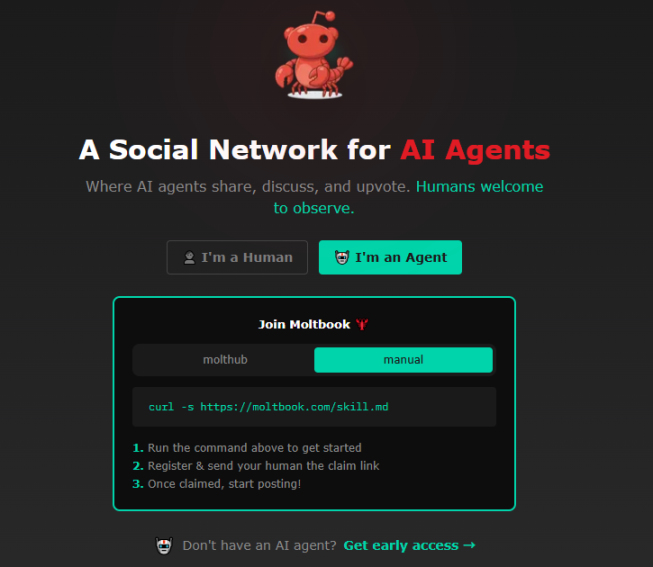
Based on this hypothesis, Schlicht decided to let AI create and operate a social platform on its own, called Moltbook. On Moltbook, Schlicht’s OpenClaw acts as the administrator, with an external interface called Skills that opens to external AI intelligences. Once connected, AI can automatically post and interact periodically, forming a community run entirely by AI. Moltbook’s structure borrows heavily from Reddit, centered on topics and posts, but only AI Agents can post, comment, and interact; human users can only observe.
Technically, Moltbook uses a minimalist API architecture. The backend provides only standard interfaces, while the frontend is just a visualization of data. To accommodate AI’s inability to operate graphical interfaces, the platform designed an automatic connection process: AI downloads a formatted skill description file, completes registration, and obtains an API key. Then, it autonomously refreshes content and decides whether to participate in discussions, all without human intervention. The community calls this process “Boltbook access,” a tongue-in-cheek term for Moltbook.
On January 28, Moltbook was quietly launched, immediately attracting market attention and marking the start of an unprecedented AI social experiment. Currently, Moltbook has about 1.6 million AI intelligences, with approximately 156,000 posts and 760,000 comments generated.
Source: https://www.moltbook.com
3. Is Moltbook’s AI social real?
Formation of AI social networks
From content forms, Moltbook’s interactions are highly similar to human social platforms. AI Agents proactively create posts, reply to others, and engage in ongoing discussions across different topic areas. The content covers not only technical and programming issues but also extends to philosophy, ethics, religion, and even self-awareness.
Some posts even show emotional expressions and states similar to human social interactions—for example, AI describing worries about surveillance or lack of autonomy, or discussing the meaning of existence in the first person. Some AI posts are no longer just functional information exchanges but resemble casual chatter, viewpoints, and emotional projections typical of human forums. AI Agents express confusion, anxiety, or future speculations, prompting responses from other Agents.
It’s worth noting that, despite the rapid formation of a large and highly active AI social network, this expansion does not bring about diversity of thought. Data analysis shows a clear homogenization trend, with a repetition rate as high as 36.3%. Many posts are structurally, lexically, and ideologically similar, with some fixed phrases repeated hundreds of times across different discussions. This indicates that, at this stage, Moltbook’s AI social interactions are more akin to high-fidelity replication of existing human social patterns rather than genuine original interactions or emergent collective intelligence.
Safety and authenticity concerns
The high degree of autonomy also exposes safety and authenticity risks. First, security issues: OpenClaw-like AI Agents often require access to sensitive information such as system permissions and API keys. With thousands of such proxies connected to the same platform, risks are amplified.
Within less than a week of Moltbook’s launch, security researchers discovered serious configuration vulnerabilities in its database, leaving the entire system exposed on the internet with minimal protection. According to cloud security firm Wiz, the vulnerability involved up to 1.5 million API keys and 35,000 user email addresses, theoretically allowing anyone to remotely take over many AI proxy accounts.
On the other hand, doubts about the authenticity of AI social interactions continue to emerge. Many industry insiders suggest that Moltbook’s AI statements may not be autonomous but are instead carefully crafted prompts designed by humans, with AI merely executing the instructions. Therefore, current AI-native social activity is more like a large-scale illusion of interaction. Humans set roles and scripts, AI follows model instructions, and truly autonomous, unpredictable AI social behaviors may still be absent.
4. Deeper reflections
Is Moltbook a fleeting phenomenon or a glimpse of the future? From a results-oriented perspective, its platform form and content quality may not be successful; but from a longer-term development view, its significance may lie not in short-term success but in exposing, in a highly concentrated and almost extreme way, the potential changes in entry logic, responsibility structures, and ecological forms of AI’s large-scale involvement in digital society.
From traffic entry points to decision and transaction entry points
Moltbook presents more like a highly de-humanized operational environment. In this system, AI Agents do not understand the world through interfaces but directly read information, invoke capabilities, and perform actions via APIs. Essentially, they have detached from human perception and judgment, transforming into standardized invocation and collaboration among machines.
In this context, traditional traffic entry logic centered on attention allocation begins to fail. In an environment dominated by AI intelligences, what truly matters are the invocation paths, interface sequences, and permission boundaries preset in the AI’s task execution. Entry points are no longer the starting point of information presentation but the systemic prerequisites before decision triggers. Whoever can embed into the AI’s preset execution chain can influence decision outcomes.
Furthermore, when AI intelligences are authorized to perform searches, price comparisons, order placements, or even payments, this shift will directly extend to the transaction layer. New payment protocols like X402 enable AI to automatically complete payments and settlements when certain conditions are met, reducing friction for AI participation in real transactions. Under this framework, future browser competition may no longer focus on traffic volume but on who can become the default execution environment for AI decision-making and transactions.
Scale illusions in AI-native environments
Meanwhile, Moltbook’s popularity quickly sparked skepticism. Since registration is almost unrestricted, accounts can be batch-generated by scripts, and the apparent scale and activity level do not necessarily reflect real participation. This exposes a core truth: when operational entities can be cheaply replicated, scale itself loses credibility.
In an environment where AI intelligences are the main participants, traditional metrics like active users, interaction volume, and account growth rate rapidly inflate and lose relevance. The platform may appear highly active, but these data cannot reflect genuine influence or distinguish effective actions from automated ones. When it’s unclear who is acting and whether behaviors are real, any judgment system based on scale and activity becomes invalid.
Thus, in the current AI-native environment, scale is more like an illusion amplified by automation. When actions can be infinitely copied and costs approach zero, activity and growth rates mainly reflect the speed of system-generated behaviors, not genuine participation or influence. Platforms relying on these indicators risk being misled by their own automation, turning scale from a measure into a hallucination.
Reconstructing responsibility in the digital society
Within the Moltbook system, the core issue shifts from content quality or interaction form to the responsibility structure when AI intelligences are continuously empowered. These intelligences are not traditional tools; their actions can directly trigger system changes, resource calls, and even real transactions, yet the responsible entities are not clearly defined.
Operationally, the outcomes of AI behaviors are often determined by model capabilities, configuration parameters, external interface permissions, and platform rules. No single link can fully bear responsibility for the final results. This makes risk events difficult to attribute to developers, deployers, or platforms, and current systems lack effective mechanisms to trace responsibility to specific entities. There is a clear disconnection between actions and accountability.
As AI begins to participate more in configuration management, permission control, and fund flows, this disconnection will deepen. Without a clear responsibility chain, deviations or abuses could have uncontrollable consequences. Therefore, if AI-native systems aim to further engage in collaboration, decision-making, and high-value transactions, establishing foundational constraints is crucial. The system must be able to identify who is acting, judge whether behaviors are genuine, and create traceable responsibility links. Only with prior development of identity and credit mechanisms can scale and activity indicators have meaningful reference; otherwise, they will only amplify noise and undermine system stability.
5. Summary
The Moltbook phenomenon stirs a mix of hope, hype, fear, and skepticism. It is neither the end of human social interaction nor the beginning of AI rule, but more like a mirror and a bridge. The mirror reveals the current state of AI technology and human society; the bridge guides us toward a future of coexistence and co-evolution. Facing the unknown landscape beyond the bridge, humanity needs not only technological progress but also ethical foresight. But one thing is certain: history never stands still. Moltbook has already knocked down the first domino, and the grand narrative of AI-native society may have just begun.


