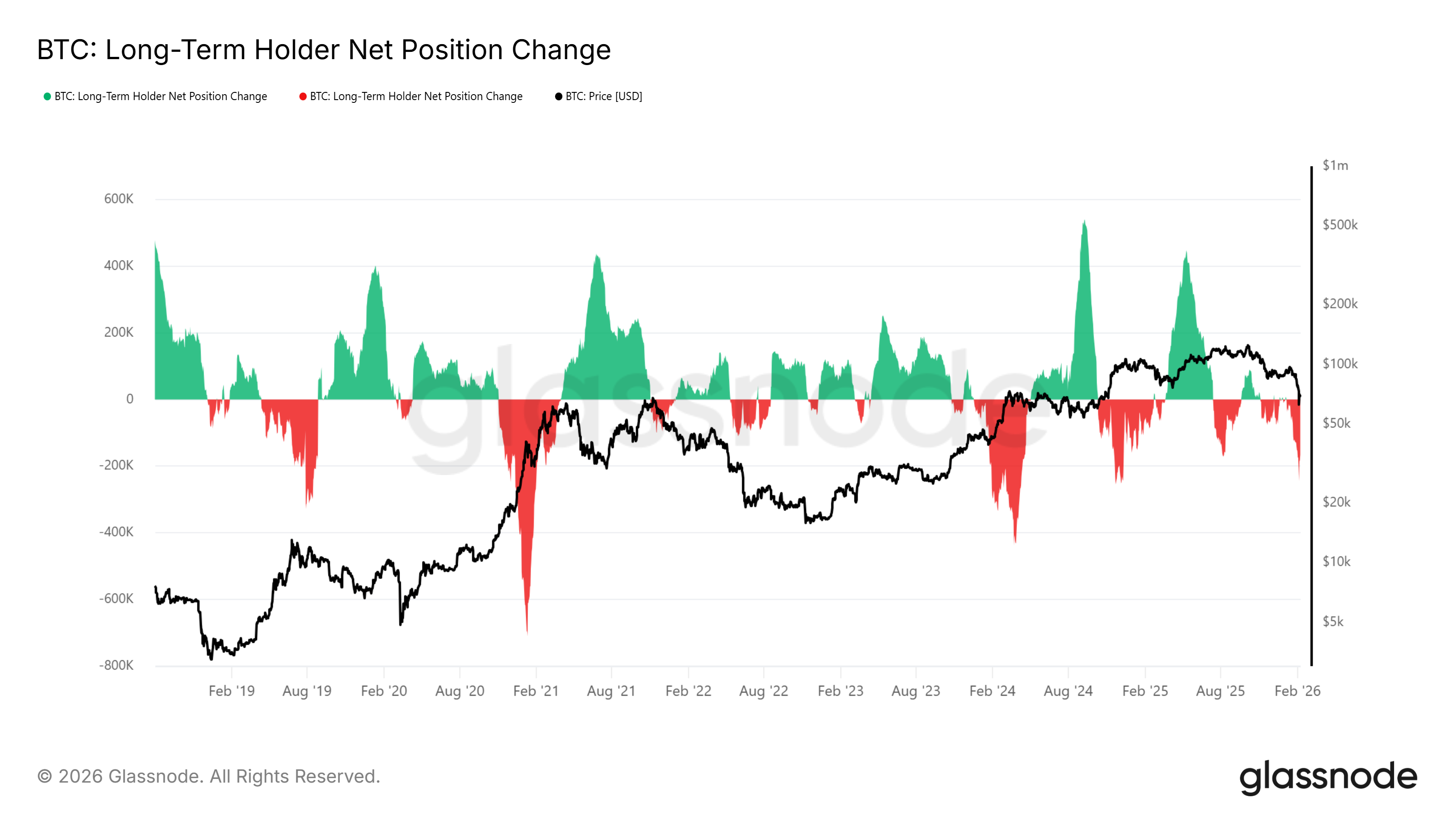
Bitcoin closed on February 10 at $70,000, still maintaining a sluggish trend. Long-term holders’ net positions decreased by 245,000 BTC, but the total supply increased from 13.63 million to 13.81 million, indicating repositioning. On February 6, 66,940 BTC flowed into accumulated addresses, reaching the weekly maximum, absorbing supply by whales. The Sharpe ratio of -10 hit a new low, aligning with the late bear market phase.
Contradiction: Long-term holders sell 245,000 BTC but total supply increases
(Source: Glassnode)
Glassnode data shows that last Thursday, BTC long-term holders (LTH) reduced their net holdings by 245,000 BTC within the past 30 days, reaching an extreme cyclical high in daily average holdings. Similar peaks in LTH net holdings also appeared during mid-corrections in 2019 and 2021, when prices were consolidating rather than entering a downtrend. Long-term holders are generally defined as addresses holding coins for over 155 days, and their behavior is considered an important market confidence indicator.
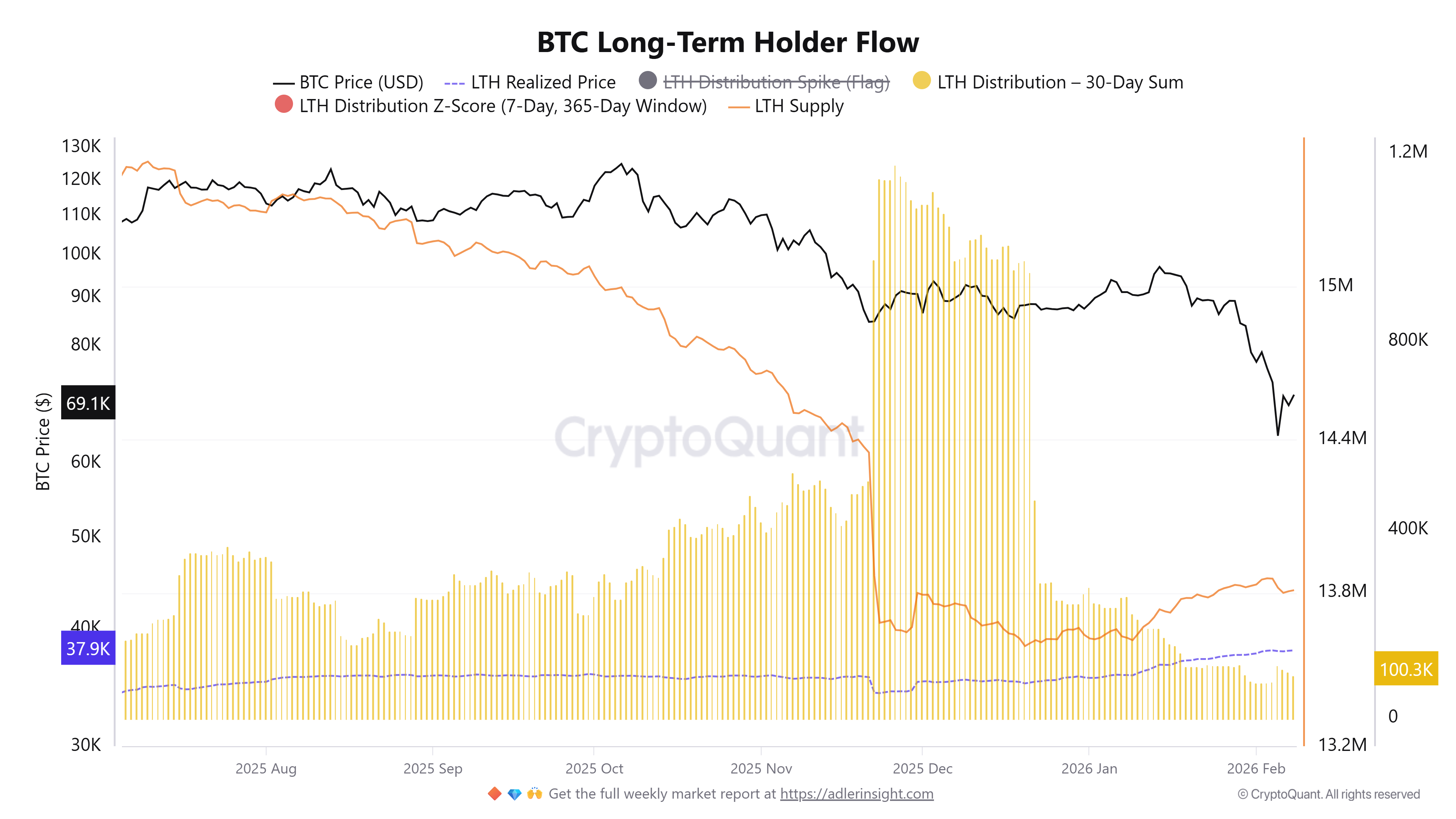
Meanwhile, CryptoQuant data indicates that although LTHs are still distributing, their total supply has increased from 13.63 million at the start of 2026 to 13.81 million. This “selling yet increasing” paradox reflects the time-based classification of LTHs. During uncertain market periods, short-term holders reduce trading activity, causing coin aging and eventually transitioning into long-term holdings. Therefore, even if older cohorts are selling, the supply of long-term holdings can still increase.
The underlying logic is: when prices plummet, panic-selling short-term traders exit, and their coins are bought by long-term investors. These newly purchased coins, although just entering long-term wallets, will be reclassified as LTH supply after surpassing 155 days. Meanwhile, some older LTHs do sell (-245,000 BTC), but the number of newly aging LTHs exceeds that, leading to a net increase in total supply.
Dual interpretation of long-term holder data
(Source: CryptoQuant)
Bearish signal: Net holdings decreased by 245,000 BTC, old LTHs taking profits at high levels
Bullish signal: Total supply increased to 13.81 million, short-term coins aging into long-term coins, indicating increased holding willingness after selling
Long-term holder SOPR (Spent Output Profit Ratio) returned above 1 on Monday, indicating a rebound after a period of losses. SOPR measures the average profit ratio of coins sold; values above 1 suggest overall profit-taking, while below 1 indicates losses. Given Bitcoin’s current realized price above $55,000, this situation may align with a bottoming phase.
66,940 BTC inflow into accumulated addresses hits weekly maximum
According to CryptoQuant data, recent BTC sell-offs have met the active buy-in demand from wallets that are long-term and not spending. On February 6, about 66,940 BTC flowed into accumulated addresses, the largest single-day inflow in this cycle, implying major holders absorbed supply during the dip and are now holding these coins themselves.
66,940 BTC is roughly equivalent to $4 billion (at the then-current price). Such a scale of single-day buy-in is extremely rare in the Bitcoin market. Accumulated addresses refer to wallets that rarely send coins out or have minimal spending, typically representing long-term investors, institutions, or whale cold wallets. The increase in holdings of these addresses is a strong bullish signal, as it reduces circulating supply and locks in chips.
In other words, traders are transferring Bitcoin into wallets that historically distribute coins more slowly. This is significant because panic selling usually only continues after buyers have exited. The opposite is happening here: the deeper the decline, the more coins flow into those investors who are unlikely to sell in the short term, tightening liquidity and potentially stabilizing prices.
Note: a single peak may contain noise (entity clustering, internal reorganization), but sustained increases in inflow volume reinforce the argument that “the crash won’t last.” Glassnode’s 1K-10K BTC supply has risen noticeably during recent sell-offs, indicating whales are increasing holdings as prices weaken. These players typically absorb supply during deleveraging, helping to end sell-offs more quickly.
Sharpe ratio at -10 and exchange index turning positive
CryptoQuant analyst Darkfost states that Bitcoin’s Sharpe ratio has fallen to around -10, the lowest since March 2023, placing it in a region consistent with late-stage bear markets. The indicator measures risk-adjusted returns, suggesting Bitcoin’s recent performance relative to risk is unattractive, which explains ongoing downward pressure.
However, similar negative readings at the end of 2018 to early 2019 and late 2022 to early 2023 coincided with market bottoms, not prolonged selling. From a practical perspective, BTC may still carry risks in the short term, but the risk-reward ratio is becoming increasingly asymmetric, often signaling trend reversals rather than deeper declines.
The Coinbase Premium Index, which gauges institutional demand in the US, has quickly rebounded into positive territory after Bitcoin’s price dropped to the mid-$60,000s. During most of January, Coinbase’s premium was deeply discounted, indicating persistent selling pressure from US traders. The current sudden reversal suggests spot buying on Coinbase has increased as prices weaken.
Market pauses ahead of Non-Farm Payroll and CPI data
Macroeconomic factors may still be the main drivers of recent volatility. January US CPI data will be released on Wednesday, with policy uncertainty still high. According to CME FedWatch, the market currently assigns an 82.2% probability that the March FOMC meeting will not cut rates, reflecting ongoing inflation pressures and tightening policy outlook.
Uncertainty surrounding Kevin Warsh’s appointment as Federal Reserve Chair adds further risk to assets. Elevated US Treasury yields and a tightening financial environment continue to pressure risk assets. The 10-year US Treasury yield remains near 4.22%, a multi-month high, with credit spreads also narrowing. High real yields coincide with declining crypto liquidity and weak spot demand for Bitcoin.
Investors are closely watching later this week for the US non-farm payroll report, CPI, and initial jobless claims. The market will focus on the January non-farm payrolls, with Reuters estimating an increase of 70,000 jobs. ING notes: “The market expects about a 70,000 increase in US employment in January, but will be more sensitive to worse-than-expected results.”
Currently, markets are betting on at least two 25 basis point rate cuts by the Fed this year. Expectations for a June rate cut are rising rapidly, as if Trump’s nomination of Warsh as Fed Chair is confirmed, June would be his first policy meeting in office.
Related Articles
The crypto market is widely declining, with BTC breaking below $68,000, while AI and Meme sectors rally against the trend with gains exceeding 3%
On March 23, the crypto market experienced widespread declines, with Bitcoin and Ethereum falling 1.42% and 1.78% respectively. The RWA sector suffered a significant drop of 4.85%, while AI and Meme sectors bucked the trend with gains of 10.36% and 3.66% respectively. Other sectors showed mixed performance, with overall market sentiment remaining weak.
GateNews39m ago
Michael Saylor Signals Continued Bitcoin Accumulation as Funding Strategy Shifts Toward STRC Preferred Stock
Strategy Executive Chairman Michael Saylor posted on March 22, 2026, that "The Orange March Continues," signaling the company's ongoing Bitcoin accumulation as total holdings reached 761,068 BTC valued at approximately $52.36 billion with an average acquisition cost of $75,696 per coin.
CryptopulseElite42m ago
BTC rises 0.61% in 15 minutes: Whale fund inflows superimposed with futures premium resonance driving
Between 2026-03-23 02:15 and 2026-03-23 02:30 (UTC), BTC yield recorded +0.61%, with prices fluctuating between 67807.1 and 68304.9 USDT, representing a volatility of 0.73%. During this short-term volatility period, market trading activity was robust, with enhanced linkage between spot and futures markets, and sustained volume increase in core trading zones, attracting market attention.
The primary driver of this volatility was significant capital inflow from on-chain whale wallets to exchanges during the window period, with approximately 17,184 BTC flowing in within a short timeframe, marking a new monthly high. M
GateNews48m ago
Bitcoin Falls Below $69,000, Derivatives Market Shifts to Defense, Downside Risks Intensify
10x Research analysis points out that Bitcoin has broken below $69,000, marking a shift in market structure. Traders have significantly adjusted positions, with increased futures liquidations and negative funding rates. Options capital flows are moving toward downside protection, signaling hedging demand against downside risks. Meanwhile, market expectations regarding rate increases are diverging from the Federal Reserve's rate-cutting guidance, which could impact risk asset performance.
GateNews49m ago
NYSE Lifts Crypto Options Cap Across 11 BTC and ETH ETFs
Two NYSE-affiliated venues have scrapped the 25,000-contract cap on options tied to 11 crypto ETF options, a move the exchanges filed with the Federal Register on March 10. The Securities and Exchange Commission acknowledged the rule alterations on Sunday by waiving the standard 30-day waiting
CryptoBreaking1h ago
NYSE Exchanges Remove 25,000-Contract Options Cap on 11 Bitcoin and Ether ETFs
NYSE Arca and NYSE American have removed the 25,000-contract position and exercise limits on options tied to 11 spot Bitcoin and Ether exchange-traded funds (ETFs), with the rule changes filed on March 10, 2026, becoming immediately effective after the Securities and Exchange Commission (SEC) waived the standard 30-day waiting period.
CryptopulseElite1h ago


