
Discord clarifies global age verification policy, emphasizing that most adults can be automatically assessed through predictive models without additional verification. Although the official stance is to proactively protect minors, privacy concerns have been raised, leading to a surge in searches for alternative platforms.
Users’ backlash continues, Discord responds to age verification controversy
Popular messaging app Discord posted a statement early this morning (2/11 Taiwan time), directly addressing the controversy over its age verification policy in an attempt to quell user concerns.
Discord emphasizes that the vast majority of users do not need to undergo facial scans or upload government IDs to continue using the platform normally. The system will utilize existing account behavior patterns and signals to build an “age prediction” model, which will determine whether a user is an adult with high confidence.
This means that most adult users can access relevant features without explicit age checks. Only when the system cannot confidently determine a user’s age will it require the user to complete additional verification through a third-party partner.
- Background: Discord to launch global age verification in March! No verification, no access to adult content; community uncovers past data leaks
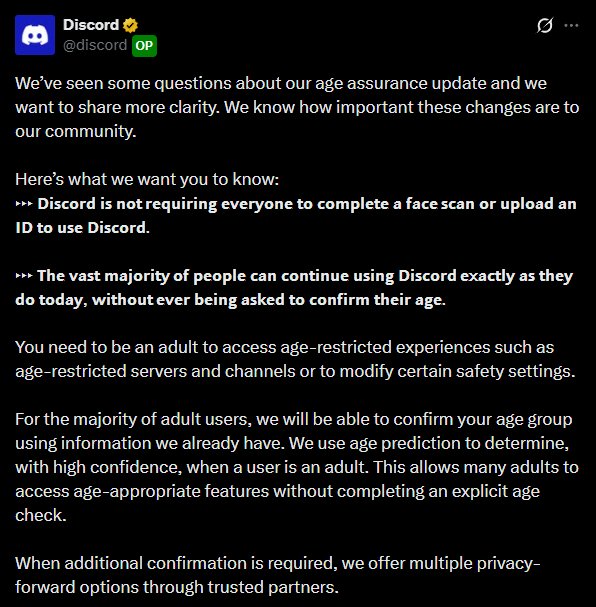
Image source: Discord Users’ backlash continues, Discord responds to age verification controversy
Discord’s new policy rollout in March causes surge in alternative platform searches
Discord’s global age verification policy will officially take effect this March. Users will only be prompted to verify when attempting to access servers and channels restricted to those over 18 or when changing certain safety settings.
This policy has sparked strong backlash within the community, leading to a sharp increase in searches for alternatives. According to a report by Windows Central, search interest for “Discord alternatives” on Google has surged over 10,000% in the past 48 hours compared to last month, reflecting user concerns and dissatisfaction with the new policy.
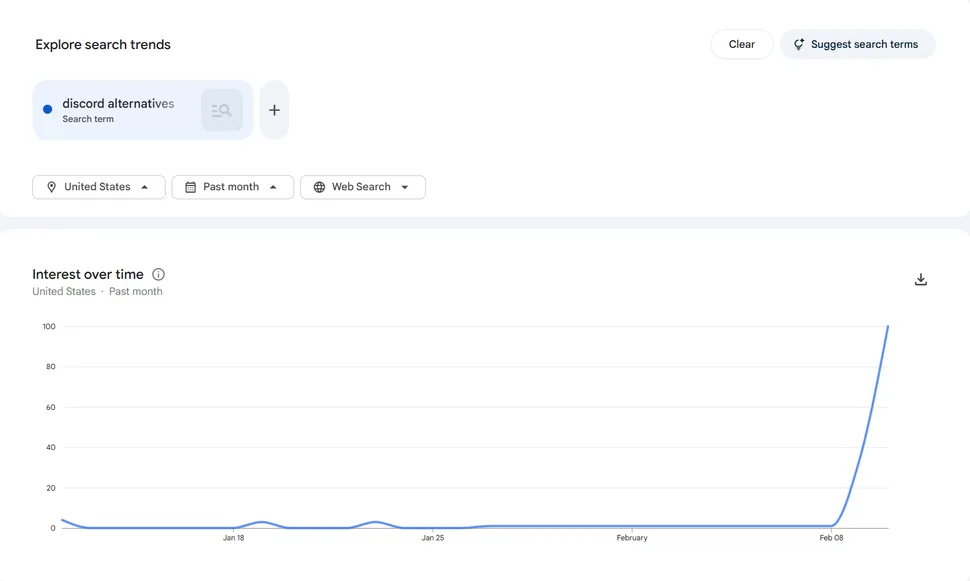
Image source: Windows Central Search interest for “Discord alternatives” on Google has increased over 10,000% in the past 48 hours compared to last month
Community regulation becomes a global trend, Telegram CEO issues warning
Over the past few years, age verification mechanisms on social platforms have increasingly become a global trend.
Telegram CEO Pavel Durov has publicly criticized Spanish regulators, arguing that banning minors from using social platforms and extending age verification policies are pushing dangerous new regulations that threaten online freedom.
The Electronic Frontier Foundation (EFF) also pointed out that age verification policies have shifted from experimental edge cases to a widespread reality across the United States. Last year, the Australian government even attempted legislation to ban users under 16 from social platforms. However, as reported by BBC interviews, the effectiveness of such measures has been limited, as young people quickly find ways to bypass restrictions.
Related reports:
Spain plans to ban social media use for minors under 16! TG founder criticizes: This is surveillance, not protection
Discord emphasizes proactive protection, experts worry about insufficient privacy control
While social platform regulation is trending, Savannah Badalich, Head of Global Product Policy at Discord, told Decrypt that their policies are not related to specific legal requirements but are made as proactive commitments to youth safety and well-being.
However, privacy advocacy groups remain skeptical, believing that such policies require users to trust tech companies without independent verification.
Suzanne Bernstein, an advisor at the nonprofit Electronic Privacy Information Center (EPIC), pointed out that many companies already hold large amounts of user data, and asking users to trust them is often an illusion. This reflects that users, when seeking to use online services, actually lack sufficient control over their own privacy information.
Further reading:
Tether ventures into AI health tech! How does QVAC Health integrate biological data while protecting your privacy?
Disclaimer: The information on this page may come from third parties and does not represent the views or opinions of Gate. The content displayed on this page is for reference only and does not constitute any financial, investment, or legal advice. Gate does not guarantee the accuracy or completeness of the information and shall not be liable for any losses arising from the use of this information. Virtual asset investments carry high risks and are subject to significant price volatility. You may lose all of your invested principal. Please fully understand the relevant risks and make prudent decisions based on your own financial situation and risk tolerance. For details, please refer to
Disclaimer.
Related Articles
Tether CEO Seeks User Input to Optimize Wallet Small Balance Display Method
Gate News reported that on March 20, Tether Chief Executive Officer Paolo Ardoino posted on X, stating that the team is optimizing the wallet user interface and inviting users to vote on the display format for small balances. For ultra-small balances below one cent, users can choose to display fractions precise to the cent, or select a more streamlined alternative display format. Paolo Ardoino encouraged users to participate in feedback to help the team decide on the final display effect.
GateNews2h ago
Tether Enters Bitcoin Lightning Network, USDT Seeks to Reshape Crypto Payment Landscape and On-Chain Transfer Efficiency
Tether is accelerating the introduction of USDT into the Bitcoin Lightning Network to enhance transfer efficiency and expand application scenarios. This move combines stablecoins with Bitcoin, promoting efficient payments and cross-chain application development, and is expected to improve the usability of cryptocurrency payment systems, though it faces market competition and technical challenges.
GateNews12h ago
World Gold Council Partners with BCG to Release Tokenized Gold Shared Framework, Directly Takes On Tether and Paxos
The World Gold Council and Boston Consulting Group released a white paper proposing a "Gold as a Service" framework aimed at standardizing the issuance and management of tokenized gold, challenging the existing market dominated by Paxos and Tether. The framework will lower barriers to entry and encourage greater institutional participation. However, implementation timelines and specific plans remain unclear, and whether the WGC's brand influence can shake up the existing market remains to be seen.
動區BlockTempo14h ago
World Gold Council Proposes 'Gold as a Service' Framework to Challenge Tether and Paxos
The World Gold Council (WGC), the organization behind the $163 billion SPDR Gold Shares ETF (GLD), unveiled a proposed "Gold as a Service" infrastructure framework on March 19, 2026, designed to standardize the tokenized gold market currently dominated by Tether Gold (XAUT) and PAX Gold (PAXG).
CryptopulseElite14h ago
Cantor Competes for FalconX IPO Advisory Role, Positioning for Crypto Institutional Listing Wave
Wall Street financial services firm Cantor is competing to serve as IPO advisor for crypto platform FalconX. Cantor holds a competitive advantage due to its bitcoin lending partnership with FalconX. FalconX has strengthened its business positioning through three acquisitions, but the IPO timeline has been affected by market downturns, and whether it will ultimately go public remains to be seen pending changes in market conditions.
MarketWhisper15h ago


