
- Pi Network set March 1 as the mandatory deadline for Step 2 upgrades, and Mainnet nodes that miss it risk losing network connectivity.
- The update advances Pi’s protocol path toward newer Stellar consensus versions, with the Core Team targeting version 23 by June 2026.
Pi Network has started Phase 2 of its Mainnet protocol upgrades and set March 1, 2026, as the cutoff for required updates by Mainnet node operators. Pi Core team noted that nodes that do not complete Step 2 by that date may lose connectivity to the network.
Step 2 continues a staged migration of the underlying Stellar-based protocol, moving Mainnet nodes to consensus protocol version 19.9. The deadline follows an earlier migration to version 19.6, as we reported in mid-February, keeping node software aligned before subsequent steps. The work is part of a broader plan to progress toward Stellar consensus protocol version 23 by June 2026.
Protocol upgrades in progress (Step 2 – Deadline: March 1): The Pi Mainnet blockchain protocol continues to undergo a series of upgrades. All Mainnet nodes are required to complete this step before the deadline to remain connected to the network. Details here:…
— Pi Network (@PiCoreTeam) February 25, 2026
Pi Node remains central to the network’s desktop-based participation model, in which users can contribute through node operations on laptops and desktops.
Node operators should follow Step 2 instructions and finish the necessary update. Pi Node software is provided through the Pi Desktop application, and its latest release is version 0.5.4 on Windows, macOS, and Linux.
At the same time, community discussion around Mainnet migration transparency and token movement from testnet to mainnet has continued. CNF previously reported that Pi Network introduced simulated USDT to its testnet wallet, giving users a safe way to try out stablecoin transactions without any real financial risk.
Most recently, Pi Network celebrated the first anniversary of its Open Network and outlined its future Mainnet priorities, which included AI tools, KYC growth, and ecosystem tokens.
Pi Network’s Token Price Action Stays Below Key Resistance
Pi Coin trades around $0.1690 at the time of writing, a little extension of a brief recovery following increased gains of over 3% in the last session. The action put the altcoin above the $0.1533 support level, though it was below the 50-day Exponential Moving Average around $0.1748.
A technical breakdown shows that momentum readings are giving mixed conditions. The MACD has stayed slightly above its signal line while positive histogram bars have weakened, indicating slower upside movement than earlier in the rebound.
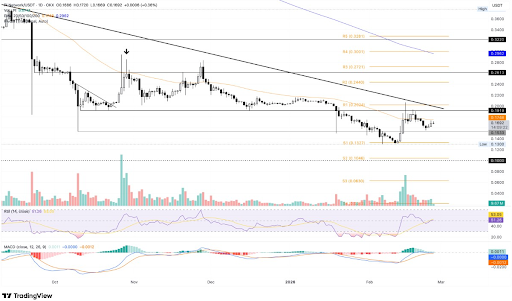
Source: TradingView
Should the breaks above the 50-day EMA, the next resistance level would be $0.1919, which is near a descending trendline from prior highs. On the downside, immediate support is $0.1533. Below that, the next key support zone is around $0.1300, where buying interest emerged earlier in February.
In early January, Pi Network launched a free Product Design Workshop to help community members turn ideas into launch-ready Pi Apps through training in UX/UI, prototyping, testing, and release planning. The program is designed for developers and non-coders, with a focus on practical product design skills and integration with Pi ecosystem tools such as App Studio.
Disclaimer: The information on this page may come from third parties and does not represent the views or opinions of Gate. The content displayed on this page is for reference only and does not constitute any financial, investment, or legal advice. Gate does not guarantee the accuracy or completeness of the information and shall not be liable for any losses arising from the use of this information. Virtual asset investments carry high risks and are subject to significant price volatility. You may lose all of your invested principal. Please fully understand the relevant risks and make prudent decisions based on your own financial situation and risk tolerance. For details, please refer to
Disclaimer.
Related Articles
Pi Network Transfers 30M Coins as Migration Resumes
Pi Network has restarted its long-running migration process after a short pause. In the latest update, around 30 million Pi coins moved from an intermediary address to user-linked wallets. The transfer happened just hours after activity resumed, following a one-week break
The update suggests the n
Coinfomania1h ago
Pi Network restarts the migration, and 30 million Pi have been transferred into users’ wallets
Pi Network resumed mainnet migration after a pause, transferring about 30 million Pi tokens to users’ wallets, mainly targeting users who have completed KYC. The first migration has been completed, and a second migration is currently underway, with the core team emphasizing batch processing. Some false information appeared during the process; the official account has issued a clarification, reminding users to obtain information through official channels.
MarketWhisper16h ago
Pi Network version 21 released; mainnet RPC and smart contract acceleration are advancing
Pi Network released version 21 on April 9. The key update is that the testnet RPC has officially gone live, providing developers with a secure environment to test smart contracts and DApps. Next, smart contracts are expected to be deployed within two months, enabling Pi幣 to transition from a community token into a functional digital asset and to support DeFi applications and automated workflows, while also advancing the KYC migration to ensure compliance.
MarketWhisper21h ago
Pi Network Launches RPC Server on Testnet for Smart Contracts
Pi Network has introduced a new tool for developers. The project has launched an RPC server on its testnet. This update is an important step toward building smart contracts and real applications on the network
For now, the feature is only available in the test environment. Still, it shows that Pi
Coinfomania21h ago
Pi Launchpad 12 Grid testnet launch, pioneer token distribution completed
Pi Network recently launched a token distribution test for the Pi Launchpad. More than 300k users participated, staking 24 million Test-Pi. The core architecture “12 Grid” enables end-to-end token delivery, and all transactions are publicly verifiable. This test confirmed the system’s feasibility and paved the way for a future official launch. The upgrade roadmap includes the PiRC1 framework and Protocol 23, which will be rolled out in April and May, respectively.
MarketWhisper04-09 05:21
Pi Launchpad Testnet Begins 12 Grid Token Distribution Trial
Pi Network has taken another step toward building its ecosystem. A new update shows that its Launchpad feature has started testing token distribution on the testnet. This test uses a system called the “12-Grid.” While the name may sound complex, the idea is simple. It allows users to subscribe to a
Coinfomania04-08 18:02


