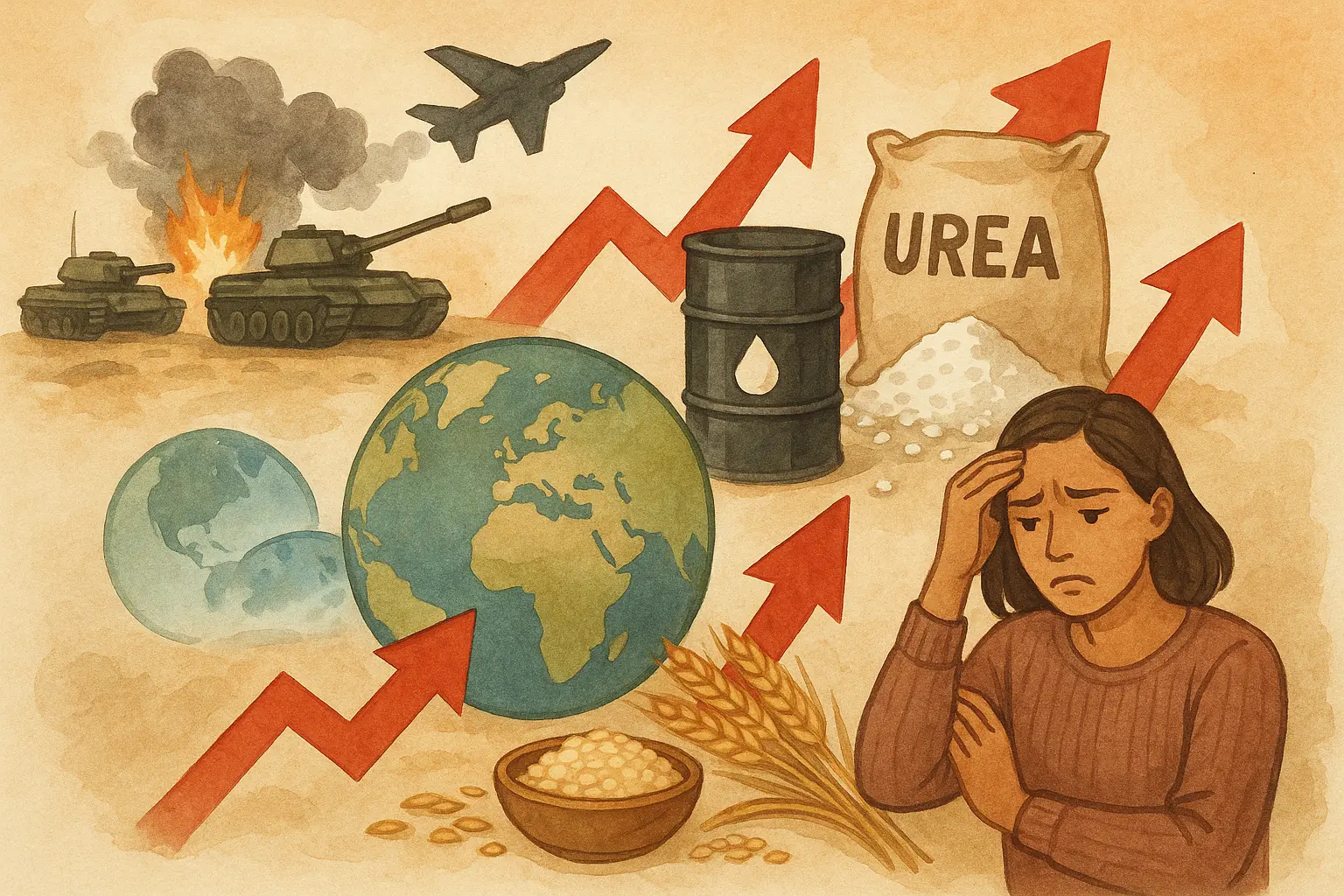
The market impact caused by the Iran conflict has far exceeded the oil sector. The actual blockade of the Strait of Hormuz is directly affecting the global fertilizer supply chain, with urea prices as of March 16 reaching $601 per ton, an increase of over 34% in a month and 57% compared to the same period last year. Meanwhile, WTI crude oil approached $90 per barrel, and Bitcoin surged to $75,000 in early Tuesday trading.
Hormuz Blockade: The Overlooked Impact on the Fertilizer Supply Chain
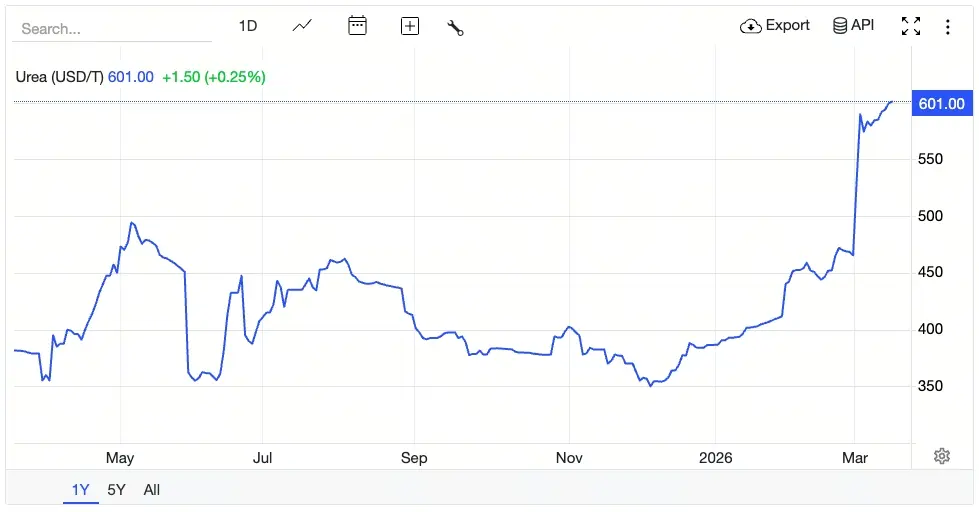
(Source: Trading Economics)
Media coverage has focused on soaring oil prices, but the impact of the Strait of Hormuz on the agricultural supply chain is equally significant. According to data from the United Nations Conference on Trade and Development, approximately 16 million tons of fertilizer—one-third of global fertilizer maritime trade—are transported through the Strait of Hormuz each year, with over two-thirds being urea. The blockade causes chain reactions across multiple commodities:
- Agricultural Fertilizer (Urea): The most widely used nitrogen fertilizer globally, directly influencing global food production costs and agricultural supply chains.
- Industrial Raw Materials: Production and logistics of industrial goods such as aluminum and plastics depend on smooth transportation through Hormuz, which is now disrupted.
- Energy Derivatives: Interruptions in natural gas and oil supplies drive up costs for all energy-intensive products.
Why Is Urea So Sensitive to Energy Shocks?
Urea production is highly dependent on natural gas: natural gas is the key industrial raw material for the Haber-Bosch process to synthesize ammonia, accounting for approximately 70% to 90% of urea production costs. Therefore, when the Hormuz blockade increases the risk premium on Middle Eastern natural gas and oil supplies, raw material costs for fertilizer producers rise directly and quickly, transmitting rapidly to market prices.
Market tracker Myriad is currently monitoring a critical threshold: whether the benchmark price of urea will exceed $610 per ton by March 25. As of now, it is at $601, less than $10 away from the threshold. Besides its use in agriculture, urea is also used in some animal feeds, and price fluctuations have broad implications for global agricultural production costs.
Cross-Market Linkages: Oil Near $90, Bitcoin Reemerges as a Safe Haven
The cross-market effects of the Iran conflict are becoming evident. WTI crude oil prices are driven higher by supply concerns, approaching $90 per barrel; according to Myriad’s data, there is a 65% probability that oil will rise to $120, down from 76% the previous day.
Bitcoin surged to $75,000 in early Tuesday trading. QCP Capital analyst noted on Monday that recent trends in the crypto market suggest: “The narrative of Bitcoin as a ‘digital safe haven’ or ‘geopolitical hedge’ may be re-emerging, with the market testing this hypothesis in real time.” The analyst observed that during the escalation of Middle Eastern tensions, some funds shifted from gold ETFs to Bitcoin ETFs, but the classification of Bitcoin as a safe haven remains a subject of debate within the industry.
Frequently Asked Questions
Q: Why has urea become the most affected fertilizer during the Iran conflict?
Approximately one-third of global fertilizer maritime trade passes through the Strait of Hormuz, with over two-thirds being urea. The blockade directly cuts off the main supply route; combined with urea’s high dependence on natural gas, the compounded energy supply risks have driven urea prices sharply higher.
Q: Besides urea, which other markets are impacted by the Hormuz blockade?
In addition to fertilizers, the supply and logistics of industrial raw materials such as aluminum and plastics are also disrupted. This, along with rising oil and natural gas prices, exerts cost pressures on all energy-dependent manufacturing. WTI crude is nearing $90 per barrel, and Bitcoin has seen inflows driven by geopolitical tensions.
Q: Is it credible to see Bitcoin as a safe haven asset in this Iran conflict?
QCP Capital analysts state that the market is currently testing Bitcoin’s role as a “geopolitical hedge,” with some institutional funds shifting into Bitcoin ETFs. However, historically, Bitcoin has also declined in the early stages of conflicts alongside other risk assets, so this classification remains a debated topic within the industry.
Disclaimer: The information on this page may come from third parties and does not represent the views or opinions of Gate. The content displayed on this page is for reference only and does not constitute any financial, investment, or legal advice. Gate does not guarantee the accuracy or completeness of the information and shall not be liable for any losses arising from the use of this information. Virtual asset investments carry high risks and are subject to significant price volatility. You may lose all of your invested principal. Please fully understand the relevant risks and make prudent decisions based on your own financial situation and risk tolerance. For details, please refer to
Disclaimer.


