
Bitcoin temporarily breaks $70,000 amid rumors of US-Iran war de-escalation, but Iran denies the reports. Analysts warn this rebound may be a “bull trap”; if geopolitical risks and inflation are not resolved, the price could test $46,000.
US-Iran War De-escalation Rumors Spark Short-term Bitcoin Rally
Last night, President Trump suddenly announced a five-day pause on military strikes against Iran’s energy infrastructure, stating that constructive talks are underway and a comprehensive resolution to Middle East hostilities is possible. He also called for Iran to restart the Hormuz Strait, but Iranian officials completely deny such an agreement.
In addition to Iran’s Parliament Speaker Ali Larijani calling these reports false news aimed at manipulating financial and oil markets, the Islamic Revolutionary Guard Corps (IRGC) issued a warning: if infrastructure is attacked, they will retaliate against Middle Eastern countries providing power to US military bases.
Despite this, the news temporarily eased energy market tensions, with global oil prices dropping sharply and US stocks rising. Simultaneously, Bitcoin ($BTC) experienced a short-term rebound, breaking through the $70,000 mark.
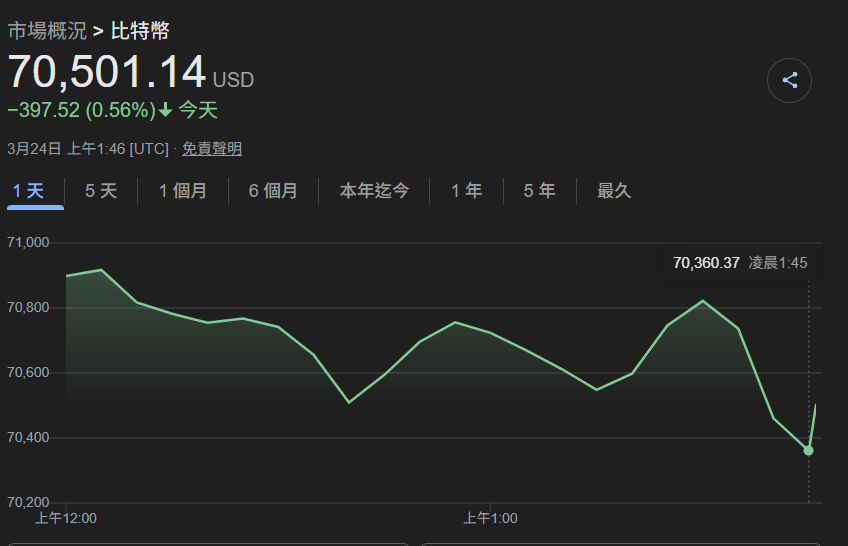
Derivatives Data Suggest Bitcoin Could Test $46,000
Although Bitcoin rose about 4% on news of the US-Iran de-escalation, foreign media Cointelegraph cites analysts who point out that the annualized premium on Bitcoin futures is only 2%, well below the neutral market range of 4% to 8%, indicating weak bullish leverage demand.
Options market data also shows that traders estimate only a 20% chance of Bitcoin reaching $80,000 by April 24.
Crypto analyst Jelle and market observer Michael J. Kramer warn that recent Bitcoin gains are likely a “bull trap.” If geopolitical tensions and inflation concerns are not resolved, Bitcoin could further fall below $60,000.
- Bull Trap: A deceptive technical signal in financial markets, occurring during a downtrend. It often shows bullish signals that lure traders to buy, but the price fails to sustain the high and then drops back below support.
CryptoQuant analyst Axel Adler Jr. states that deeper structural support for Bitcoin is around $47,000. If this level is broken, it could trigger panic selling among large holders.
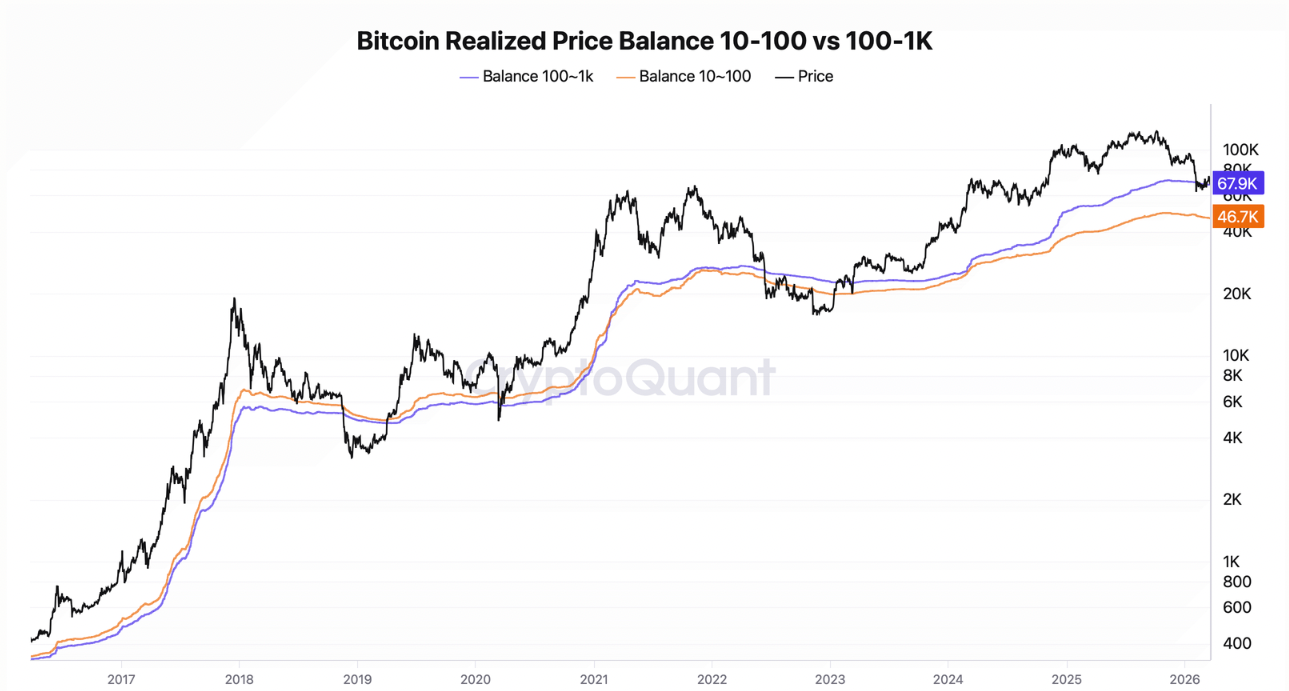
Image source: CryptoQuant, showing Bitcoin realized prices between $10-$100 and $100-$1000 groups.
Overall market sentiment remains pessimistic, mainly due to high oil prices, the Federal Reserve’s pause on rate cuts, and the lingering shadow of the October 2025 flash crash.
Hormuz Strait as Negotiation Leverage, Trump Faces Domestic Political Pressure
When will the US-Iran conflict finally end? According to ABC News analysis, Trump’s strategy is under severe test. In this asymmetric war, Iran has found significant influence to counterbalance the US president.
Iran controls the Strait of Hormuz, which accounts for 20% of global oil shipments, successfully pushing up global oil prices and domestic gasoline prices in the US. Even though Trump claims the strait is secure, most oil tankers cannot pass without insurance coverage from international insurers.
The rising prices caused by the US-Iran conflict have led to strong backlash from Trump’s supporters, including conservatives like Marjorie Taylor Greene and Steve Bannon, who criticize Trump for breaking his promise to avoid foreign wars and demand that the US prioritize addressing domestic labor and living costs.
ABC News predicts that although Iran’s military capabilities have been severely weakened by US and allied bombings, Iran has demonstrated its ability to hold the global oil supply hostage. Both sides may continue to clash over hidden uranium enrichment facilities, adding long-term instability to the Middle East.
Further reading:
Hormuz Strait Crisis Continues: Gold Falls for Seven Days, Bitcoin Retreats, and Multiple Countries Issue Joint Statements
Disclaimer: The information on this page may come from third parties and does not represent the views or opinions of Gate. The content displayed on this page is for reference only and does not constitute any financial, investment, or legal advice. Gate does not guarantee the accuracy or completeness of the information and shall not be liable for any losses arising from the use of this information. Virtual asset investments carry high risks and are subject to significant price volatility. You may lose all of your invested principal. Please fully understand the relevant risks and make prudent decisions based on your own financial situation and risk tolerance. For details, please refer to
Disclaimer.


