Is Core DAO (CORE) a good investment?: A comprehensive analysis of tokenomics, governance, and growth potential in 2024

Introduction: Core DAO (CORE) Investment Position and Market Prospects
CORE is an important asset in the cryptocurrency field. As of December 2025, CORE maintains a market capitalization of $330.33 million with a circulating supply of approximately 1.02 billion tokens, currently trading at $0.1573. As an EVM-compatible Layer 1 blockchain powered by the innovative "Satoshi Plus" consensus mechanism that combines delegated Bitcoin mining hash power with delegated proof-of-stake, CORE has positioned itself uniquely in the blockchain landscape by merging the composability of EVM chains with the decentralization and security of Bitcoin. This distinctive approach has made CORE an increasingly discussed asset when investors consider "Is Core DAO (CORE) a good investment?" This article will provide a comprehensive analysis of CORE's investment value, historical price performance, future price predictions, and associated investment risks to serve as a reference for investors.
Core DAO (CORE) Cryptocurrency Asset Research Report
I. Price History Review and Current Investment Value of CORE
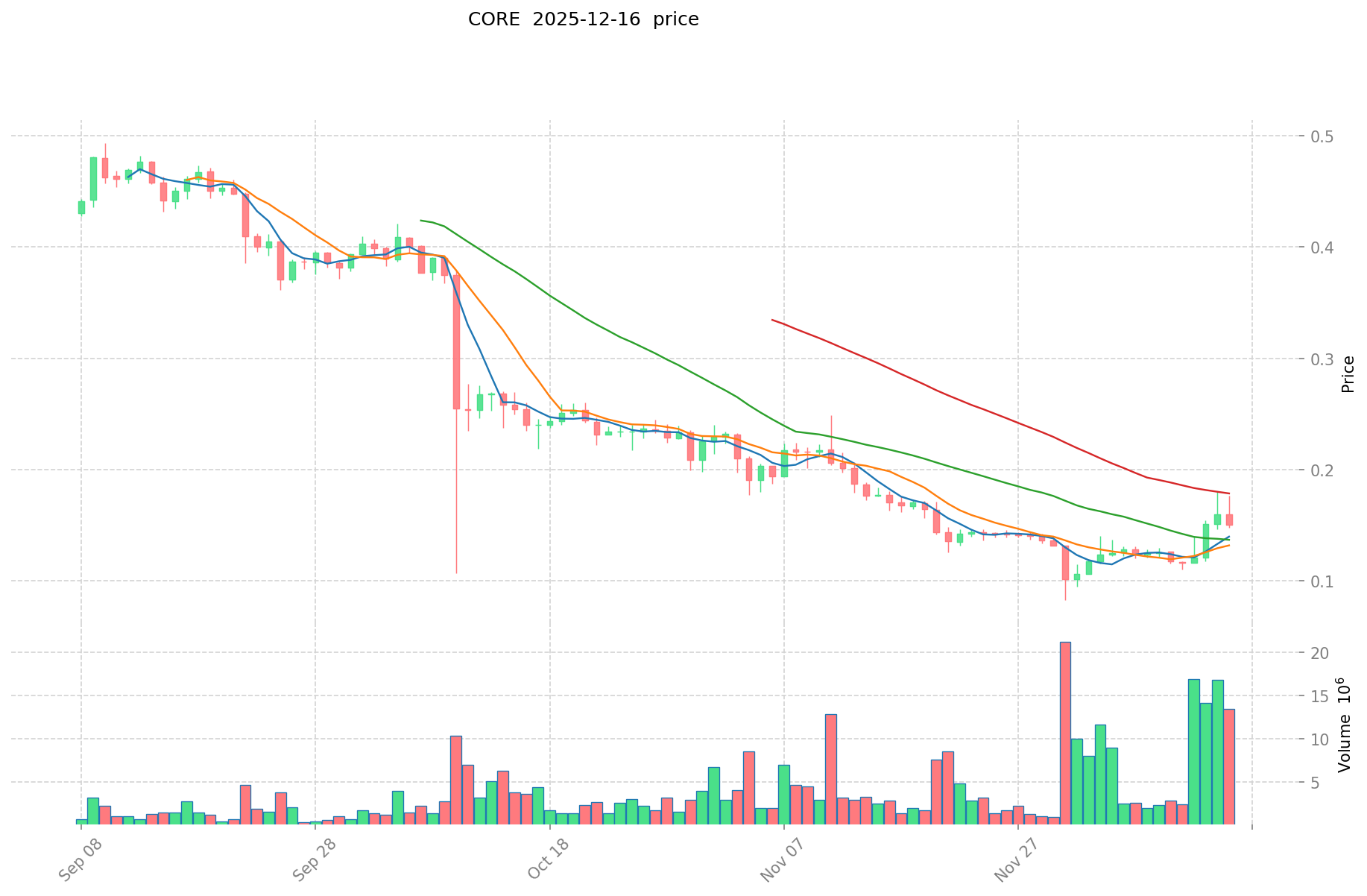
CORE Historical Price Trends and Investment Performance
Historical Price Milestones:
- All-Time High (ATH): $6.14 on February 8, 2023
- All-Time Low (ATL): $0.09046 on December 2, 2025
- Cumulative Return from ATH to ATL: -85.27% (significant drawdown from peak)
Performance Across Key Timeframes (as of December 17, 2025):
| Time Period | Price Change | Change Amount |
|---|---|---|
| 1 Hour | +0.06% | +$0.000094 |
| 24 Hours | +0.25% | +$0.000392 |
| 7 Days | +22.56% | +$0.028955 |
| 30 Days | -6.60% | -$0.011115 |
| 1 Year | -88.64% | -$1.227383 |
Current CORE Market Status (December 17, 2025)
Price Metrics:
- Current CORE Price: $0.1573 USD
- 24-Hour Range: $0.1416 - $0.1658
- 24-Hour Trading Volume: $1,043,800.13 USD
- Total Market Capitalization: $160,480,323.91 USD
- Fully Diluted Valuation (FDV): $330,330,000.00 USD
- Market Capitalization to FDV Ratio: 48.58%
Supply Metrics:
- Circulating Supply: 1,020,218,206.67 CORE (48.58% of total supply)
- Total Supply: 2,100,000,000 CORE
- Maximum Supply: 2,100,000,000 CORE
- Active Holders: 69,227,604
Market Position:
- Global Ranking: #256 by market capitalization
- Market Dominance: 0.010%
- Exchange Listings: Available on 25 exchanges
For real-time CORE market price data, visit Gate CORE Price
II. Core DAO Project Overview
Project Description
Core DAO is an EVM-compatible Layer 1 blockchain that combines the composability of EVM chains with the decentralization and security characteristics of Bitcoin. The project operates as a fork of Geth with modifications to its underlying infrastructure.
Core Technical Innovation - Satoshi Plus Consensus Mechanism:
Core DAO implements a novel consensus mechanism called "Satoshi Plus," which represents a unique approach to blockchain security by:
- Integrating delegated Bitcoin mining hash power
- Combining delegated Proof of Stake (dPoS) mechanisms
- Addressing the blockchain trilemma (scalability, decentralization, and security) through hybrid consensus design
Project Ecosystem
Native Token: CORE
- Token utilization: Network operations, governance participation, and transaction facilitation
- Distribution: 48.58% circulating supply indicates progressive token release schedule
Network Infrastructure:
- Official Website: https://coredao.org
- Block Explorer: https://scan.coredao.org/
- Official Twitter: https://twitter.com/coredao_org
- GitHub Repository: https://github.com/coredao-org
III. Market Analysis and Assessment
Current Market Conditions
Volatility Analysis:
The asset demonstrates significant volatility with a 22.56% seven-day positive movement, indicating potential recovery momentum following an extended bearish period. However, the year-to-date performance of -88.64% reflects substantial losses for long-term holders acquired near previous market peaks.
Liquidity Assessment:
Daily trading volume of approximately $1.04 million USD against a market cap of $160.48 million indicates moderate liquidity. The volume-to-market cap ratio suggests normal trading conditions with room for price movement during significant buy or sell pressure.
Market Sentiment:
The circulating-to-maximum supply ratio of 48.58% indicates that additional token supply will gradually enter circulation, which may create ongoing dilution pressure on price dynamics in the medium term.
Report Generation Date: December 17, 2025
Data Currency: Real-time market data as of 04:21:46 UTC
Core DAO (CORE) Investment Analysis Report
I. Executive Summary
Core DAO is an EVM-compatible Layer 1 blockchain that combines the composability of EVM chains with the decentralization and security of Bitcoin through its novel Satoshi Plus consensus mechanism. As of December 17, 2025, CORE is trading at $0.1573 with a market capitalization of $160.48 million, ranking 256th by market cap. The token has experienced significant volatility, trading down 88.64% over the past year from its all-time high of $6.14 reached in February 2023.
II. Core Factors Influencing CORE Investment Potential
Supply Mechanism and Scarcity
Core DAO operates with a fixed maximum supply of 2,100,000,000 CORE tokens, mirroring Bitcoin's scarcity model. The circulating supply stands at 1,020,218,206.67 tokens, representing approximately 48.58% of the maximum supply. The fully diluted valuation (FDV) is $330.33 million, indicating significant potential for price appreciation if adoption increases relative to token dilution.
The fixed supply cap provides a structural foundation for long-term value preservation, as no additional tokens can be created beyond the predetermined maximum, similar to Bitcoin's monetary policy design.
Technology and Ecosystem Development
Satoshi Plus Consensus Mechanism
Core DAO's primary technological differentiator is its Satoshi Plus consensus, which combines delegated Bitcoin mining hash power with delegated proof-of-stake. This hybrid approach addresses the blockchain trilemma by:
- Leveraging Bitcoin's security and decentralization through mining hash delegation
- Enabling EVM compatibility for developer composability
- Reducing reliance on traditional proof-of-work energy consumption
Network Infrastructure
Core operates as an EVM-compatible fork of Geth, enabling developers to deploy Ethereum-native applications without modification. This compatibility facilitates ecosystem growth through reduced technical barriers to entry.
The ecosystem shows measurable activity with 69,227,604 token holders, indicating broad distribution and engagement across the network.
Market Position and Trading Dynamics
Current Market Metrics
- 24-hour trading volume: $1,043,800
- Market dominance: 0.010%
- Trading on 25 exchanges
The limited 24-hour volume relative to market capitalization suggests moderate liquidity conditions. The token's presence on 25 exchanges provides reasonable accessibility for institutional and retail participants.
Price Performance Analysis
Recent price action shows mixed signals:
- 1-hour change: +0.06%
- 24-hour change: +0.25%
- 7-day change: +22.56% (significant weekly momentum)
- 30-day change: -6.60%
- 1-year change: -88.64%
The 22.56% weekly gain contrasts sharply with sustained annual losses, indicating potential technical recovery patterns forming following extended downtrends.
III. Price Prediction Landscape
Market analysts present divergent forecasts for CORE's future performance:
Bullish Scenarios
- CoinDataFlow projects CORE could reach $6.71-$6.83 by end of 2025
- CCN analysis suggests potential trading range of $0.35-$1.75 in 2025
- Changelly forecasts average price around $2.99 by year-end, with potential highs of $5.03
Bearish Scenarios
- Long Forecast predicts minimal or negative returns through 2028
- CoinCodex suggests prices may remain at or below current levels ($0.1236)
Long-Term Projections
- Changelly forecasts average price of $2.84 in 2033
- Some analyses suggest CORE could reach $22.65 by 2029 under bullish scenarios
IV. Risk Factors
Legal and Execution Risks
Reference materials note that "Core's price faces a tug-of-war between Bitcoin's DeFi potential and legal/execution risks," with Q1 2026 identified as a critical monitoring period for resolution of the Maple case.
Market Adoption Uncertainty
Long-term value depends on sustained adoption of Bitcoin DeFi (BTCfi) applications, ecosystem developer activity, and user engagement on the Core network. Failure to achieve meaningful ecosystem traction would limit upside potential.
Liquidity Constraints
The relatively modest 24-hour trading volume compared to market cap suggests limited liquidity depth, which could amplify price volatility during significant trading activity.
V. Conclusion
Core DAO presents a technically differentiated blockchain combining Bitcoin's security with EVM composability through its Satoshi Plus consensus mechanism. However, current market conditions reflect significant skepticism, with the token trading 88.64% below its all-time high despite technological innovations.
Investment viability depends on multiple contingent factors: ecosystem developer adoption, Bitcoin DeFi market growth, resolution of identified legal challenges, and sustained network participation. The divergence between bullish price predictions ($6-22) and bearish scenarios (stable or declining) reflects genuine uncertainty about Core's path to achieving meaningful market adoption.
Market participants should monitor Q1 2026 developments, ecosystem activity metrics, and Bitcoin DeFi adoption trends before formulating investment decisions. Past performance and theoretical valuations do not guarantee future results.
III. Core DAO (CORE) Future Investment Predictions and Price Outlook
Short-term Investment Prediction (2025, Short-term CORE Investment Outlook)
- Conservative Forecast: $0.138 - $0.160
- Neutral Forecast: $0.160 - $0.173
- Optimistic Forecast: $0.173 - $0.190
Mid-term Investment Outlook (2026-2027, Mid-term Core DAO(CORE) Investment Forecast)
-
Market Stage Expectations: The token is projected to enter a gradual recovery phase with moderate volatility. The network may benefit from increased EVM composability adoption and Bitcoin ecosystem integration initiatives during this period.
-
Investment Return Projections:
- 2026: $0.119 - $0.224 (potential 5% annual upside)
- 2027: $0.115 - $0.209 (potential 23% annual upside)
-
Key Catalysts: Network scalability enhancements, institutional Bitcoin DeFi adoption, ecosystem developer growth, and mainstream integration of the Satoshi Plus consensus mechanism.
Long-term Investment Outlook (Is Core DAO (CORE) a Good Long-term Investment?)
- Base Scenario: $0.190 - $0.347 by 2030 (assumes steady network adoption and stable market conditions)
- Optimistic Scenario: $0.275 - $0.380 by 2030 (assumes accelerated institutional adoption and breakthrough ecosystem applications)
- Risk Scenario: $0.103 - $0.190 by 2030 (reflects extreme market downturns or protocol adoption challenges)
Explore CORE long-term investment and price forecasting: Price Prediction
2025-12-17 to 2030 Long-term Outlook
- Base Scenario: $0.190 - $0.275 USD (corresponds to steady progress and mainstream application adoption)
- Optimistic Scenario: $0.275 - $0.347 USD (corresponds to large-scale adoption and favorable market environment)
- Transformative Scenario: $0.380 USD and above (potential breakthrough ecosystem progress and mainstream adoption)
- End of 2030 Predicted High: $0.347 USD (based on optimistic development assumptions)
Disclaimer: This analysis is for informational purposes only and should not be construed as investment advice. Cryptocurrency markets are highly volatile and subject to regulatory, technological, and macroeconomic risks. Past performance does not guarantee future results. Investors should conduct thorough due diligence and consult with qualified financial advisors before making investment decisions.
| 年份 | 预测最高价 | 预测平均价格 | 预测最低价 | 涨跌幅 |
|---|---|---|---|---|
| 2025 | 0.173092 | 0.1588 | 0.138156 | 0 |
| 2026 | 0.2240271 | 0.165946 | 0.11948112 | 5 |
| 2027 | 0.2086356085 | 0.19498655 | 0.1150420645 | 23 |
| 2028 | 0.246209516685 | 0.20181107925 | 0.1029236504175 | 28 |
| 2029 | 0.32705503503255 | 0.2240102979675 | 0.1433665906992 | 42 |
| 2030 | 0.347171159790031 | 0.275532666500025 | 0.190117539885017 | 75 |
Core DAO (CORE) Investment Analysis Report
I. Project Overview
Basic Information
Core DAO is an EVM-compatible Layer 1 blockchain built as a fork of Geth. The project combines the composability of an EVM chain with the decentralization and security of Bitcoin. CORE is the native token of the Core blockchain.
Key Statistics (As of December 17, 2025)
| Metric | Value |
|---|---|
| Current Price | $0.1573 |
| Market Cap | $160,480,323.91 |
| Fully Diluted Valuation | $330,330,000.00 |
| 24-hour Trading Volume | $1,043,800.13 |
| Circulating Supply | 1,020,218,206.67 CORE |
| Total Supply | 2,100,000,000 CORE |
| Market Dominance | 0.010% |
| Market Ranking | 256 |
Price Performance
| Period | Change | Movement |
|---|---|---|
| 1 Hour | +0.06% | +$0.000094 |
| 24 Hours | +0.25% | +$0.000392 |
| 7 Days | +22.56% | +$0.02895 |
| 30 Days | -6.60% | -$0.01112 |
| 1 Year | -88.64% | -$1.2274 |
| All-Time High | $6.14 (February 8, 2023) | |
| All-Time Low | $0.09046 (December 2, 2025) |
II. Technical Architecture & Innovation
Satoshi Plus Consensus Mechanism
Core DAO introduces a novel consensus mechanism called "Satoshi Plus" that combines two key elements:
- Delegated Bitcoin Mining Hash: Leverages Bitcoin's mining infrastructure and security
- Delegated Proof of Stake (DPoS): Incorporates stakeholder participation in network governance
This hybrid approach represents the project's solution to the blockchain trilemma (scalability, security, and decentralization), attempting to achieve high security through Bitcoin integration while maintaining scalability through EVM compatibility.
Ecosystem Features
- EVM Compatibility: Full compatibility with Ethereum Virtual Machine, enabling seamless deployment of existing smart contracts and DeFi protocols
- Bitcoin Security Layer: Utilizes Bitcoin's proven security model to enhance network resilience
- Composability: Inherits the composability benefits of EVM-based chains
III. Market Position & Sentiment
Market Metrics
- Listed on 25 cryptocurrency exchanges
- Circulating supply represents 48.58% of total supply
- 69,227,604 total token holders
- Market share: 0.010%
Market Sentiment
The market emotion indicator shows neutral to slightly positive sentiment, though the significant year-over-year decline (-88.64%) and recent all-time low suggest considerable bearish pressure.
Trading Liquidity
With 24-hour volume of approximately $1.04 million against a market cap of $160.48 million, the current volume-to-market cap ratio indicates moderate liquidity constraints during high-volume trading periods.
IV. Investment Strategy & Risk Management
Investment Methodology
Long-term Holding (HODL CORE)
- Suitable for investors with high risk tolerance who believe in the project's long-term technical vision
- Appropriate for those seeking exposure to Bitcoin-integrated L1 blockchain innovation
- Relevant for portfolio diversification across different blockchain architectures
Active Trading
- Requires technical analysis of the significant volatility observed
- Suitable for experienced traders exploiting the 22.56% weekly gains and recent price recovery
- Dependent on understanding the project's development milestones and ecosystem adoption
Risk Management
Asset Allocation Guidelines
- Conservative Investors: 1-2% portfolio allocation maximum, focusing on dollar-cost averaging over extended periods
- Aggressive Investors: 3-5% allocation with tactical rebalancing based on development progress
- Professional Investors: Position sizing based on liquidity analysis and risk-adjusted returns models
Risk Hedging Strategies
- Multi-asset portfolio composition reducing single-project concentration risk
- Stablecoin reserves for opportunistic accumulation during sharp drawdowns
- Diversification across different consensus mechanisms and layer-1 solutions
Secure Storage
- Hot Wallets: For active trading and staking participation on Core network
- Cold Wallets: For long-term holdings, utilizing hardware wallet solutions (Ledger, Trezor)
- Non-Custodial Solutions: Self-custody via seed phrase management and multi-signature wallets
V. Investment Risks & Challenges
Market Risk
- High Volatility: 88.64% decline over one year demonstrates extreme price fluctuation; token reached all-time low recently
- Liquidity Risk: Moderate trading volume relative to market cap may result in significant price impact for large orders
- Market Sentiment: Declining momentum evidenced by 30-day (-6.60%) and annual performance metrics
Regulatory Risk
- Evolving regulatory frameworks across different jurisdictions may impact blockchain operations
- Potential restrictions on staking mechanisms or consensus participation in certain regions
- Uncertainty regarding how Bitcoin integration affects regulatory classification
Technology Risk
- Network Security: Dependence on successful implementation of Satoshi Plus consensus; any vulnerabilities could impact security claims
- Integration Risk: Complex coordination between Bitcoin mining infrastructure and Core blockchain may encounter technical challenges
- Upgrade Execution: Failed protocol upgrades or hard fork complications could destabilize the network
- EVM Compatibility: Any divergence from Ethereum standards could limit ecosystem adoption
Execution Risk
- Development timeline delivery on core features and ecosystem expansion
- Adoption challenges in a competitive L1 blockchain landscape
- Validator network decentralization achievement and maintenance
VI. Conclusion: Is Core DAO a Good Investment?
Investment Value Summary
Core DAO presents a technically innovative approach to blockchain design through its Satoshi Plus consensus mechanism, combining Bitcoin's security with EVM composability. However, the project faces significant headwinds reflected in its -88.64% annual decline and recent all-time low pricing. The current market capitalization of $160.48 million suggests early-stage adoption challenges.
The project's long-term investment potential depends critically on:
- Successful ecosystem adoption and developer engagement
- Effective Bitcoin mining integration implementation
- Competitive differentiation amid numerous L1 alternatives
- Market recovery from current valuation levels
Investor Recommendations
✅ Beginners:
- Dollar-cost averaging strategy with small initial positions (1-2% portfolio allocation)
- Utilize non-custodial wallets or established exchange custody solutions
- Establish clear stop-loss levels given high volatility
✅ Experienced Traders:
- Wave trading strategy capitalizing on 20-30% swing opportunities
- Technical analysis using support/resistance at $0.09 (ATL) and $0.16 (current) levels
- Portfolio hedging with uncorrelated assets
✅ Institutional Investors:
- Strategic long-term allocation based on technology thesis validation
- Monitor development milestones and ecosystem growth metrics
- Consider staged entry strategy aligned with protocol upgrades
⚠️ Important Disclaimer: Cryptocurrency investments carry substantial risk including potential total loss of capital. This analysis is provided for informational purposes only and does not constitute investment advice, financial recommendations, or solicitation to buy or sell. Conduct thorough independent research and consult qualified financial advisors before making investment decisions. Past performance does not guarantee future results.
Core DAO (CORE) Investment Analysis Report - FAQ Section
VII. FAQ
Q1: What is the Satoshi Plus consensus mechanism and how does it differ from other blockchain consensus models?
A: Satoshi Plus is Core DAO's proprietary consensus mechanism that combines delegated Bitcoin mining hash power with delegated proof-of-stake (dPoS). Unlike pure proof-of-work (PoW) systems that consume significant energy, or pure proof-of-stake (PoS) systems that may sacrifice decentralization, Satoshi Plus leverages Bitcoin's existing mining infrastructure to enhance security while maintaining EVM compatibility for developer composability. This hybrid approach aims to address the blockchain trilemma by achieving scalability, decentralization, and security simultaneously through Bitcoin integration and dPoS mechanisms.
Q2: Is Core DAO a good investment given its 88.64% decline over the past year?
A: Core DAO presents a high-risk, high-reward investment opportunity. The significant price decline reflects broader market skepticism regarding the project's adoption prospects rather than fundamental technical flaws. The token is currently trading at $0.1573, with analysts presenting divergent forecasts ranging from bearish scenarios ($0.10-$0.19 by 2030) to bullish projections ($0.38+ by 2030). Investment suitability depends on individual risk tolerance, investment timeframe, and belief in Bitcoin DeFi ecosystem adoption. Conservative investors should limit allocation to 1-2% of portfolio using dollar-cost averaging strategies, while experienced traders may exploit current volatility for tactical positions.
Q3: What factors could drive Core DAO's price recovery in the near to mid-term?
A: Several catalysts could influence CORE price performance: (1) increased Bitcoin DeFi (BTCfi) adoption and ecosystem developer growth on the Core network; (2) successful resolution of legal challenges mentioned in analysis materials, particularly the Maple case outcome by Q1 2026; (3) institutional adoption of Bitcoin-integrated Layer 1 solutions; (4) network scalability enhancements and protocol upgrades; (5) mainstream integration of the Satoshi Plus consensus mechanism; (6) successful deployment of breakthrough ecosystem applications. The recent 22.56% seven-day price movement suggests potential technical recovery momentum following extended downtrends.
Q4: What are the main risks associated with investing in Core DAO?
A: Key investment risks include: (1) Regulatory Risk - evolving cryptocurrency regulations may impact blockchain operations or staking mechanisms; (2) Technology Risk - execution challenges with Satoshi Plus consensus implementation or Bitcoin mining coordination; (3) Market Risk - extreme volatility (88.64% annual decline) and moderate liquidity conditions relative to market capitalization; (4) Adoption Risk - failure to achieve meaningful ecosystem traction or developer engagement in competitive L1 landscape; (5) Execution Risk - delays in core feature development or failed protocol upgrades; (6) Legal Risk - unresolved legal challenges that could destabilize the project. Investors should establish clear stop-loss levels and diversify across multiple blockchain solutions.
Q5: How should investors store and manage Core DAO (CORE) tokens securely?
A: Recommended security practices include: (1) Hot Wallets - use for active trading and staking participation on the Core network through official wallets or established exchanges; (2) Cold Wallets - store majority holdings in hardware wallets (Ledger, Trezor) or other offline storage solutions for long-term holdings; (3) Non-Custodial Solutions - maintain personal seed phrase backups and implement multi-signature wallet configurations for enhanced security; (4) Exchange Custody - if using exchange storage, select established platforms with strong security records; (5) Multi-Asset Approach - diversify across different storage methods to reduce single-point-of-failure risk. Never share private keys or seed phrases with third parties.
Q6: What is the difference between Core DAO's current market cap ($160.48M) and fully diluted valuation ($330.33M)?
A: The disparity reflects token supply dynamics. Current market capitalization ($160.48M) is calculated using circulating supply (1.02 billion CORE tokens at $0.1573). Fully diluted valuation ($330.33M) assumes all 2.1 billion maximum supply tokens are in circulation at current price. Currently, only 48.58% of total supply is circulating, with approximately 1.08 billion tokens still to be released according to project tokenomics. As additional tokens enter circulation, they create potential dilution pressure on price unless accompanied by proportional demand increases. This metric is important for understanding long-term valuation dynamics and assessing investment value relative to total token supply.
Q7: How does Core DAO's EVM compatibility impact its competitive positioning and adoption prospects?
A: EVM compatibility provides significant competitive advantages: (1) Developer Accessibility - Ethereum developers can deploy existing smart contracts without modification, reducing technical barriers and accelerating ecosystem growth; (2) Liquidity Integration - existing DeFi protocols and tokens can migrate or deploy on Core with minimal changes; (3) Composability Benefits - enables seamless interaction between applications, enhancing ecosystem network effects; (4) Learning Curve Reduction - developers familiar with Ethereum tooling (Hardhat, Truffle, MetaMask) can work immediately on Core; (5) Risk Mitigation - battle-tested EVM codebase reduces execution risks compared to novel virtual machines. However, EVM compatibility alone is insufficient competitive advantage given numerous EVM-compatible L1s exist. Core must differentiate through its Bitcoin integration thesis and establish meaningful developer engagement to convert technical advantages into adoption momentum.
Q8: What price targets and investment timeline should different investor profiles consider?
A: Investment strategies vary by profile: (1) Conservative Investors - Target accumulation at $0.10-$0.12 range using dollar-cost averaging; establish 2-3 year time horizon; accept modest returns ($0.19-$0.27 by 2030) and maintain 1-2% portfolio allocation; utilize cold storage and avoid active trading; (2) Active Traders - Exploit volatility between $0.14-$0.18 support/resistance levels; execute 3-6 month tactical positions; capitalize on 20-30% swing opportunities; maintain 3-5% portfolio allocation with disciplined stop-losses; (3) Long-term Believers - Accumulate based on development milestone achievements; target 5-7 year horizon; evaluate success by ecosystem adoption metrics rather than short-term price action; accept scenarios ranging from $0.19-$0.38 by 2030 based on adoption progression. All investor profiles should monitor Q1 2026 developments, Bitcoin DeFi market growth, and legal challenge resolutions before increasing exposure.
Share
How to Buy Cryptocurrency


Trending Cryptocurrencies



XZXX: A Comprehensive Guide to the BRC-20 Meme Token in 2025

Bitcoin Fear and Greed Index: Market Sentiment Analysis for 2025

Top Crypto ETFs to Watch in 2025: Navigating the Digital Asset Boom

5 ways to get Bitcoin for free in 2025: Newbie Guide

Bitcoin Market Cap in 2025: Analysis and Trends for Investors
2025 Bitcoin Price Prediction: Trump's Tariffs' Impact on BTC

Is Vana (VANA) a good investment?: A Comprehensive Analysis of the Emerging Data Economy Token

Is VVS Finance (VVS) a good investment?: A Comprehensive Analysis of Tokenomics, Risk Factors, and Potential Returns in 2024

Is Sushiswap (SUSHI) a good investment?: A Comprehensive Analysis of Risk, Potential Returns, and Market Position in 2024

ROSE vs ICP: Comparing Two Leading Blockchain Ecosystems for Enterprise and Developer Solutions

Is GMX (GMX) a good investment?: A Comprehensive Analysis of Tokenomics, Risk Factors, and Market Potential for 2024