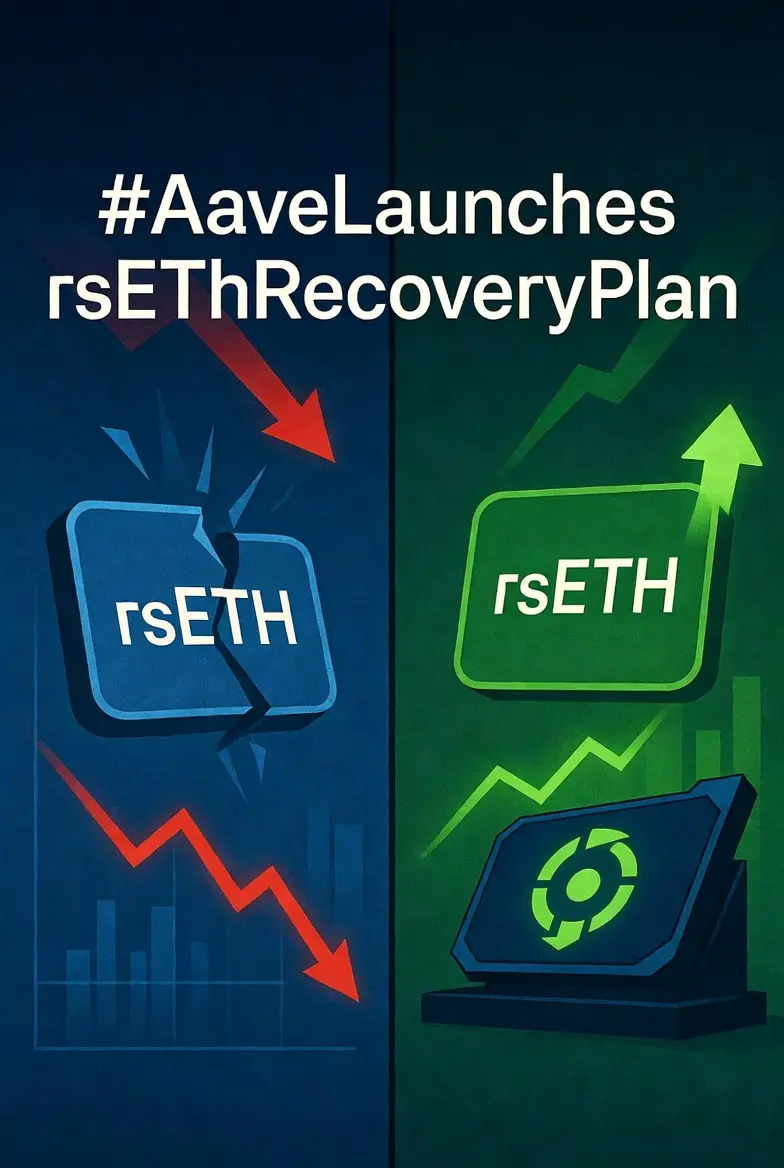
#AaveLaunchesrsETHRecoveryPlan #加密市场行情震荡
The recent turbulence across the crypto market has once again reminded everyone of a fundamental truth: decentralized finance is no longer an experimental playground—it is a living, interconnected financial system where shocks travel fast, but recovery can be just as powerful when coordination is strong. The rsETH incident, triggered by a bridge vulnerability linked to Kelp DAO, did not just expose a technical weakness. It tested the structural integrity, coordination ability, and psychological resilience of the entire DeFi ecosystem.
At the center of this response stands Aave, which has taken a leadership role in designing and initiating one of the most comprehensive recovery efforts the space has seen. This is not just a patch or a temporary fix. It is a multi-layered recovery framework that blends liquidity support, governance coordination, and long-term ecosystem thinking. And more importantly, it reflects a shift in how DeFi handles crises—not with panic, but with structured response.
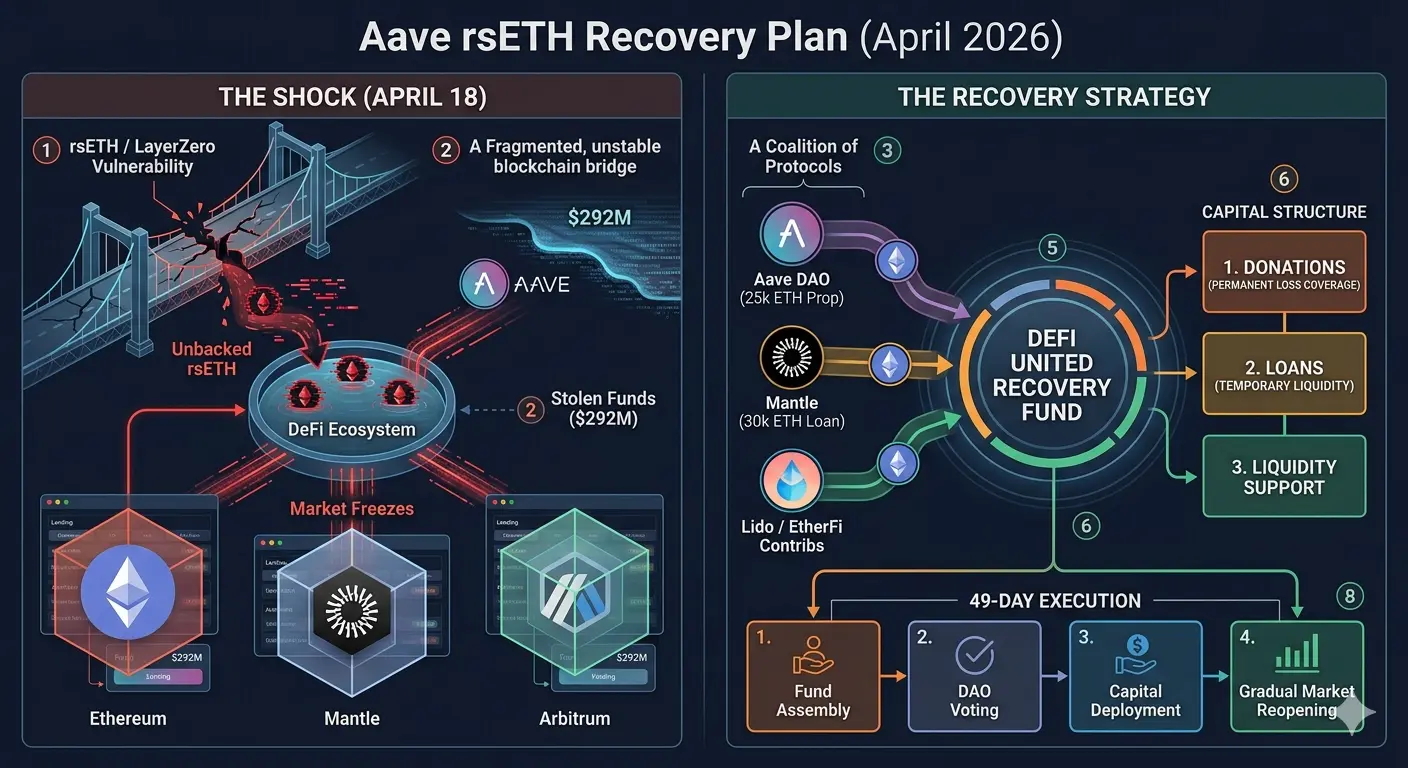
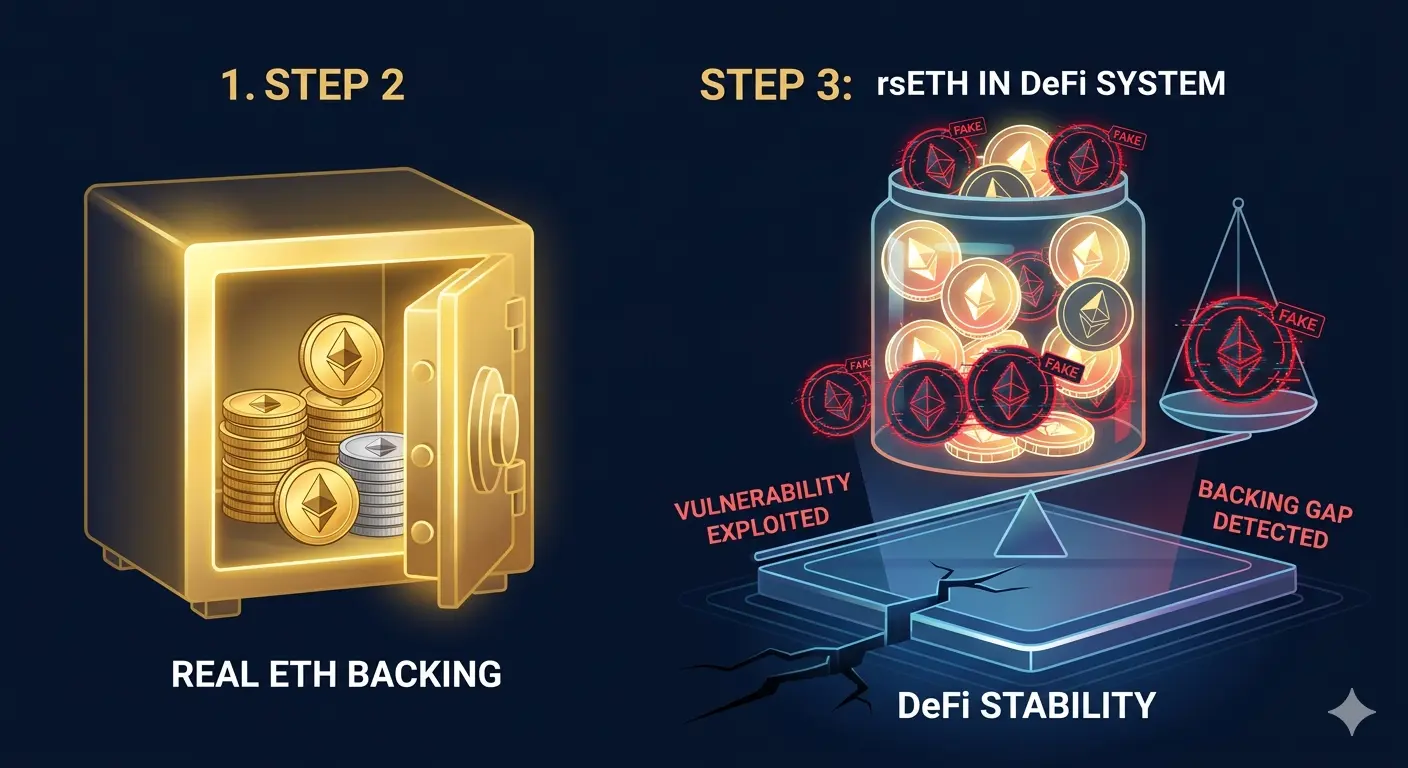
The incident itself was a classic example of how interconnected risk can become in modern DeFi. A disruption in one layer—the bridge infrastructure—quickly cascaded into another layer—the collateral structure of lending markets. rsETH, which was widely used as collateral across platforms, suddenly faced a backing shortfall. And in a system where collateral integrity is everything, even a small imbalance can create amplified effects.
This created immediate concerns. Not just about losses, but about trust.
Because in DeFi, trust is not built on institutions—it is built on code, collateral, and collective belief in the system’s ability to function under stress.
The initial impact spread across multiple dimensions at once. Collateral backing uncertainty created risk exposure within lending pools. Potential bad debt scenarios started to form. Liquidity conditions tightened as participants became cautious. And perhaps most importantly, confidence in restaking-based assets experienced a visible shock.
These are not isolated effects.
They are layered reactions that feed into each other.
And if left unmanaged, they can evolve into systemic instability.
What makes this situation different, however, is the response.
Instead of fragmentation, the ecosystem moved toward coordination.
Instead of denial, it moved toward transparency.
Instead of waiting, it acted.
And that is where the DeFi United initiative comes into focus.
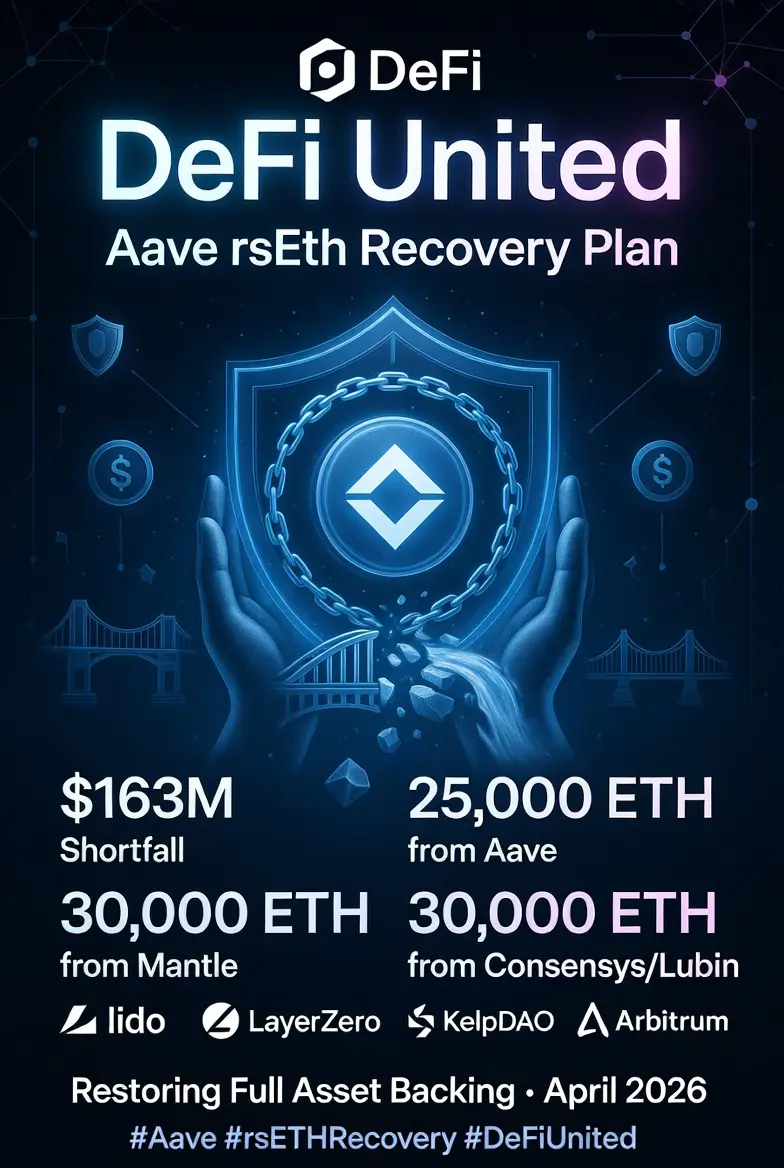
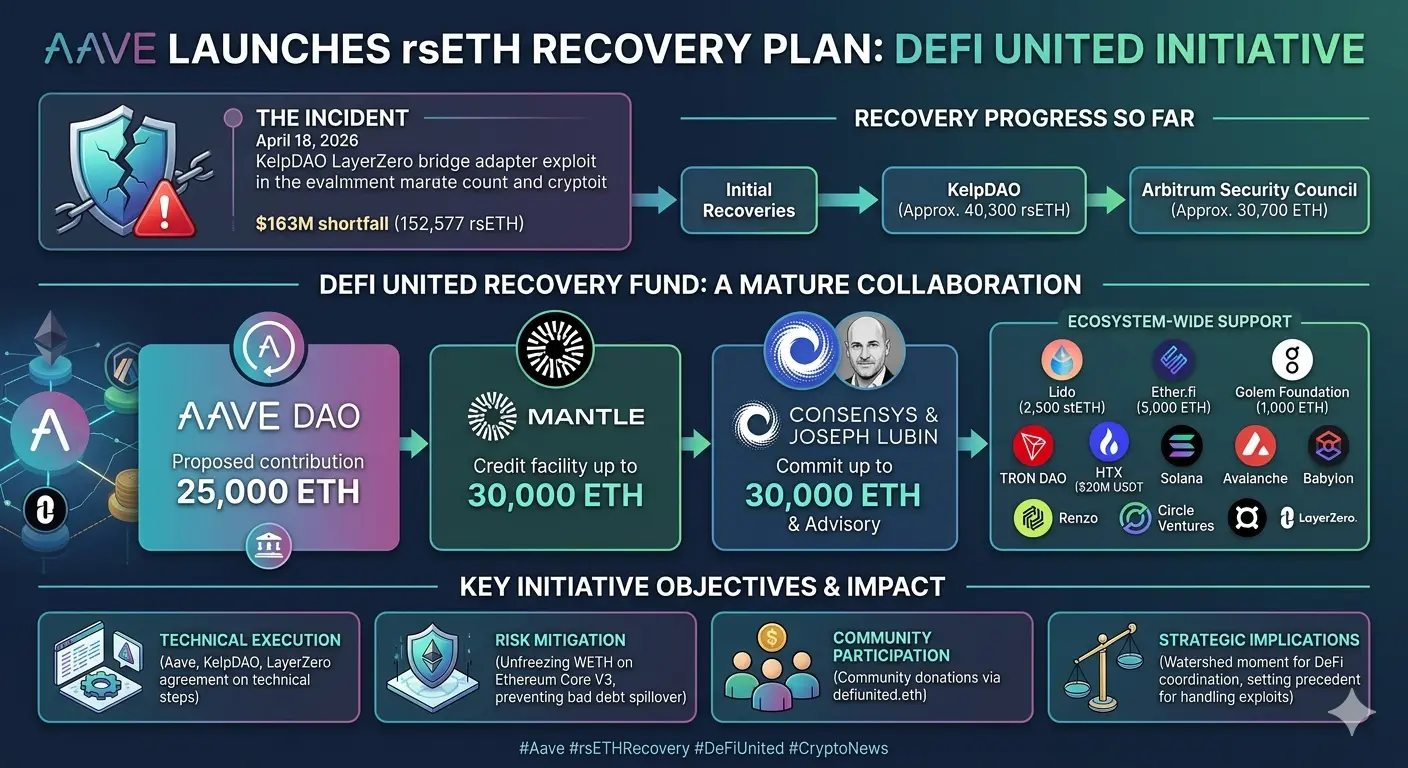
The recovery framework introduced under this initiative is not just about restoring numbers. It is about restoring equilibrium. It combines treasury deployment, external credit support, governance-driven execution, and technical safeguards into a unified strategy. Each component plays a specific role, and together they create a structure that is designed not only to fix the current issue but to strengthen the system going forward.
At the core of this effort is a significant treasury commitment. Aave’s proposal to allocate a large portion of its reserves is not a small decision. It represents a willingness to prioritize ecosystem stability over passive treasury growth. That alone sends a strong signal.
It says: protection comes first.
Alongside this, additional liquidity support mechanisms are being introduced. External credit facilities provide an extra buffer, ensuring that even under stressed conditions, the system maintains solvency. This layered approach is critical because relying on a single source of recovery would introduce its own risks.
Diversification, even in recovery, matters.
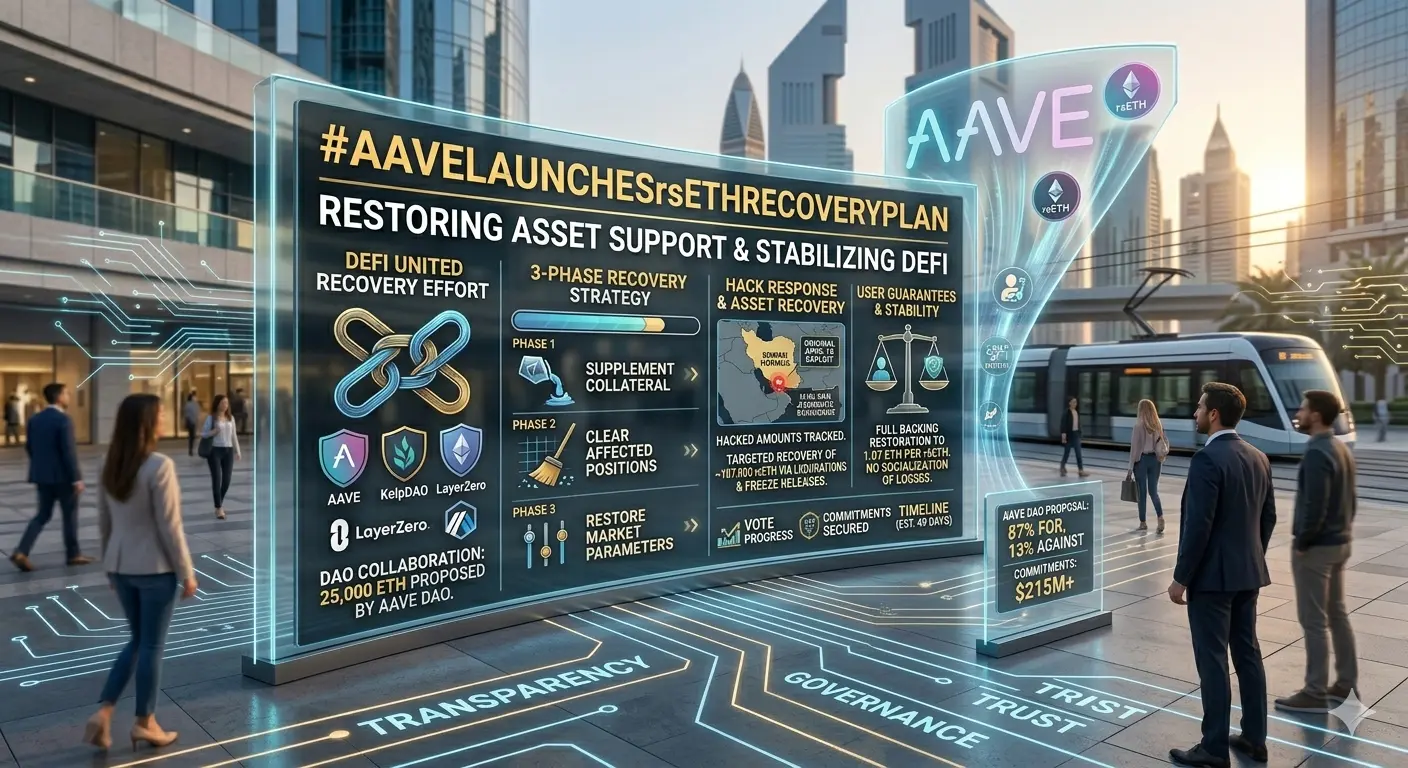
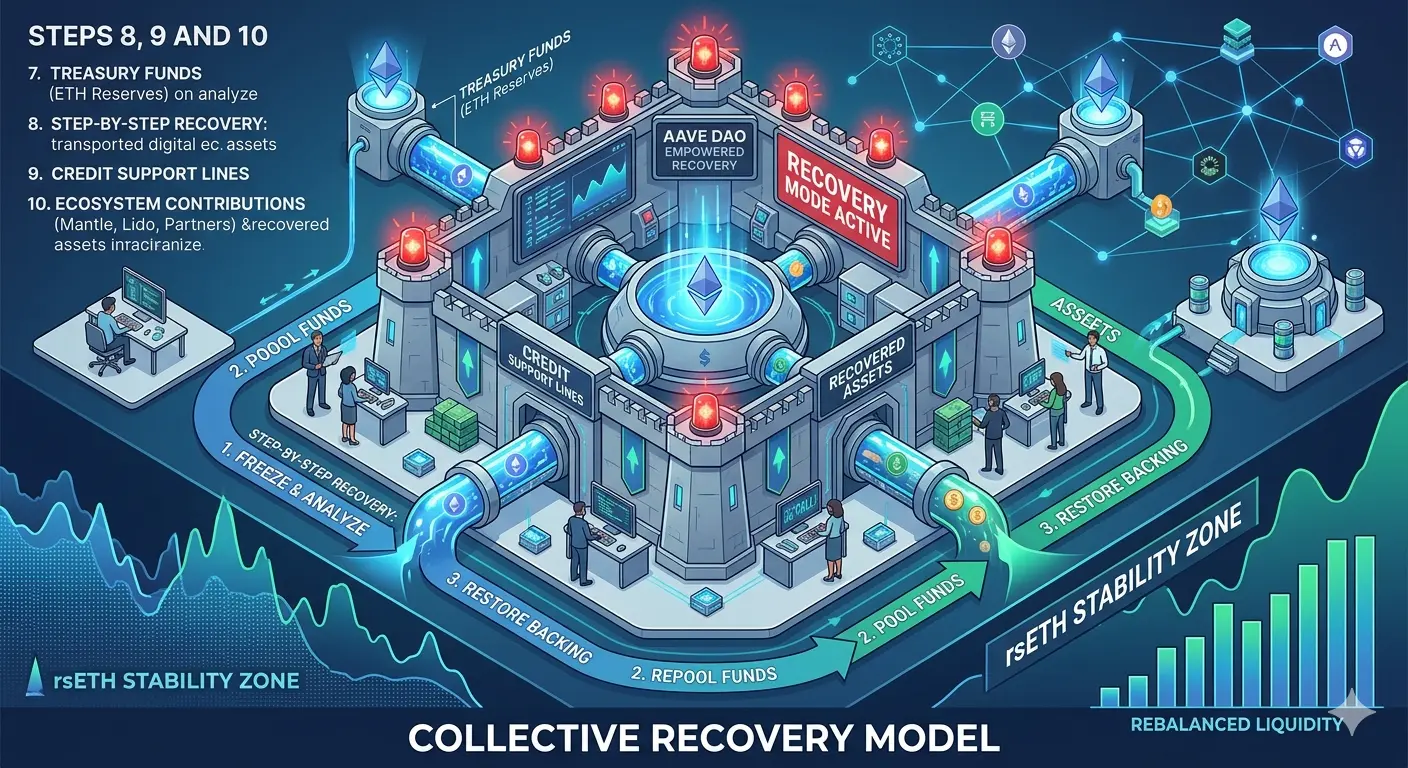
From a structural perspective, the recovery plan follows a phased design.
The first phase focused on immediate stabilization. Interest rates were adjusted, risk exposure was controlled, and affected markets were temporarily restricted. These actions were not meant to solve the problem—they were meant to stop it from growing.
Containment always comes before resolution.
The second phase moves into active capital deployment. Treasury resources are positioned to directly address the collateral shortfall. This is where theoretical plans turn into measurable action.
The third phase introduces additional liquidity reinforcement through credit mechanisms, ensuring that worst-case scenarios remain covered.
And finally, the fourth phase restores normal operations—reopening markets, normalizing parameters, and allowing the system to function without restrictions.
This step-by-step structure is important because it avoids chaos.
Instead of reacting randomly, the system progresses logically.
And in financial systems, structured response reduces uncertainty.
Another critical layer here is governance.
Unlike traditional finance, where decisions are often centralized, this entire process moves through decentralized governance channels. Proposals, voting mechanisms, and community participation define the outcome. This ensures transparency, but it also introduces complexity.
Because coordination at this scale is not easy.
Multiple stakeholders, different incentives, and varying risk perceptions all need to align.
And yet, the system is designed to handle exactly that.
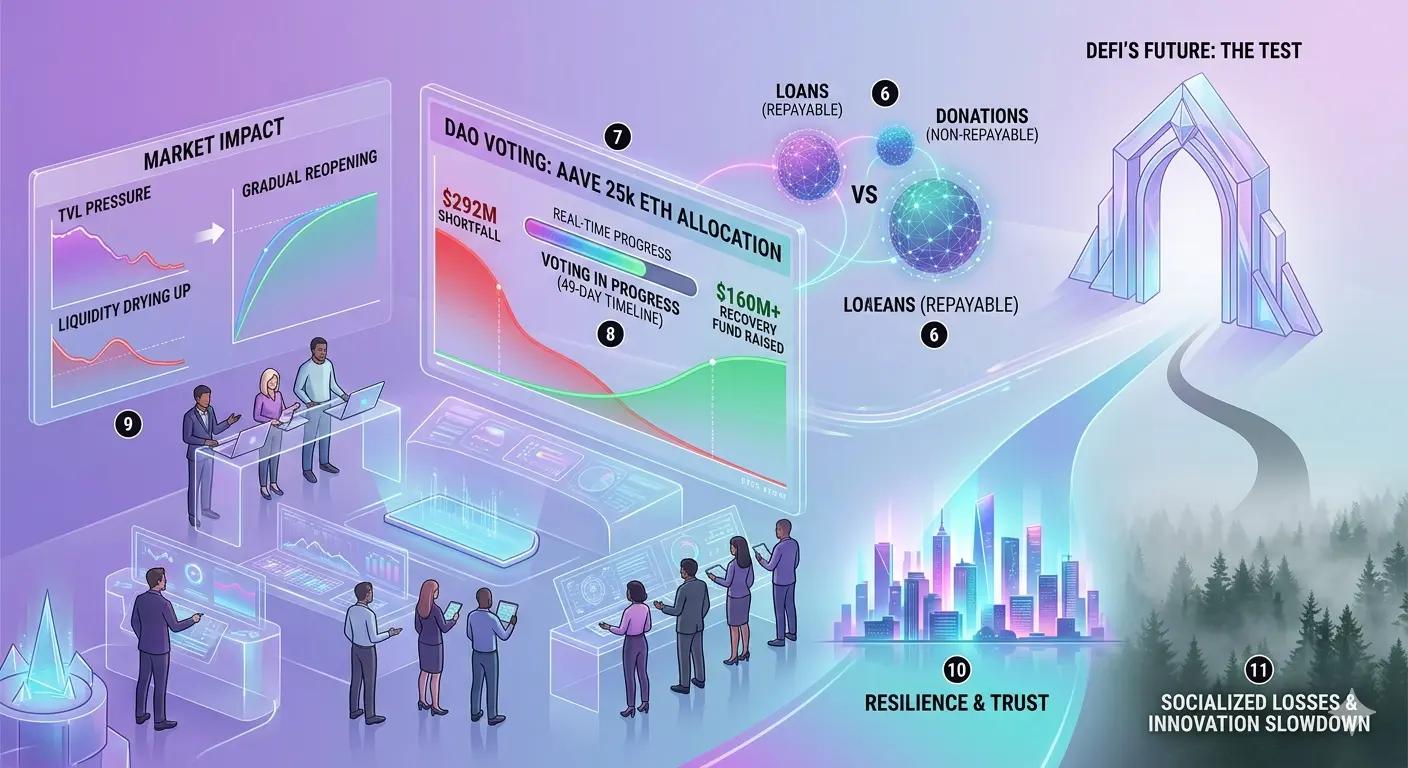
From a risk analysis standpoint, one of the most interesting elements is how different loss scenarios are being evaluated.
In one approach, losses could be distributed across the system in a balanced way. This minimizes concentrated damage but spreads impact more widely.
In another approach, losses could remain localized, protecting core markets while concentrating effects in specific segments.
Neither approach is perfect.
Both involve trade-offs.
And the final decision depends on what the ecosystem values more—broad fairness or targeted containment.
At the same time, liquidation dynamics play a major role.
When collateral value becomes uncertain, liquidation mechanisms can trigger chain reactions. Managing these reactions is critical, because uncontrolled liquidations can create more damage than the initial issue itself.
That’s why proactive adjustments—like rate changes and monitoring systems—are essential.
They don’t just react to risk.
They shape how risk unfolds.
From a technical perspective, implementing a recovery of this scale is not simple.
Smart contracts may require updates. Oracle systems need to maintain accurate pricing under stress conditions. Security reviews must ensure that new vulnerabilities are not introduced during the recovery process.
Because fixing one problem should never create another.
What stands out most to me is the balance between speed and caution.
Move too fast, and you risk errors.
Move too slow, and you risk escalation.
This recovery plan attempts to sit in the middle—fast enough to stabilize, careful enough to protect.
Now, stepping back, the bigger picture becomes clearer.
This is not just about rsETH.
This is about how DeFi handles systemic stress.
And in that sense, this moment is bigger than the incident itself.
There are clear implications for users across the ecosystem.
For depositors, the focus is on restoring value and ensuring that assets remain redeemable at expected levels. For lenders, the priority is protection against bad debt exposure. For general participants, the goal is continuity—ensuring that access to the system remains intact.
These are not just technical outcomes.
They are trust outcomes.
And trust, once shaken, is not restored by words.
It is restored by action.
From an industry perspective, this event sets a precedent.
It shows that decentralized systems can coordinate at scale. It shows that treasury reserves are not just idle capital—they are strategic tools. And it shows that collaboration across protocols is not only possible, but effective.
This is where DeFi starts to resemble a true financial ecosystem rather than a collection of isolated platforms.
Comparing this to traditional finance reveals an important contrast.
In traditional systems, crises are often resolved through centralized intervention—governments, regulators, or external bailouts. Here, the response is internal. It is driven by protocol-owned resources and community governance.
That difference is not just technical.
It is philosophical.
At the same time, this incident highlights areas that need improvement.
Bridge security remains a critical vulnerability point. Collateral diversification needs to be stronger. Monitoring systems must become more proactive rather than reactive.
And perhaps most importantly, risk awareness needs to evolve alongside innovation.
Looking forward, several improvements are likely to emerge from this experience.
Stricter criteria for collateral inclusion.
Enhanced evaluation of cross-chain dependencies.
Better early warning systems for liquidity imbalances.
And a stronger emphasis on stress testing before adoption.
From a market perspective, events like this create temporary instability but long-term strength.
Because systems that survive stress become more resilient.
And resilience is what attracts long-term capital.
For traders, the key takeaway is not just what happened, but how the market reacts during and after the recovery process.
Volatility is expected.
Narratives will shift.
Sentiment will fluctuate.
But underlying structure is what ultimately defines direction.
From my perspective, this entire situation can be summarized in a simple way:
This was not just a failure.
It was a stress test.
And the response is the real story.
The combination of treasury deployment, liquidity support, governance coordination, and technical execution creates a framework that goes beyond short-term recovery.
It creates a blueprint.
A blueprint for how decentralized systems can handle complexity, uncertainty, and pressure.
And that blueprint matters.
Because this will not be the last crisis.
But it may be one of the first that shows how effectively DeFi can respond.
🔥 Final Insight
Markets don’t collapse because of a single event.
They collapse when systems fail to respond.
Right now:
A disruption exposed weakness
Liquidity gaps created pressure
Confidence was shaken
But at the same time:
Coordination increased
Capital was mobilized
Recovery frameworks were activated
👉 This is not just stabilization
👉 This is evolution
Because in the end, the strength of a financial system is not measured by how it performs in perfect conditions—
It’s measured by how it responds when everything goes wrong.
The recent turbulence across the crypto market has once again reminded everyone of a fundamental truth: decentralized finance is no longer an experimental playground—it is a living, interconnected financial system where shocks travel fast, but recovery can be just as powerful when coordination is strong. The rsETH incident, triggered by a bridge vulnerability linked to Kelp DAO, did not just expose a technical weakness. It tested the structural integrity, coordination ability, and psychological resilience of the entire DeFi ecosystem.
At the center of this response stands Aave, which has taken a leadership role in designing and initiating one of the most comprehensive recovery efforts the space has seen. This is not just a patch or a temporary fix. It is a multi-layered recovery framework that blends liquidity support, governance coordination, and long-term ecosystem thinking. And more importantly, it reflects a shift in how DeFi handles crises—not with panic, but with structured response.
The incident itself was a classic example of how interconnected risk can become in modern DeFi. A disruption in one layer—the bridge infrastructure—quickly cascaded into another layer—the collateral structure of lending markets. rsETH, which was widely used as collateral across platforms, suddenly faced a backing shortfall. And in a system where collateral integrity is everything, even a small imbalance can create amplified effects.
This created immediate concerns. Not just about losses, but about trust.
Because in DeFi, trust is not built on institutions—it is built on code, collateral, and collective belief in the system’s ability to function under stress.
The initial impact spread across multiple dimensions at once. Collateral backing uncertainty created risk exposure within lending pools. Potential bad debt scenarios started to form. Liquidity conditions tightened as participants became cautious. And perhaps most importantly, confidence in restaking-based assets experienced a visible shock.
These are not isolated effects.
They are layered reactions that feed into each other.
And if left unmanaged, they can evolve into systemic instability.
What makes this situation different, however, is the response.
Instead of fragmentation, the ecosystem moved toward coordination.
Instead of denial, it moved toward transparency.
Instead of waiting, it acted.
And that is where the DeFi United initiative comes into focus.
The recovery framework introduced under this initiative is not just about restoring numbers. It is about restoring equilibrium. It combines treasury deployment, external credit support, governance-driven execution, and technical safeguards into a unified strategy. Each component plays a specific role, and together they create a structure that is designed not only to fix the current issue but to strengthen the system going forward.
At the core of this effort is a significant treasury commitment. Aave’s proposal to allocate a large portion of its reserves is not a small decision. It represents a willingness to prioritize ecosystem stability over passive treasury growth. That alone sends a strong signal.
It says: protection comes first.
Alongside this, additional liquidity support mechanisms are being introduced. External credit facilities provide an extra buffer, ensuring that even under stressed conditions, the system maintains solvency. This layered approach is critical because relying on a single source of recovery would introduce its own risks.
Diversification, even in recovery, matters.
From a structural perspective, the recovery plan follows a phased design.
The first phase focused on immediate stabilization. Interest rates were adjusted, risk exposure was controlled, and affected markets were temporarily restricted. These actions were not meant to solve the problem—they were meant to stop it from growing.
Containment always comes before resolution.
The second phase moves into active capital deployment. Treasury resources are positioned to directly address the collateral shortfall. This is where theoretical plans turn into measurable action.
The third phase introduces additional liquidity reinforcement through credit mechanisms, ensuring that worst-case scenarios remain covered.
And finally, the fourth phase restores normal operations—reopening markets, normalizing parameters, and allowing the system to function without restrictions.
This step-by-step structure is important because it avoids chaos.
Instead of reacting randomly, the system progresses logically.
And in financial systems, structured response reduces uncertainty.
Another critical layer here is governance.
Unlike traditional finance, where decisions are often centralized, this entire process moves through decentralized governance channels. Proposals, voting mechanisms, and community participation define the outcome. This ensures transparency, but it also introduces complexity.
Because coordination at this scale is not easy.
Multiple stakeholders, different incentives, and varying risk perceptions all need to align.
And yet, the system is designed to handle exactly that.
From a risk analysis standpoint, one of the most interesting elements is how different loss scenarios are being evaluated.
In one approach, losses could be distributed across the system in a balanced way. This minimizes concentrated damage but spreads impact more widely.
In another approach, losses could remain localized, protecting core markets while concentrating effects in specific segments.
Neither approach is perfect.
Both involve trade-offs.
And the final decision depends on what the ecosystem values more—broad fairness or targeted containment.
At the same time, liquidation dynamics play a major role.
When collateral value becomes uncertain, liquidation mechanisms can trigger chain reactions. Managing these reactions is critical, because uncontrolled liquidations can create more damage than the initial issue itself.
That’s why proactive adjustments—like rate changes and monitoring systems—are essential.
They don’t just react to risk.
They shape how risk unfolds.
From a technical perspective, implementing a recovery of this scale is not simple.
Smart contracts may require updates. Oracle systems need to maintain accurate pricing under stress conditions. Security reviews must ensure that new vulnerabilities are not introduced during the recovery process.
Because fixing one problem should never create another.
What stands out most to me is the balance between speed and caution.
Move too fast, and you risk errors.
Move too slow, and you risk escalation.
This recovery plan attempts to sit in the middle—fast enough to stabilize, careful enough to protect.
Now, stepping back, the bigger picture becomes clearer.
This is not just about rsETH.
This is about how DeFi handles systemic stress.
And in that sense, this moment is bigger than the incident itself.
There are clear implications for users across the ecosystem.
For depositors, the focus is on restoring value and ensuring that assets remain redeemable at expected levels. For lenders, the priority is protection against bad debt exposure. For general participants, the goal is continuity—ensuring that access to the system remains intact.
These are not just technical outcomes.
They are trust outcomes.
And trust, once shaken, is not restored by words.
It is restored by action.
From an industry perspective, this event sets a precedent.
It shows that decentralized systems can coordinate at scale. It shows that treasury reserves are not just idle capital—they are strategic tools. And it shows that collaboration across protocols is not only possible, but effective.
This is where DeFi starts to resemble a true financial ecosystem rather than a collection of isolated platforms.
Comparing this to traditional finance reveals an important contrast.
In traditional systems, crises are often resolved through centralized intervention—governments, regulators, or external bailouts. Here, the response is internal. It is driven by protocol-owned resources and community governance.
That difference is not just technical.
It is philosophical.
At the same time, this incident highlights areas that need improvement.
Bridge security remains a critical vulnerability point. Collateral diversification needs to be stronger. Monitoring systems must become more proactive rather than reactive.
And perhaps most importantly, risk awareness needs to evolve alongside innovation.
Looking forward, several improvements are likely to emerge from this experience.
Stricter criteria for collateral inclusion.
Enhanced evaluation of cross-chain dependencies.
Better early warning systems for liquidity imbalances.
And a stronger emphasis on stress testing before adoption.
From a market perspective, events like this create temporary instability but long-term strength.
Because systems that survive stress become more resilient.
And resilience is what attracts long-term capital.
For traders, the key takeaway is not just what happened, but how the market reacts during and after the recovery process.
Volatility is expected.
Narratives will shift.
Sentiment will fluctuate.
But underlying structure is what ultimately defines direction.
From my perspective, this entire situation can be summarized in a simple way:
This was not just a failure.
It was a stress test.
And the response is the real story.
The combination of treasury deployment, liquidity support, governance coordination, and technical execution creates a framework that goes beyond short-term recovery.
It creates a blueprint.
A blueprint for how decentralized systems can handle complexity, uncertainty, and pressure.
And that blueprint matters.
Because this will not be the last crisis.
But it may be one of the first that shows how effectively DeFi can respond.
🔥 Final Insight
Markets don’t collapse because of a single event.
They collapse when systems fail to respond.
Right now:
A disruption exposed weakness
Liquidity gaps created pressure
Confidence was shaken
But at the same time:
Coordination increased
Capital was mobilized
Recovery frameworks were activated
👉 This is not just stabilization
👉 This is evolution
Because in the end, the strength of a financial system is not measured by how it performs in perfect conditions—
It’s measured by how it responds when everything goes wrong.