

#StrategyAccumulates2xMiningRate
— A Structural Shift in Bitcoin Supply Dynamics
The crypto market is entering a phase where underlying supply dynamics are becoming more important than short-term price action. One of the most critical developments right now is the growing imbalance between Bitcoin’s fixed issuance and the accelerating pace of accumulation. When accumulation consistently exceeds mining output, it creates a structural pressure that does not always reflect immediately in price—but builds silently over time.
At its core, this trend highlights a simple reality: markets are driven not just by activity, but by who is holding and who is selling.
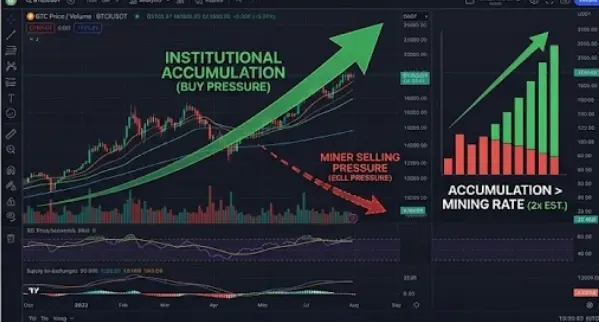
Bitcoin’s supply is predictable, especially after the halving, which significantly reduced the number of new coins entering circulation each day. However, current data suggests that large entities—institutions, funds, and high-net-worth participants—are absorbing Bitcoin at a rate that is nearly double the new supply being produced. This creates a supply squeeze where available liquidity gradually tightens, even if price appears stable in the short term.
This type of accumulation is fundamentally different from retail-driven buying. It is not reactive or emotional. Instead, it is strategic, patient, and often invisible. Large players tend to accumulate during periods of uncertainty, low sentiment, and sideways movement. They are not chasing breakouts—they are building positions before those breakouts happen. This is why markets can feel slow or indecisive while, in reality, strong hands are steadily taking control of supply.
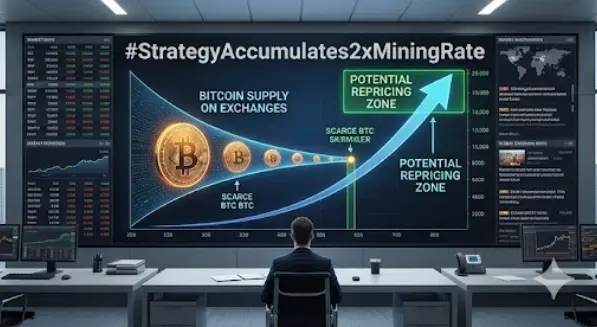
One of the clearest confirmations of this behavior is the ongoing reduction of Bitcoin held on exchanges. When assets move off exchanges into cold storage or custodial wallets, it signals long-term intent rather than short-term trading. This reduces immediate sell pressure and limits the available supply that can be quickly sold into the market. Over time, this shrinking liquidity creates conditions where even moderate demand can push prices higher more aggressively.
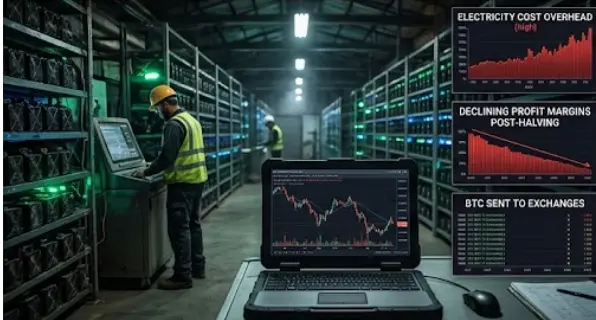
Another important factor is the changing role of miners. Traditionally, miners have been a consistent source of sell pressure, as they distribute newly mined Bitcoin to cover operational costs. However, post-halving conditions have forced many miners to become more strategic. With reduced rewards, some are choosing to hold rather than sell immediately, further tightening supply and reinforcing the accumulation trend.
Despite all these bullish structural signals, price does not always respond instantly. Markets often move in phases, and accumulation phases are typically marked by low volatility, consolidation, and occasional sharp dips designed to remove weak hands. These dips are frequently misunderstood as weakness, but in many cases, they are simply liquidity events that allow larger players to continue accumulating at favorable prices.
As supply tightens, liquidity becomes thinner. This creates an environment where price movements can become more explosive once demand increases. Breakouts in such conditions tend to be sharp and fast, as there is less available supply to absorb incoming buying pressure. This is why accumulation phases are often followed by strong expansion phases.
For traders, this shift requires a change in mindset. Instead of focusing only on short-term price movements, it becomes essential to understand the broader supply and demand dynamics. The real opportunity often lies in identifying accumulation zones and positioning early, rather than reacting late when the market has already moved.
At the same time, it is important to remain aware of risks. External factors such as macroeconomic changes, regulatory developments, or unexpected large-scale selling can still impact the market. Even in strong accumulation phases, volatility remains part of the system, and proper risk management is always necessary.
Looking at the bigger picture, this trend suggests that Bitcoin is gradually being treated less like a speculative asset and more like a long-term store of value. As more capital adopts this perspective, market behavior evolves. Cycles may become less dependent on hype and more influenced by structural flows, institutional positioning, and long-term conviction.
The key takeaway is clear: accumulation exceeding mining supply is not just a statistic—it is a signal of a market quietly preparing for its next phase. These are the moments where foundations are built, not headlines. And when the market eventually transitions from accumulation to expansion, the move is often fast, decisive, and difficult to chase.
In this phase, patience is not just a virtue—it is an advantage.
#GateSquare
#ContentMining
#CreaterCarnival
— A Structural Shift in Bitcoin Supply Dynamics
The crypto market is entering a phase where underlying supply dynamics are becoming more important than short-term price action. One of the most critical developments right now is the growing imbalance between Bitcoin’s fixed issuance and the accelerating pace of accumulation. When accumulation consistently exceeds mining output, it creates a structural pressure that does not always reflect immediately in price—but builds silently over time.
At its core, this trend highlights a simple reality: markets are driven not just by activity, but by who is holding and who is selling.
Bitcoin’s supply is predictable, especially after the halving, which significantly reduced the number of new coins entering circulation each day. However, current data suggests that large entities—institutions, funds, and high-net-worth participants—are absorbing Bitcoin at a rate that is nearly double the new supply being produced. This creates a supply squeeze where available liquidity gradually tightens, even if price appears stable in the short term.
This type of accumulation is fundamentally different from retail-driven buying. It is not reactive or emotional. Instead, it is strategic, patient, and often invisible. Large players tend to accumulate during periods of uncertainty, low sentiment, and sideways movement. They are not chasing breakouts—they are building positions before those breakouts happen. This is why markets can feel slow or indecisive while, in reality, strong hands are steadily taking control of supply.
One of the clearest confirmations of this behavior is the ongoing reduction of Bitcoin held on exchanges. When assets move off exchanges into cold storage or custodial wallets, it signals long-term intent rather than short-term trading. This reduces immediate sell pressure and limits the available supply that can be quickly sold into the market. Over time, this shrinking liquidity creates conditions where even moderate demand can push prices higher more aggressively.
Another important factor is the changing role of miners. Traditionally, miners have been a consistent source of sell pressure, as they distribute newly mined Bitcoin to cover operational costs. However, post-halving conditions have forced many miners to become more strategic. With reduced rewards, some are choosing to hold rather than sell immediately, further tightening supply and reinforcing the accumulation trend.
Despite all these bullish structural signals, price does not always respond instantly. Markets often move in phases, and accumulation phases are typically marked by low volatility, consolidation, and occasional sharp dips designed to remove weak hands. These dips are frequently misunderstood as weakness, but in many cases, they are simply liquidity events that allow larger players to continue accumulating at favorable prices.
As supply tightens, liquidity becomes thinner. This creates an environment where price movements can become more explosive once demand increases. Breakouts in such conditions tend to be sharp and fast, as there is less available supply to absorb incoming buying pressure. This is why accumulation phases are often followed by strong expansion phases.
For traders, this shift requires a change in mindset. Instead of focusing only on short-term price movements, it becomes essential to understand the broader supply and demand dynamics. The real opportunity often lies in identifying accumulation zones and positioning early, rather than reacting late when the market has already moved.
At the same time, it is important to remain aware of risks. External factors such as macroeconomic changes, regulatory developments, or unexpected large-scale selling can still impact the market. Even in strong accumulation phases, volatility remains part of the system, and proper risk management is always necessary.
Looking at the bigger picture, this trend suggests that Bitcoin is gradually being treated less like a speculative asset and more like a long-term store of value. As more capital adopts this perspective, market behavior evolves. Cycles may become less dependent on hype and more influenced by structural flows, institutional positioning, and long-term conviction.
The key takeaway is clear: accumulation exceeding mining supply is not just a statistic—it is a signal of a market quietly preparing for its next phase. These are the moments where foundations are built, not headlines. And when the market eventually transitions from accumulation to expansion, the move is often fast, decisive, and difficult to chase.
In this phase, patience is not just a virtue—it is an advantage.
#GateSquare
#ContentMining
#CreaterCarnival