This report is authored by Tiger Research. In 2025, the cryptocurrency industry witnessed the rise of numerous narratives. Some were fleeting, collapsing quickly; but those key narratives left us with profound and lasting insights.
Core Insights
- In 2025, the crypto market experienced intense shifts in narratives, with market fatigue and skepticism building throughout the year.
- Most narratives merely consumed short-term attention, but some fostered real application scenarios and market structures, steadily driving industry evolution.
- Besides trends centered on speculators, more narratives that facilitate retail participation emerged and expanded, broadening the market’s participant base. This is also a deeply meaningful shift.
1. Narratives, Narratives, or Narratives
The most notable feature of the 2025 crypto market is the astonishing speed of narrative switching. Market attention shifts to the next hot topic before the current narrative is fully validated.
Meme coins drove particularly dramatic turns. New narratives around Trump, Musk, and Sydney Sweeney emerged one after another. Investors’ focus also shifted rapidly.
The core issue is that most narratives turn out to be mere one-time celebrations. They devour short-term attention but fail to build a foundational infrastructure that can evolve into a real industry. Some market participants even fabricate false narratives to harvest investors. The result is that market participants become increasingly exhausted, and skepticism deepens.
That said, not all narratives end in fatigue. Some establish themselves as genuine industries, truly advancing the evolution of the crypto market. So, what endures, and what vanishes into smoke? This report will delve into the main narratives shaping 2025 and extract lessons from their rise and fall.
2. What insights do the 2025 narratives reveal?
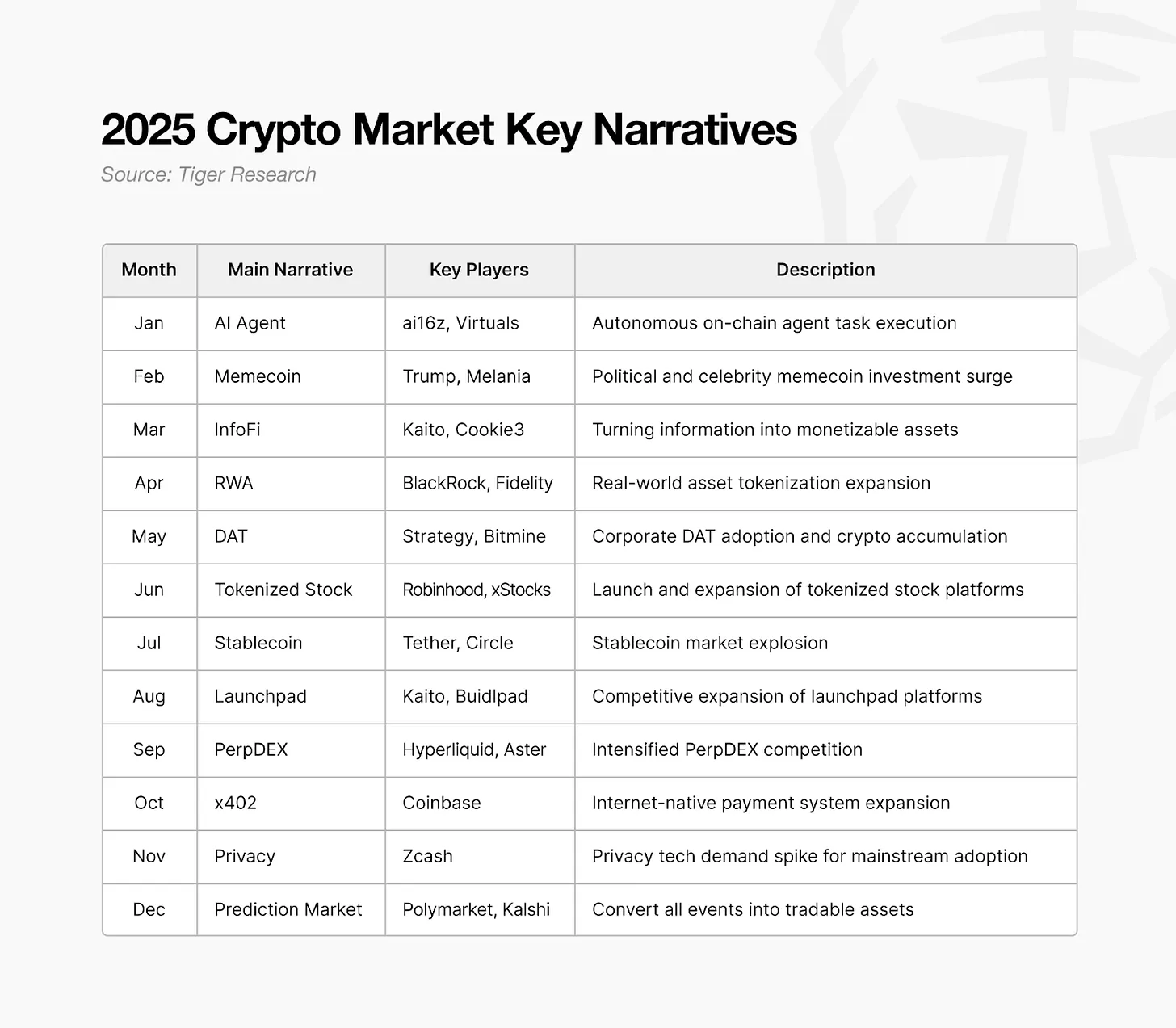
Source: Tiger Research
2.1. Retention value far exceeds new customer acquisition
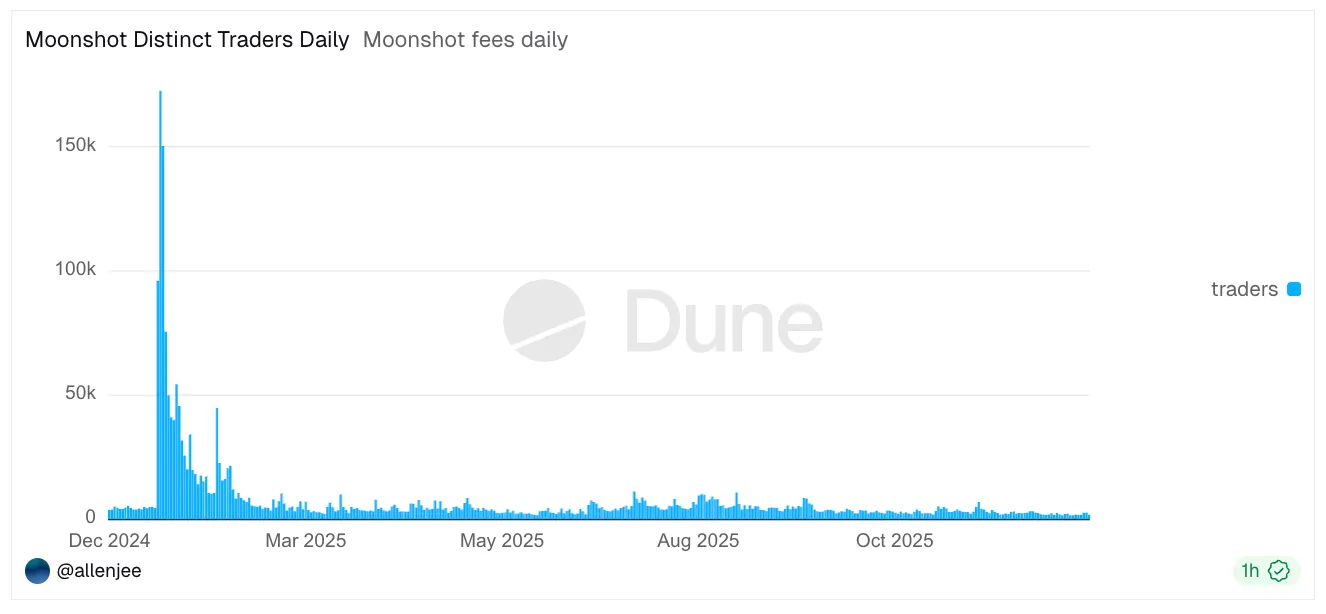
Source: Dune
This year, Meme coins captured the most market attention. Their simple and intuitive features even attracted those previously dismissive of or overwhelmed by crypto complexity. Trading apps like Moonshot further lowered entry barriers, causing a flood of new users in a short period.
However, most users did not stay long. They came for quick gains and left just as swiftly. Their activity neither spread to other services nor generated any lasting spillover effects. Despite large inflows, it was merely a one-time participation surge.
This case clearly shows that when the right catalyst meets low entry barriers, large-scale user influx is possible. Meme coins proved this potential. At the same time, they also reveal that mere inflow is far from enough. If projects fail to create reasons for users to stay, inflows will quickly turn into outflows. User retention remains a core challenge.
2.2. The dual sides of InfoFi
2025 was also a year when InfoFi received serious attention. Platforms like Kaito saw thriving InfoFi services, with users adopting a model of producing information and earning incentives in return. Combining incentive mechanisms with information production was a meaningful experiment, bringing many retail investors into the market.
However, limitations soon became apparent. Content quality is inherently subjective and difficult to quantify. But incentive distribution requires objective standards based on metrics, which gradually distorted participant behavior. Participants began prioritizing sensational content over accuracy. As a result, platform X transformed from a space of information accumulation into something more akin to an advertising billboard.
InfoFi demonstrated the potential to stimulate information production. But it also left an unresolved question: how do we evaluate and reward information quality? Without solving this, InfoFi cannot expand the information ecosystem and may even worsen market fatigue.
2.3. Privacy has become a necessity
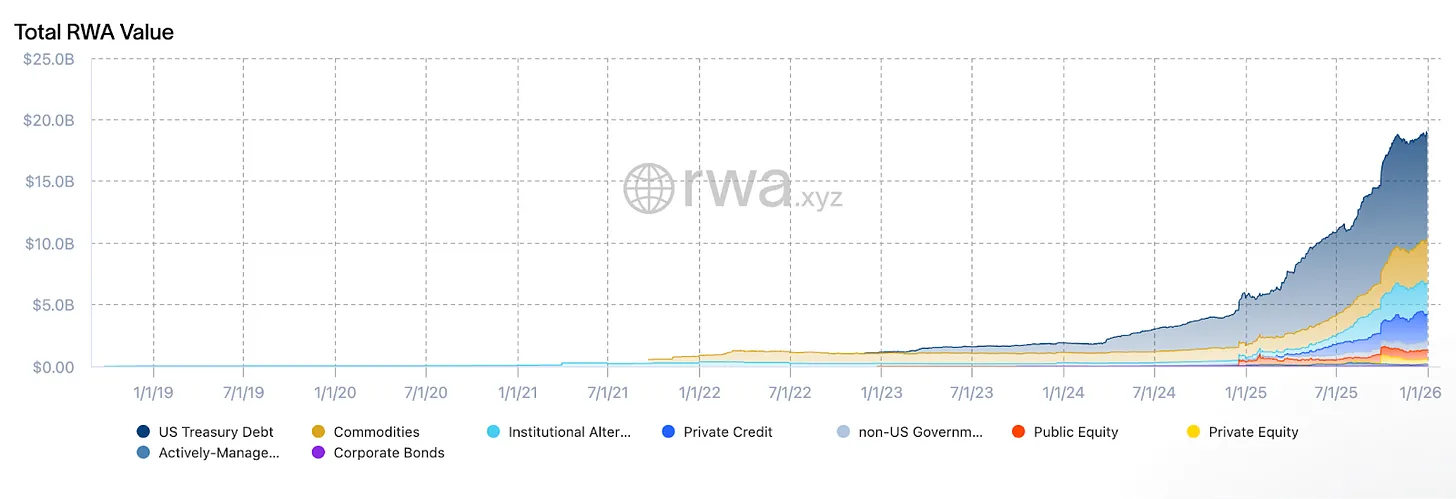
Source: rwa.xyz
As institutional capital accelerates inflows, the crypto market is shifting from retail-led to institution-led. Alongside this change, privacy sectors began to gain attention. This is no coincidence.

Source: Tiger Research
On-chain transparency has long been regarded as a key advantage of crypto. However, an environment exposing transaction size, timing, and holdings means strategies are fully exposed for institutional investors. The rising proportion of off-chain trading in traditional finance also reflects growing unease about fully transparent structures.
Transparency has not benefited all participants equally. As discussions around institutional involvement and market expansion deepen, privacy issues can no longer be considered secondary.
2.4. A year showcasing crypto’s product-market fit
2025 was the year crypto moved beyond abstract potential to demonstrate real, feasible applications. Stablecoins, x402, and prediction markets, though diverse in form, share a core advantage: they organically combine crypto’s borderless currency properties and its ability to provide transactional trust with real-world problem-solving.
The key is that crypto can facilitate transactions and provide results trust without central authorities. In an environment with global participants, crypto can enable transactions and verify outcomes without intermediaries. Traditional systems struggle to offer such advantages. These cases show that in certain fields, crypto can demonstrate relative superiority.
These examples do not prove that crypto is a panacea for all sectors. But they indicate that when crypto’s unique attributes align with problem structures, projects can achieve clear product-market fit. 2025 first clearly revealed these conditions.
3. Rapid narrative cycles and the sediment of reality
The 2025 crypto market saw an unprecedented number of narratives. Before current narratives could be fully validated, attention shifted to the next story, with many narratives fading quickly after brief consumption. Given the astonishing speed of these shifts, this year may seem superficially like a waste of time.
However, it would be overly simplistic to dismiss 2025 as meaningless based solely on this impression. While narratives are short-lived, various experiments advanced behind the scenes, and institutions began serious planning and integration. This period’s trends have gone beyond mere speculative stories. Compared to small-circle stories centered on speculators, more narratives accessible to retail investors emerged and expanded, beginning to broaden the market’s participation base.
Briefly consumed narratives did not produce immediate results. But this process helped us clarify which frameworks are effective and which are illusions. Now is the time to use these lessons as fuel for the next phase.
Original link: Tiger Research
Disclaimer: The information on this page may come from third parties and does not represent the views or opinions of Gate. The content displayed on this page is for reference only and does not constitute any financial, investment, or legal advice. Gate does not guarantee the accuracy or completeness of the information and shall not be liable for any losses arising from the use of this information. Virtual asset investments carry high risks and are subject to significant price volatility. You may lose all of your invested principal. Please fully understand the relevant risks and make prudent decisions based on your own financial situation and risk tolerance. For details, please refer to
Disclaimer.
Related Articles
a16z crypto: Stablecoin trading volume has grown for 10 straight quarters
Gate News message, April 7, a16z crypto data and fund strategy lead Daren Matsuoka posted on X that stablecoin trading volume has continued to grow for 10 straight quarters, and the growth accelerated after the “GENIUS Act” (the U.S. stablecoin regulatory bill) was introduced.
GateNews37m ago
Research: 84% of traders on Polymarket are currently losing money
Research by independent on-chain analyst Andrey Sergeenkov shows that 84.1% of traders on Polymarket lose money, only 2% have profits over $1,000, and 0.033% reach $100k in profits. Of the 6,600 traders with monthly profits over $5,000, only 2.6% remain consistently active for more than a year. Most traders leave after trading for a while.
GateNews2h ago
21 crypto projects announced they are shutting down or cutting back services due to the bear market, covering DeFi, NFTs, wallets, and gaming.
April 7, under the influence of the bear market, 21 crypto projects announced they would shut down or scale back services, covering areas such as wallets, DeFi, NFTs, and games. Projects like Leap Wallet and Magic Eden exited or adjusted due to market pressure; industry insiders believe this shakeout will help reshape the market, and that focusing on sustainable Web3 projects in the future will be more competitive.
GateNews3h ago
The Solana Foundation launches the STRIDE and SIRN dual security program, covering protocol assessments and incident response
The Solana Foundation launched an ecosystem security initiative on April 7, led by Asymmetric Research. It includes two major mechanisms, STRIDE and SIRN, providing security assessments, threat monitoring, and response services, and it will freely open a variety of security tools, but it does not replace the security responsibilities of protocol teams.
GateNews5h ago
Anthropic annual revenue exceeding $30 billion will partner with Broadcom and Google to expand AI compute capacity
Gate News message, April 7, Anthropic posted on the X platform stating that its annualized revenue has exceeded $30 billion, up significantly from $9 billion at the end of 2025. Anthropic confirmed that it will work with Broadcom and Google to expand AI compute capacity, providing support for its rapidly expanding business.
GateNews5h ago
South Korean fintech company Toss plans to develop its own blockchain and issue a native cryptocurrency.
Gate News message. On April 6, according to The Block, South Korea’s payments and banking giant Toss disclosed that it is considering developing its own blockchain network and issuing a native cryptocurrency. Insiders say Toss may build on a Layer1 mainnet and is exploring Layer2 expansion solutions, but has not yet made a final decision on what architecture to use. Related decisions are influenced by the progress of South Korea’s “Digital Asset Basic Act,” which will regulate key areas such as token issuance, stablecoins, and crypto ETFs.
GateNews15h ago


